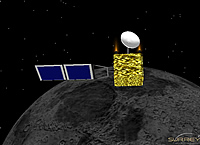
A concept illustration of the Magnolia project under study by SSTL for MSU.
GUILDFORD, UNITED KINGDOM: August 14, 2007—Satnews Daily—The study phase of a potential U.S.-U.K. lunar orbiter mission named Magnolia has resulted in a contract for Surrey Satellite Technology Ltd. (SSTL) from Mississippi State University (MSU). A preliminary mission design is going to run for 9 months as the first phase. Training by SSTL and the University of Surrey is part of the contract package. This data and the knowledge accrued by SSTL over the last 25 years across 27 small satellite missions will be shared with MSU and NASA Stennis Space Center staff.
SSTL performed a lunar exploration design study in 2006 for the United Kingdom government’s Particle Physics and Astronomy Research Council that, in 2007, was merged into the newly created Science & Technology Facilities Council. The study revealed the feasibility of a pair of low cost missions known as MoonLITE and MoonRaker.
The company recently delivered a payload processor for a U.S. radar to fly onboard the 2008 Indian lunar mission, Chandrayaan-1. Plus, they’ve developed the equipment for interplanetary missions, such as the Rosetta comet chaser. SSTL has also worked with the European Space Agency and produced a feasibility study for a low cost mission to Venus. Potential missions to near-Earth asteroids and Earth re-entry have also been examined.
The next phase of Magnolia will start in 2008 and could lead to mission launch in 2010. SSTL is owned by the University of Surrey (85 percent), SSTL staff (5 percent) and Space X of the U.S.A. (10 percent.)
- Skip to primary navigation
- Skip to main content
- Skip to primary sidebar
- Skip to secondary sidebar
- Skip to footer


Satellite Industry Intelligence Since 1983
Footer

Satnews is a leading provider of satellite news, events, publications, research and other satellite industry information in both commercial and military enterprises worldwide.