

By Jordan Vannitsen, CEO, Odysseus Space
The space industry is running into a hard limit.
For years, we have been building better sensors, higher-resolution payloads, and larger constellations. But the way we move data has not kept up. We are still relying, in large part, on RF links that were never designed for the scale we are now operating at.
The result is simple: we are generating more data in orbit than we can realistically bring down. This is not a marginal issue. It is becoming a structural bottleneck. The response we are starting to see is not just incremental improvement. It is a shift in architecture.
Instead of treating satellites as isolated systems, the industry is moving toward distributed infrastructure in orbit. Satellites are beginning to act as nodes in a network, sharing data, processing it, and coordinating with each other before anything is sent to Earth.
This is the early stage of what people call orbital data centers. But the term can be misleading. There will be no single “data center” in space. What we are building instead are fragmented, distributed systems, closer to swarms than to centralized facilities.
And none of this works without laser communication.
We don’t have a compute problem. We have a transport problem.
Engineering challenges facing orbital infrastructure — from thermal management to radiation-hardened compute — are real constraints. But none of them matter if the nodes cannot talk to each other.
There is a tendency to focus on onboard processing. AI in orbit, edge computing, autonomous decision-making. All of that matters. But the binding constraint today is transport.
If satellites cannot exchange data efficiently, then distributed processing does not work. If they cannot move large volumes of data between nodes, then every spacecraft remains an island. RF does not scale to that model. It is reliable, but constrained. Spectrum is limited, coordination is complex, and bandwidth does not grow fast enough to match demand.
Laser communication changes the equation.
It allows satellites to exchange data directly, at high speed, without relying on ground relays. That is what turns a collection of spacecraft into a system. Without optical links, there is no network. Without a network, there is no orbital data infrastructure.
From constellations to networks
What is emerging is not just larger constellations, but connected constellations. Kepler Communications recently commissioned distributed computing across its optical relay constellation — an early proof point for this architecture. Data can move across satellites in orbit instead of waiting for a ground pass. It can be routed, combined, and processed where it makes the most sense. This is a fundamental change.
Latency drops because data no longer depends on ground availability. Efficiency improves because only useful data is downlinked. Resilience increases because the system no longer relies on a single path.
In practical terms, we are moving from a pipeline model to a network model. And once you make that transition, you are no longer operating satellites. You are operating infrastructure.
Orbital data centers will be distributed by design
There is still a tendency to imagine large platforms acting as space-based data centers, but that is unlikely to be the dominant model. The constraints of launch, cost, and redundancy all point in the same direction: many smaller nodes, loosely distributed, tightly connected. A swarm of satellites, each contributing part of the overall capability.
Compute on one node. Storage on another. Data generated somewhere else. The system only works because everything is connected.
Laser communication is what holds this together. It is not just a faster link. It is what allows a fragmented system to behave as a single one.
The missing piece: getting data back to Earth
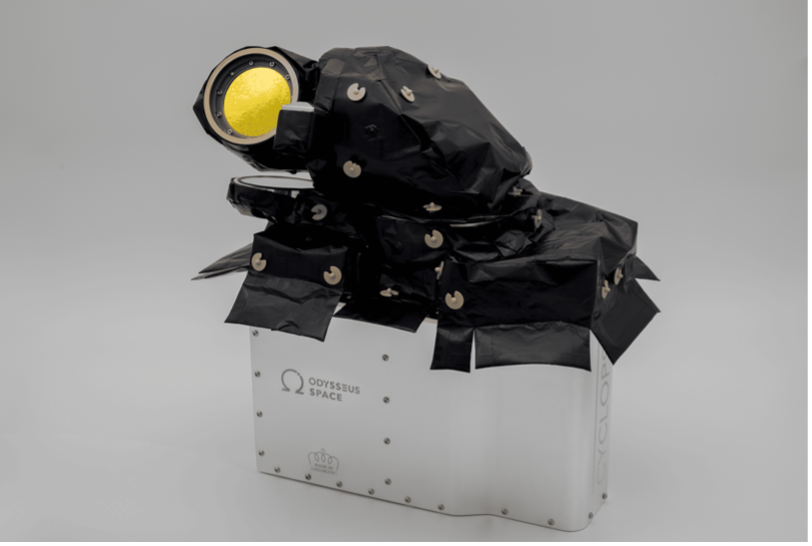
There is one part of the architecture that is often underestimated: even in a distributed system, value is delivered on the ground. You still need to bring data back efficiently, and today that remains a bottleneck. This is where the industry has been slower to evolve.
Optical inter-satellite links get most of the attention, but optical downlink is just as critical, and arguably harder to operationalize at scale. The challenge has not been the physics. It has been the complexity: integrating terminals, coordinating ground stations, managing weather constraints, and operating the system end-to-end has historically been fragmented and resource-intensive.
The companies working to close this gap — including my own — are converging on a similar insight: laser communication needs to be treated not just as hardware, but as a service layer that abstracts operational complexity. The goal is to make high-throughput optical downlink as accessible and predictable as existing RF services, without requiring operators to become laser communication experts. Because if that interface remains complex, adoption will remain limited, regardless of performance.
This is an infrastructure transition
What we are seeing is not just a new technology being introduced. It is the early stage of an infrastructure transition.
On Earth, the rise of cloud computing was enabled by high-capacity, reliable networking. Compute and connectivity became inseparable. The same pattern is now emerging in space. Laser communication is not just improving links. It is enabling a different way of designing systems — one where compute, storage, and communication are distributed and tightly integrated.
Companies that continue to treat communication as a secondary subsystem will struggle to adapt to this model. Those that design for connectivity from the start will have a structural advantage.
What comes next
Orbital data centers will not appear overnight. They will emerge progressively, as more systems become interconnected. But the direction is already clear: we are moving from isolated satellites to connected systems, from constellations to networks, from networks to critical infrastructure.
At that point, the comparison is no longer with traditional space systems. It is with cloud architecture.
And the key question becomes very simple: not whether we can move data in space, but whether we can build the infrastructure to support it at scale.
Jordan Vannitsen is the CEO of Odysseus Space, a Luxembourg-based company developing space-to-ground laser communication systems. The views expressed are the author’s own.
