

February 16, 2026 — China has successfully concluded nine months of orbital testing for its “Three-Body” Computing Constellation, marking a significant milestone in the shift toward autonomous orbital edge computing.
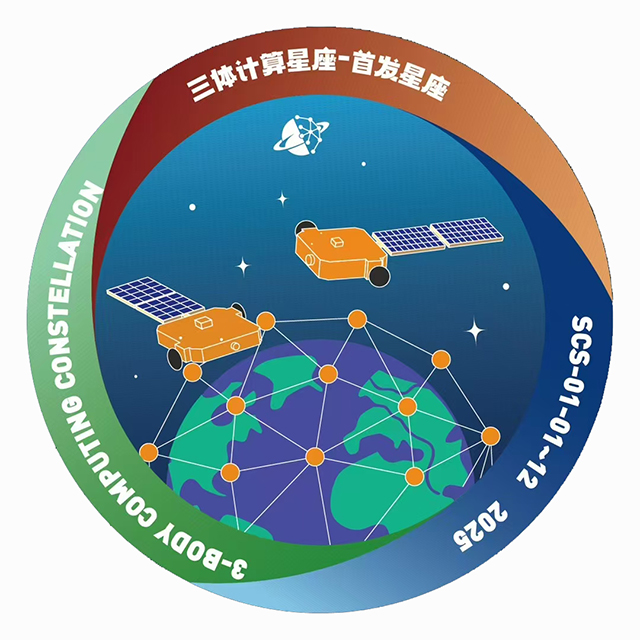
Developed by the China Aerospace Science and Industry Corporation (CASIC), the constellation has demonstrated the ability to run large-scale artificial intelligence models directly on satellite hardware, drastically reducing the latency between data capture and actionable intelligence.
The Shift to “Answers over Images”
Traditionally, remote sensing satellites act as “data pipes,” capturing massive amounts of raw imagery for transmission to ground stations for processing. The Three-Body project, named after the popular science fiction trilogy, represents a move toward Orbital Edge AI. By processing data in space, the satellites can transmit “answers”—such as specific infrastructure damage reports or ship coordinates—rather than raw image files, optimizing limited downlink bandwidth.
The 8B-Parameter Milestone
The constellation consists of three primary experimental units, each equipped with specialized neural processing units (NPUs). Key technical achievements during the testing phase include:
- In-Orbit LLMs: Successful deployment and execution of an 8-billion-parameter large language model (LLM) designed for specialized remote sensing analysis.
- Autonomous Classification: The satellites demonstrated the ability to classify astronomical phenomena and terrestrial infrastructure types with a 94% accuracy rate without ground intervention.
- Inter-Satellite Networking: Real-time data sharing between the three units to verify distributed computing tasks, where one satellite captures data and another processes the workload.
- Power Efficiency: Optimization of AI inference tasks to operate within the strict SWaP-C (Size, Weight, Power, and Cost) constraints of a 6U CubeSat platform.
Reducing the Ground Segment Bottleneck
The rationale for the Three-Body constellation is primarily economic and operational. With the proliferation of LEO constellations, the “data deluge” is overwhelming traditional ground station networks. By implementing edge computing, CASIC aims to:
- Prioritize Critical Data: Only high-value detections are downlinked immediately.
- Autonomous Navigation: Enable satellites to alter their own imaging schedules based on detected changes (e.g., detecting a wildfire and immediately switching to high-resolution infrared mode).
- Bandwidth Savings: Reducing the volume of data transmitted by a factor of 1,000 for specific reconnaissance tasks.
Scaling up to 30+ Satellites by 2030
Following the successful validation of the Three-Body pilot, Chinese state media suggests a planned expansion to a 32-satellite “Computing Grid” by 2028. This network is expected to provide real-time AI processing services to commercial and government clients across the Belt and Road Initiative regions.
The technology is also viewed as a precursor to more advanced deep-space missions, where the vast distances from Earth make autonomous decision-making a mission-critical requirement for landers and orbiters.
