

By Chris Forrester
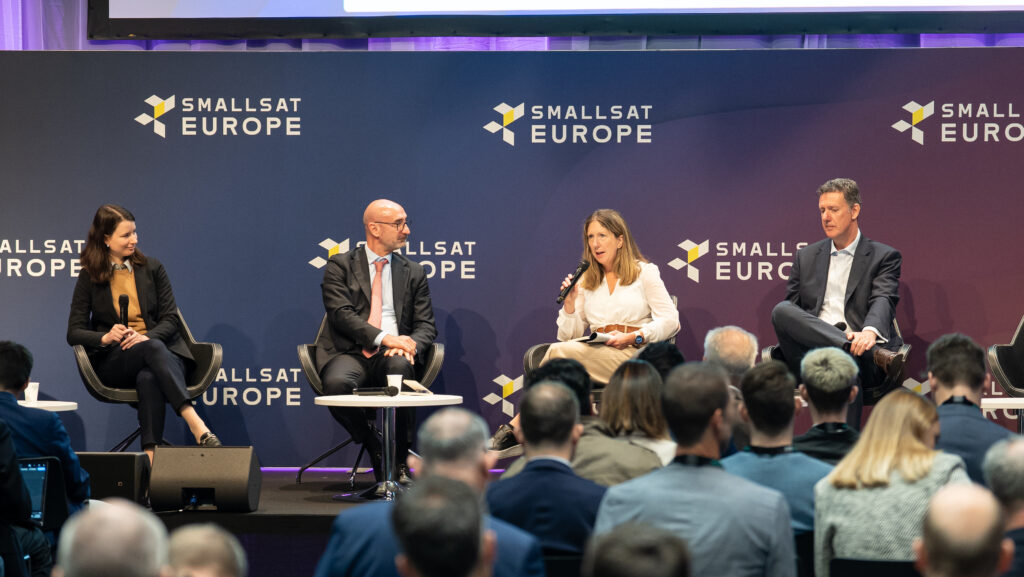
Chris Quilty (Co-CEO & President, Quilty Space) moderated with his customary professionalism the opening session of the SmallSat Europe opening day at the RAI Convention Center in Amsterdam on May 27. He posed a question to his panel and asked what the state of the industry in Europe was. The resulting comments were mixed with one speaker (Dr. Marco Molina, Managing Director, SITAEL) saying said “federation” was his keyword for Europe, but that the mix of private cash and new private investment was making a real difference.
However, Alizee Acket-Goemaere (Manager, McKinsey & Co.) said her key word for Europe activity was not federation but “fragmented”.
Úna Stanniland (Director UK Operations, Stellar Solutions Aerospace Ltd.) said that Europe was well advanced and she predicted that more demand would be coming Europe’s way. She stressed that new satcom activity and traditional experiences were coming together, but there needed to be more risk-taking as far as investment and funding was concerned.
Stewart Marsh (Head of Aerospace, Cambridge Consultants) agreed that merger activity was happening and that end-users were ready to take risks.
Quilty raised the topic of Europe’s new IRIS2 super-constellation. Dr Molina re-emphasised that federation and standardisation was hugely important, and this was essential for all projects and would itself promote demand. He explained that Europe needed to look again at European space-related funding.
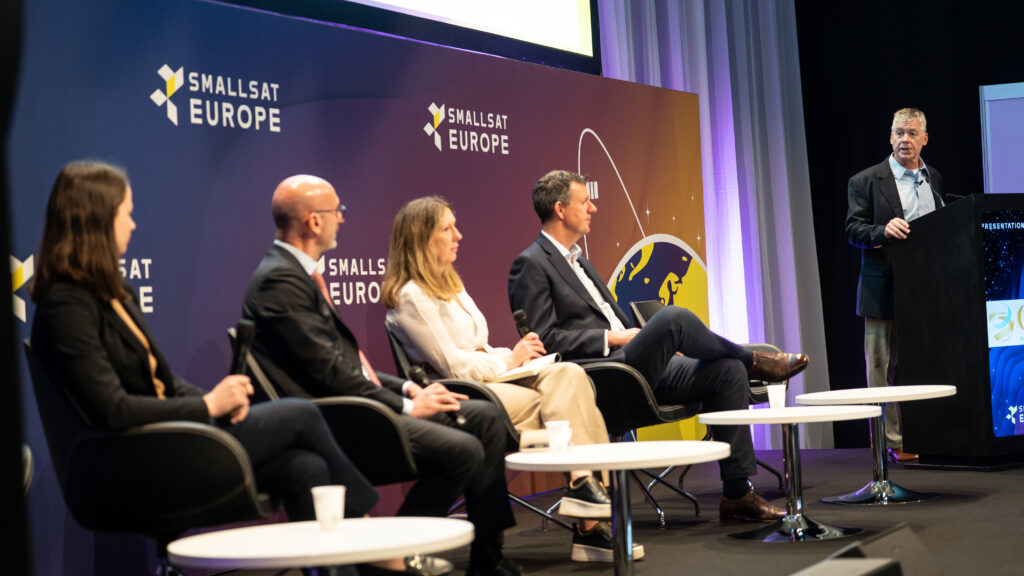
Ms Stanniland questioned whether Europe needed this super-constellation. McKinsey’s Acket-Goemaere said that the dilemma for Europe was overcoming the existing and very dense ground-based telecommunications infrastructure.
“Not everyone wants a one terminal, one antenna, solution?” suggested Stewart Marsh, and he reported that even Starlink usage is lower than anticipated, and questioned whether there was a real need for IRIS2.
The panel talked about the Airbus-Thales space-related merger plans. Úna Stanniland said the merger looked real this time around but it was important to see how they would support Europe’s smaller industry members.
Stewart Marsh said he was excited about many aspects of the industry, not least the convergence between satellite and terrestrial networks, and progress in space-to-ground connectivity was very interesting. He also touched on ‘in-space’ manufacturing and the investment needed for what could provide an interesting return on investment.
Acket-Goemaere said that Europe had huge amounts of wonderful data from Earth observation, but AI was going to be crucial in handling and interpreting that data.
But there were weaknesses, admitted the panel. Stanniland asked whether she dare utter the word ‘launch’ and where Europe needed to focus on launch and the cost of launch/per kilo. “Not every European country can afford or need their own launch capability,” she added.
