


ESA’s groundbreaking Biomass satellite, designed to provide unprecedented insights into the world’s forests and their crucial role in Earth’s carbon cycle, has been launched. The satellite lifted off aboard a Vega-C rocket from Europe’s Spaceport in Kourou, French Guiana, on 29 April at 11:15 CEST (06:15 local time).
Less than an hour after launch, Biomass separated from the rocket’s upper stage. At 12:28 CEST, the satellite controllers at ESA’s European Space Operations Center in Germany received the all-important first signal, relayed via the Troll ground station in Antarctica, that Biomass is working as expected in orbit.
Controllers will spend the coming days carrying out the ‘launch and early orbit’ phase, meticulously verifying that all systems are functioning correctly.
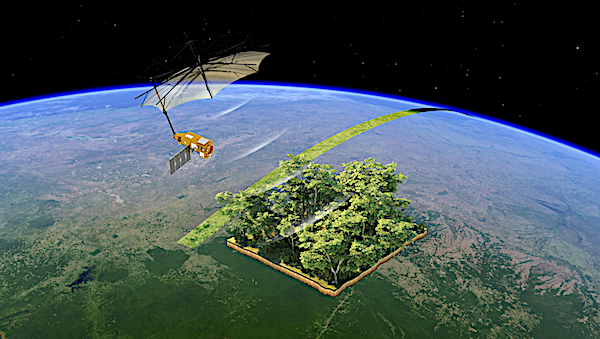
This critical phase also involves a series of intricate maneuvers to deploy the satellite’s 12-metre-wide mesh reflector supported by a 7.5-metre boom. Once this phase is complete, Biomass will join the portfolio of pioneering missions operated from ESA’s mission control center.
Carrying the first P-band synthetic aperture radar in space, the Biomass mission is designed to deliver crucial information about the state of our forests and how they are changing, and to further our knowledge of the role forests play in the carbon cycle.
ESA’s Director of Earth Observation Programs, Simonetta Cheli, said, “I’d like to extend my congratulations to everyone who has been involved in developing and launching this extraordinary mission. Biomass now joins our esteemed family of Earth Explorers – missions that have consistently delivered groundbreaking discoveries and advanced scientific understanding of our planet.
“With Biomass, we are poised to gain vital new data on how much carbon is stored in the world’s forests, helping to fill key gaps in our knowledge of the carbon cycle and, ultimately, Earth’s climate system.”
Forests play a vital role in Earth’s carbon cycle by absorbing and storing large amounts of carbon dioxide, helping to regulate the planet’s temperature. Often called ‘Earth’s green lungs’, they absorb around 8 billion tonnes of carbon dioxide annually. However, deforestation and degradation – especially in tropical regions – are releasing stored carbon back into the atmosphere, worsening climate change.
A major challenge for scientists and policymakers is the lack of accurate data on how much carbon forests store and how these stocks are changing owing to factors such as rising temperatures, increasing atmospheric carbon dioxide levels, and human-driven land-use changes.
Biomass is the first satellite equipped with a P-band synthetic aperture radar, which is capable of penetrating forest canopies to measure woody biomass – trunks, branches, and stems – where most forest carbon is stored. These measurements act as a proxy for carbon storage, the assessment of which is the mission’s primary goal.
Data from Biomass will significantly reduce uncertainties in carbon stock and flux estimates, including those related to land-use change, forest loss, and regrowth.
About Biomass
ESA’s Biomass forest mission uses advanced space technology to provide new data on forests and their changes. It enhances our understanding of forests’ roles in the carbon cycle and climate. Its P-band radar penetrates clouds and forest layers, scattering signals off forest elements. These signals reveal details like forest biomass and height. Biomass data will improve knowledge of habitat loss and its effects on biodiversity. The mission also enables the mapping of subsurface geology in deserts, ice sheet structures, and forest floor topography.
The satellite was developed by over 50 companies led by Airbus UK.
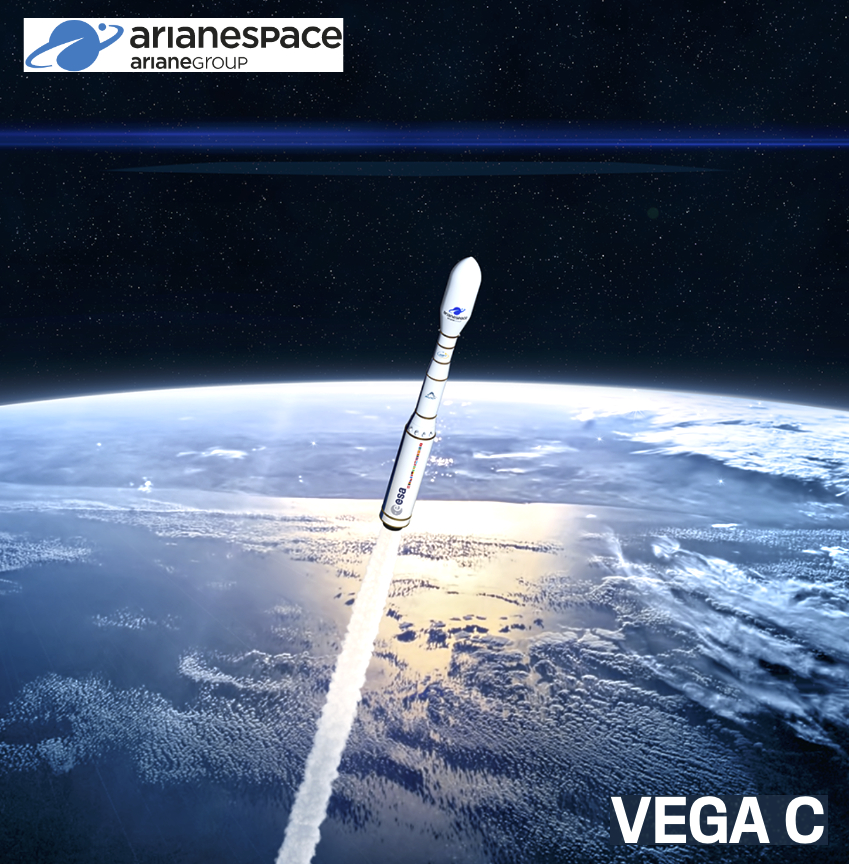
The Vega C will launch the SMILE (Solar-wind Magnetosphere Ionosphere Link Explorer) mission for the European Space Agency (ESA) and the Chinese Academy of Sciences (CAS).
SMILE is designed to study the Earth’s magnetic environment, specifically its interaction with solar wind, and will contribute significantly to our understanding of space weather and solar storms. In order for observations to start during the peak of the 11-year cycle of solar activity, the optimum launch window for the SMILE mission is around the end of 2025.
Arianespace signed a launch contract with the ESA for the deployment of the SMILE mission, a joint ESA-Science and CAS initiative that aims to better understand our solar system. SMILE will observe Earth’s magnetic environment, the magnetosphere, on a global scale, and its interaction with the solar wind. To maximize its scientific contribution, SMILE requires a launch close to the peak of solar activity during the Sun’s 11-year cycle.
SMILE was selected from a pool of 13 potential missions that were proposed to the ESA and the CAS in response to a joint call for mission concepts in 2015. After the joint ESA-China National Space Administration Double Star mission in the 1990s, SMILE marks the first time that ESA and China have selected, designed, implemented, launched, and operated a space mission together.
ESA is responsible for the payload module, the launch vehicle, one of the scientific instruments and part of the science operations. The Chinese Academy of Sciences (CAS) is responsible for three scientific instruments, the platform, and the mission and science operations.
The agreement will see the SMILE spacecraft launched by the European light-lift Vega C from Europe’s Spaceport in French Guiana, currently expected for late 2025. The exact launch period will be defined by taking into account SMILE’s scientific objectives as well as the evolution of the Vega C manifest.
Vega C is an ESA program carried out in cooperation between public institutions and private industry across 12 European partner states. Avio S.p.A (Colleferro, Italy) is the prime contractor responsible for the development and production of the launch system and delivering a “ready-to-fly” vehicle to Arianespace at Europe’s Spaceport. Arianespace is the operator and the exclusive launch service provider of Vega C up to the moment this mandate is transferred to Avio under the implementation of the Resolution adopted by ESA in Seville on 6 and 7 November 2023.
Stéphane Israël, CEO of Arianespace, said, “This signature marks over four years of collaborative efforts between Arianespace and ESA Science teams to develop the SMILE mission with a Vega C launcher. While many spacecraft already observe the Sun and its effect on the Earth’s environment, this is the first time a mission will be able to view the full Sun-Earth connection. We are thrilled to contribute to this new step in better understanding space weather, in a context where we need to protect our space-based technology and ensure human safety.”
“Today marks a major milestone for our innovative SMILE mission and signals the determination of all our teams and partners to deliver a successful mission on schedule for maximum scientific benefit,” said Prof. Carole Mundell, ESA Director of Science.
“We are delighted to be launching SMILE on such a versatile launch vehicle. Vega C has been selected as it perfectly matches the needs of the mission, such as required mass capability and injection orbit,” said David Agnolon, ESA SMILE Project Manager.
The Vega C will launch the SMILE (Solar-wind Magnetosphere Ionosphere Link Explorer) mission for the European Space Agency (ESA) and the Chinese Academy of Sciences (CAS).
SMILE is designed to study the Earth’s magnetic environment, specifically its interaction with solar wind, and will contribute significantly to our understanding of space weather and solar storms. In order for observations to start during the peak of the 11-year cycle of solar activity, the optimum launch window for the SMILE mission is around the end of 2025.
Arianespace signed a launch contract with the ESA for the deployment of the SMILE mission, a joint ESA-Science and CAS initiative that aims to better understand our solar system. SMILE will observe Earth’s magnetic environment, the magnetosphere, on a global scale, and its interaction with the solar wind. To maximize its scientific contribution, SMILE requires a launch close to the peak of solar activity during the Sun’s 11-year cycle.
SMILE was selected from a pool of 13 potential missions that were proposed to the ESA and the CAS in response to a joint call for mission concepts in 2015. After the joint ESA-China National Space Administration Double Star mission in the 1990s, SMILE marks the first time that ESA and China have selected, designed, implemented, launched, and operated a space mission together.
ESA is responsible for the payload module, the launch vehicle, one of the scientific instruments and part of the science operations. The Chinese Academy of Sciences (CAS) is responsible for three scientific instruments, the platform, and the mission and science operations.
The agreement will see the SMILE spacecraft launched by the European light-lift Vega C from Europe’s Spaceport in French Guiana, currently expected for late 2025. The exact launch period will be defined by taking into account SMILE’s scientific objectives as well as the evolution of the Vega C manifest.
Vega C is an ESA program carried out in cooperation between public institutions and private industry across 12 European partner states. Avio S.p.A (Colleferro, Italy) is the prime contractor responsible for the development and production of the launch system and delivering a “ready-to-fly” vehicle to Arianespace at Europe’s Spaceport. Arianespace is the operator and the exclusive launch service provider of Vega C up to the moment this mandate is transferred to Avio under the implementation of the Resolution adopted by ESA in Seville on 6 and 7 November 2023.
Stéphane Israël, CEO of Arianespace, said, “This signature marks over four years of collaborative efforts between Arianespace and ESA Science teams to develop the SMILE mission with a Vega C launcher. While many spacecraft already observe the Sun and its effect on the Earth’s environment, this is the first time a mission will be able to view the full Sun-Earth connection. We are thrilled to contribute to this new step in better understanding space weather, in a context where we need to protect our space-based technology and ensure human safety.”
“Today marks a major milestone for our innovative SMILE mission and signals the determination of all our teams and partners to deliver a successful mission on schedule for maximum scientific benefit,” said Prof. Carole Mundell, ESA Director of Science.
“We are delighted to be launching SMILE on such a versatile launch vehicle. Vega C has been selected as it perfectly matches the needs of the mission, such as required mass capability and injection orbit,” said David Agnolon, ESA SMILE Project Manager.
The Vega C will launch the SMILE (Solar-wind Magnetosphere Ionosphere Link Explorer) mission for the European Space Agency (ESA) and the Chinese Academy of Sciences (CAS).
SMILE is designed to study the Earth’s magnetic environment, specifically its interaction with solar wind, and will contribute significantly to our understanding of space weather and solar storms. In order for observations to start during the peak of the 11-year cycle of solar activity, the optimum launch window for the SMILE mission is around the end of 2025.
Arianespace signed a launch contract with the ESA for the deployment of the SMILE mission, a joint ESA-Science and CAS initiative that aims to better understand our solar system. SMILE will observe Earth’s magnetic environment, the magnetosphere, on a global scale, and its interaction with the solar wind. To maximize its scientific contribution, SMILE requires a launch close to the peak of solar activity during the Sun’s 11-year cycle.
SMILE was selected from a pool of 13 potential missions that were proposed to the ESA and the CAS in response to a joint call for mission concepts in 2015. After the joint ESA-China National Space Administration Double Star mission in the 1990s, SMILE marks the first time that ESA and China have selected, designed, implemented, launched, and operated a space mission together.
ESA is responsible for the payload module, the launch vehicle, one of the scientific instruments and part of the science operations. The Chinese Academy of Sciences (CAS) is responsible for three scientific instruments, the platform, and the mission and science operations.
The agreement will see the SMILE spacecraft launched by the European light-lift Vega C from Europe’s Spaceport in French Guiana, currently expected for late 2025. The exact launch period will be defined by taking into account SMILE’s scientific objectives as well as the evolution of the Vega C manifest.
Vega C is an ESA program carried out in cooperation between public institutions and private industry across 12 European partner states. Avio S.p.A (Colleferro, Italy) is the prime contractor responsible for the development and production of the launch system and delivering a “ready-to-fly” vehicle to Arianespace at Europe’s Spaceport. Arianespace is the operator and the exclusive launch service provider of Vega C up to the moment this mandate is transferred to Avio under the implementation of the Resolution adopted by ESA in Seville on 6 and 7 November 2023.
Stéphane Israël, CEO of Arianespace, said, “This signature marks over four years of collaborative efforts between Arianespace and ESA Science teams to develop the SMILE mission with a Vega C launcher. While many spacecraft already observe the Sun and its effect on the Earth’s environment, this is the first time a mission will be able to view the full Sun-Earth connection. We are thrilled to contribute to this new step in better understanding space weather, in a context where we need to protect our space-based technology and ensure human safety.”
“Today marks a major milestone for our innovative SMILE mission and signals the determination of all our teams and partners to deliver a successful mission on schedule for maximum scientific benefit,” said Prof. Carole Mundell, ESA Director of Science.
“We are delighted to be launching SMILE on such a versatile launch vehicle. Vega C has been selected as it perfectly matches the needs of the mission, such as required mass capability and injection orbit,” said David Agnolon, ESA SMILE Project Manager.
