

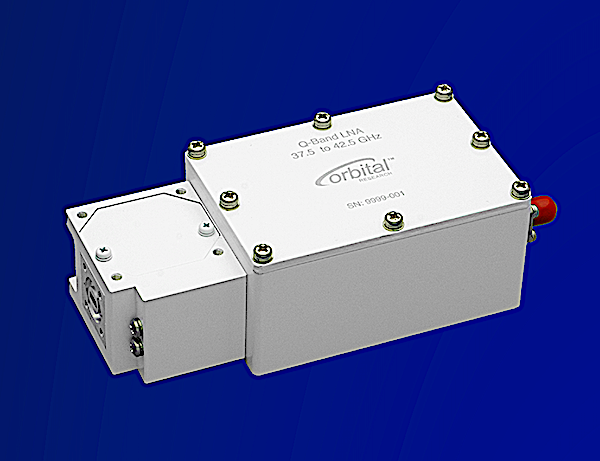

Orbital focuses on the LNA with the first Q-band product to supply the need for feeder links. Designed primarily for satellite teleports and gateways, this wideband amplifier offers exceptional performance and data throughput: high gain and low noise figure, < 2.5 dB for excellent signal.
The Orbital Q-band LNA has been designed with an isolator, providing an improved match to the antenna with less loss between the antenna and amplifier, resulting in better gain-to-noise-temperature ratio (G/T), which in turn delivers better carrier-to-noise ratio — and a lower bit error rate compared to the same LNA without an isolator. It also has a high OIP3 (output third-order intercept point), able to avoid distortion when confronted with multiple strong signals.
Orbital is providing live, over-the-air testing of the new LNA, in a variety of conditions, with partners and customers. “We’ve already seen a lot of interest in this LNA,” says Orbital CEO Ian McEachern. “We’re excited about the opportunities for innovation that lie ahead.”
LNAs are available for qualified customers to demo or test with orders being taken now for the first full rate production run with deliveries starting in June 2025.
The new Q-Band low noise amplifier (LNA) from Orbital Research provides bandwidth of 5.0 GHz for commercial and military SATCOM applications.
Designed primarily for satellite teleports and gateways, telemetry, tracking and command applications (TT&C), and airborne terminals, this wideband amplifier offers exceptional performance and data throughput.
Features
- High gain
- Low noise figure < 2.5 dB for excellent signal to noise ratios
- Superb gain flatness
- Excellent VSWR performance
- Ultra wideband frequency
Applications
The Orbital Q-Band LNA can be used for both military and commercial satellite communication applications, including large earth stations, LEO and SATCOM-on-the-Move (SOTM) applications.
ISO 9001:2015-certified QMS
