

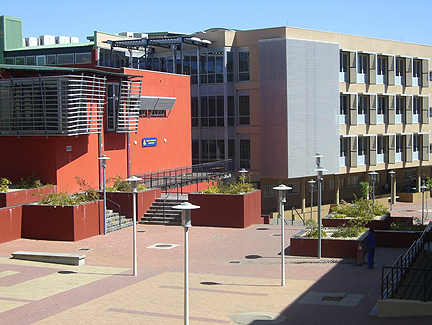
The Science and Technology Building (right) and Laboratory Building (left) on the engineering campus at Polytechnic of Namibia
Reliable data is essential to preparing for natural disasters. Earlier this year, Namibia was hit by record floods, although rainfall is generally scarce. Wildfires are expected to wreak havoc in the current dry season. “Rain is important for Namibia. Mistakes based on wrong information can be costly. For subsistence farmers, it can be the difference between having food or not,” said Marina Coetzee, a researcher at EOSA-RTC and a senior lecturer at the polytechnic. “We will use the satellite to detect and map unknown small water bodies. We will also store ‘normalized different vegetation indices’ [measure of vegetation on the ground] and then further process them into a variety of value-added products — these we will make available with extra text to help people to understand and interpret the information,” said Coetzee.
Not all vegetation has leaves so even if it looks green it does not mean there is no problem. Remote sensing, therefore, serves as an early warning system for a failed harvest, said Celeste Esbach, researcher at the polytechnic. Coetzee added, “We can predict where the problems are popping up with regard to wildfires, grazing for livestock, water scarcity, or viability of crops.” Namibian researchers have already been assessing raw data obtained directly from satellites. But the new center will now provide specific, useful indices coming from that data, making interpretation easier.
The center receives low- and medium-resolution satellite images from the international data service, Eumetcast, which disseminates meteorological data, from a variety of satellites, such as the Meteosat satellite above the equator. Starting next month, Namibia will be linked to the AMESD program that circulates a range of geographic data and maps relating to crops, droughts and wildfires to Southern African Development Community (SADC) countries. Johan le Roux, head of the National Remote Sensing Center said they will now get the processed information from the center instead of relying directly on satellites, making it easier to use remote sensing software and products. The polytechnic also cooperates with the Cape Peninsula University of Technology (CPUT) in South Africa on research, building small satellites, and designing applications for satellite imagery. (Source: EnvironmentalExpert.com)
