

• Skip to primary navigation
  • Skip to main content
  • Skip to primary sidebar
  • Skip to secondary sidebar
  • Skip to footer
  • NEWS:
  • SatNews
  • SatMagazine
  • MilSatMagazine
  • SmallSat News
  • |     EVENTS:
  • SmallSat Symposium
  • Satellite Innovation
  • MilSat Symposium
  • SmallSat Europe

SatNews

Satellite Industry Intelligence Since 1983

Subscribe
  • LATEST
  • SatNews Events
  • Magazines
  • Calendar
  • Subscribe
  • Missions & Constellations
    • Exploration & Science Missions
    • In-Orbit Servicing & Orbital Operations
    • LEO Constellations
    • Mission Autonomy & Onboard Systems
    • Mission Deployments & Manifests
    • Navigation & PNT
    • SmallSat
    • Spacecraft & Payload Technology
    View All in Missions & Constellations →
    Sovereign Space Expansion: Spain’s FOSSA Systems Secures €9.25M to Scale Defense Constellation and SIGINT InfrastructureSovereign Space Expansion: Spain’s FOSSA Systems Secures €9.25M to Scale Defense Constellation and SIGINT Infrastructure
    Sovereign Milestone: OQ Technology Achieves Europe’s First Drone Video Transmission via 3GPP NTN LEO SatelliteSovereign Milestone: OQ Technology Achieves Europe’s First Drone Video Transmission via 3GPP NTN LEO Satellite
    Hybrid Cabin Architecture: Mapping the Next Generation of In-Flight Connectivity (IFC)Hybrid Cabin Architecture: Mapping the Next Generation of In-Flight Connectivity (IFC)
    Fleet-Wide Hybrid Networks: Marlink Integrates Starlink Across 80+ Oldendorff Carriers VesselsFleet-Wide Hybrid Networks: Marlink Integrates Starlink Across 80+ Oldendorff Carriers Vessels
  • Business
    • Contracts & Commercial Deals
    • Earnings & Financial Reporting
    • Events & Conferences
    • Funding & Venture Capital
    • Market Forecasts
    • Mergers & Acquisitions
    • Personnel Moves & Appointments
    View All in Business & Finance →
    Next-Gen Spatial Intelligence: BAE Systems Secures Agreement to Build High-Resolution Vantage Satellite Buses for VantorNext-Gen Spatial Intelligence: BAE Systems Secures Agreement to Build High-Resolution Vantage Satellite Buses for Vantor
    New Lobbying Force: Top NGSO Operators Unveil “SpaceConnect Association” in WashingtonNew Lobbying Force: Top NGSO Operators Unveil “SpaceConnect Association” in Washington
    Ghost Viewers trigger secondary ripple effect on Satellite Communications (SatCom)Ghost Viewers trigger secondary ripple effect on Satellite Communications (SatCom)
    Lightpath expands fiber footprint as demand for AI-ready connectivity infrastructure acceleratesLightpath expands fiber footprint as demand for AI-ready connectivity infrastructure accelerates
  • Defense
    • Counterspace & ASAT
    • Defense Budgets & Procurement
    • ISR & Reconnaissance
    • MILSATCOM
    • Missile Warning & Defense
    • National Security Programs
    • Space Domain Awareness
    View All in Military & Defense →
    Digital Twins for Space Command: Sedaro Tapped by Space Force to Build Federated Engineering PlatformDigital Twins for Space Command: Sedaro Tapped by Space Force to Build Federated Engineering Platform
    The Strategic Redistribution of Iranian Aerospace CapabilityThe Strategic Redistribution of Iranian Aerospace Capability
    Navigating Contested Battlespaces: Military GPS Receiver Market Approaches $3 Billion Amid Electronic Warfare SurgeNavigating Contested Battlespaces: Military GPS Receiver Market Approaches $3 Billion Amid Electronic Warfare Surge
    Preparing for Day One: DARPA Solicits Tech to Rebuild Destroyed Satellite Fleets Within HoursPreparing for Day One: DARPA Solicits Tech to Rebuild Destroyed Satellite Fleets Within Hours
  • Gov
    • Export Controls & Compliance
    • International Space Agreements
    • National Space Policy
    • Space Law & Treaties
    • Space Sustainability & Debris Policy
    • Space Traffic Management / Debris Removal
    View All in Government & Regulation →
    $3.57 Billion Milestone: FCC Advanced Wireless Services (AWS-3) Spectrum Auction Concludes$3.57 Billion Milestone: FCC Advanced Wireless Services (AWS-3) Spectrum Auction Concludes
    Who Has Authority to Intervene in a Space-Based Emergency?Who Has Authority to Intervene in a Space-Based Emergency?
    Staying in Their Lanes: SpaceX and Globalstar Join Forces to Defend Spectrum ExclusivityStaying in Their Lanes: SpaceX and Globalstar Join Forces to Defend Spectrum Exclusivity
    Orbital Paperwork War: China’s Spectrum Squatting Reserves 244,000 Satellite Slots to Combat SpaceX’s LEO MonopolyOrbital Paperwork War: China’s Spectrum Squatting Reserves 244,000 Satellite Slots to Combat SpaceX’s LEO Monopoly
  • Launch
    • Launch Providers
    • Launch Schedule & Calendars
    • Launch Sites & Infrastructure
    • Rocket Technology & Vehicles
    View All in Launch →
    Arianespace fights back – possibly!Arianespace fights back – possibly!
    Direct-to-Device Momentum: AST SpaceMobile Successfully Launches Giant Next-Gen BlueBird Satellites Atop SpaceX Falcon 9Direct-to-Device Momentum: AST SpaceMobile Successfully Launches Giant Next-Gen BlueBird Satellites Atop SpaceX Falcon 9
    SpaceX’s Secret ‘Starfall’ Capsule Wins FAA Approval for Pacific Reentry TestsSpaceX’s Secret ‘Starfall’ Capsule Wins FAA Approval for Pacific Reentry Tests
    Breaking the TRL Bottleneck: Space Phoenix Systems Debuts Cost-Effective Space Test-and-Return ServiceBreaking the TRL Bottleneck: Space Phoenix Systems Debuts Cost-Effective Space Test-and-Return Service
  • Software
    • Autonomous Ground Operations
    • Data Processing & AI/ML
    • Digital Twins & Modeling
    • Ground Segment & Teleports
    • Mission Planning & Simulation
    • Space Systems Software Engineering
    • Spectrum & Licensing
    View All in Software Automation & Ground Systems →
    Powering the Automated Floor: Intralogistics Operators Must Unify AGV Charging InfrastructurePowering the Automated Floor: Intralogistics Operators Must Unify AGV Charging Infrastructure
    Poland Sovereignty: GMV to Develop Core Ground Control Platform for CAMILA ConstellationPoland Sovereignty: GMV to Develop Core Ground Control Platform for CAMILA Constellation
    Software Over the Air: FatPipe Launches Acceleration Tool to Unclog Starlink and Amazon LEO LinksSoftware Over the Air: FatPipe Launches Acceleration Tool to Unclog Starlink and Amazon LEO Links
    Three LEO Operators Bet 2026 on a Supply Chain Built for 2027Three LEO Operators Bet 2026 on a Supply Chain Built for 2027
  • Services & Apps
    • Climate & Environmental Monitoring
    • Disaster Response & Security Mapping
    • Earth Observation & Imaging
    • Maritime & Aviation Satcom
    • Satellite Communications
    View All in Services & Applications →
    Fragmentation Over Funds: Why System Disconnection, Not Under-Investment, Is Maritime’s True Cyber ThreatFragmentation Over Funds: Why System Disconnection, Not Under-Investment, Is Maritime’s True Cyber Threat
    U.S. viewership of the 2026 World Cup via satellite television is strong and easily accessibleU.S. viewership of the 2026 World Cup via satellite television is strong and easily accessible
    Space-Based Underwriting: Liberty and ICEYE Launch Satellite-Powered Parametric Wildfire InsuranceSpace-Based Underwriting: Liberty and ICEYE Launch Satellite-Powered Parametric Wildfire Insurance
    Rapid Deployment: ZeroUSV Streamlines Uncrewed Vessel Portability for Defense and Survey MissionsRapid Deployment: ZeroUSV Streamlines Uncrewed Vessel Portability for Defense and Survey Missions

Iran Jams Foreign Satellite News In Bid To Isolate Public

June 29, 2009

At RFE/RL’s Radio Farda, the e-mails and phone calls come in continuously from Iran.

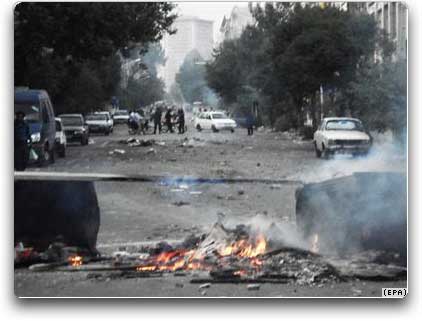
IOrians cut off “It’s really important that Radio Farda send reports every moment to us, because we do not have any access to news inside Iran,” says one listener in Tehran. “Now the VOA and BBC have been jammed.” Iranians are increasingly cut off from non-official sources of news on the ongoing protests against the reelection of President Mahmud Ahmadinejad.

The listeners are helping the U.S. Congress-funded Radio Farda, which broadcasts 24 hours a day in Persian from Prague, to play an escalating cat-and-mouse game with Iranian government censors.

The censors have been trying to black out both U.S. and British government-sponsored newscasts in Persian almost from the moment a week ago that people began protesting the July 12 presidential election results.

To black out a newscast, Iranian authorities beam their own signal up to the commercial satellite carrying the foreign program. The beam is on the same frequency as the newscast, only at much higher power. As a result, anyone in Iran trying to receive the newscast on their home satellite dish receives only the meaningless, substitute signal instead.

Similarly, the government is blacking out foreign news programming in Persian on shortwave and medium-wave radio, particularly within major population centers. Here, authorities set up a local high-power transmitter to again overwhelm the newscast with a stronger signal on the same frequency.

Game Of Frequencies

Iranian officials are aiming most at broadcasts during the peak evening listening hours. And it is during these hours that the feedback from the news program’s audience in Tehran grows most frenzied.

Iran has blocked not only opposition and news websites, but social networks like Facebook as well. Many listeners simply send messages noting their location and that they can no longer hear the program. That alerts the broadcasters to the moment the programming is blocked. The trick for the broadcasters then becomes to shift the transmission signal slightly to escape the blackout.

During the time it takes the censors to catch up and similarly shift their substitute signal, the programming can be received by listeners searching their dials.

As the game has escalated, foreign broadcasters have dramatically increased the number of satellites and short wave frequencies carrying their programs.

From broadcasting originally only on Hotbird 6, a satellite whose “footprint” covers the Mideast and South Asia, Radio Farda now also broadcasts on four more satellites covering the region: Telstar 12, Nilesat 101, Arabsat BADR4, and Asiasat 3-D.

TBBC said last week it was using two extra satellites to broadcast its Persian-language service. VOA’s Persian News Network (PNN) television programs are now beamed through five satellites with six different distribution channels.

It is the kind of struggle once common during the Cold War. For decades, the Soviet government spent huge amounts of money to isolate its citizenry from outside news sources.

But it’s not something seen often since then. Iran has periodically blocked U.S. broadcasting at critical moments — including the student demonstrations of 1999 and the last presidential election in 2005 — but never with such a sustained effort as now.

Legality vs. Sovereignty

Iran’s activity raises some legal questions, because the jamming is also knocking out some transmissions to countries other than Iran itself.

The BBC says its Arabic-language service and other language services to the Middle East have also experienced transmission problems since the jamming of its Persian-language frequency began June 14.

Rod Kirwan, a communications law and regulation expert at the international law firm Denton Wilde Sapte in London, says that Iran has the right under international telecommunications treaties to control the use of the broadcast spectrum within its territory, including foreign satellite broadcasting.

But when there is a spillover effect into neighboring countries, it is creating a harmful interference with the same rights of other member states in the International Telecommunications Union (ITU).

Kirwan says that while the broadcast spectrum is a “sovereign right,” it’s up to each country “to decide how to best use the spectrum and, of course, nations have decided for the greater good to sign up to the ITU coordination arrangements in order that everything works and you have smooth international services.”

But Kirwan adds that this “is a sort of voluntary restriction on your freedom to act as a sovereign body and that is the tension: national rights over sovereign territory or spectrum vs. international coordination rights.”

Kirwan says that if other states complain, the case could become an escalating dispute. But it is not likely to result in clear penalties for Iran.

“It’s one of the basic problems with public international law: who is around to enforce it? And, of course, there is nobody and so it ends in some kind of diplomacy and maybe bilateral pressure,” Kirwan says. “But essentially these international treaty organizations operate on a voluntary basis.”

SOS Calls For News

That makes jamming the foreign broadcasts a fairly cost-free political strategy for Iran. It is also not particularly expensive in financial terms. It only requires uplink equipment to reach the target satellite and the patience and manpower to play the cat-and-mouse game of shifting frequencies that follows.

Overall, the jamming effort falls into Tehran’s larger goal of blocking out all key communications links that challenge the legitimacy of the presidential election results.

The government is blocking many international websites, including Facebook and Twitter, as well as local opposition sites. Text messaging has been cut off for the past week, and mobile-phone service in Tehran is frequently down.

No wonder, then that some of the messages Radio Farda receives from listeners sound like an SOS to the outside world from an increasingly cut-off populace.

“Today is Sunday, June 21. All sites, radios, and anything from which we could get true information have been jammed and now we can’t get any news,” one caller says.

“Now you need to show your higher technology. We are waiting to see whether you are able to overcome these parasites or not.”

Iran’s supreme leader, Ayatollah Ali Khamenei, has accused international media of waging a “psychological war” against the country. It’s a charge that millions of Iranians now can make against Khamenei himself.

By Charles Recknagel

of Radio Free Europe
Radio Liberty
The original article may be read at this direct link.

Filed Under: National Security Programs, Spectrum & Licensing

Primary Sidebar

Coverage

  • Missions & Constellations
  • Business & Finance
  • Military & Defense
  • Launch
  • Software Automation & Ground Systems
  • Government & Regulation
  • Services & Applications

Most Read Stories

  • SpaceX’s Secret ‘Starfall’ Capsule Wins FAA Approval for Pacific Reentry Tests
  • American military space closed around one company in seven days
  • Analyst Projects Massive Subscription Growth for Starlink Ahead of Imminent SpaceX IPO
  • Major opportunities for 2 GHz over Europe
  • Amazon Leo Constellation Surpasses 330 Satellites Following Latest Atlas V Launch

Secondary Sidebar

Footer


Satnews is a leading provider of satellite news, events, publications, research and other satellite industry information in both commercial and military enterprises worldwide.

Stories By Category

  • Business & Finance
  • Government & Regulation
  • Launch
  • Military & Defense
  • Missions & Constellations
  • Services & Applications
  • Software Automation & Ground Systems
  • Spectrum & Licensing
  • Startups & NewSpace Business

About Us

  • Leadership & Editorial Team
  • SatNews History
  • Free Satnews Subscription
  • SatNews Events
  • Magazines

Navigation

  • Latest Stories
  • Magazines
  • Events
  • Contact
  • Cookie & Privacy Policy for Satnews

We use cookies to ensure that we give you the best experience on our website. If you continue to use this site we will assume that you are happy with it.
x
Sign up Now (For Free)
Access daily or weekly satellite news updates covering all aspects of the commercial and military satellite industry.
Invalid email address
Notify Me Regarding ( At least one ):
We value your privacy and will not sell or share your email or other information with any other company. You may also unsubscribe at anytime.

Click Here to see our full privacy policy.
Thanks for subscribing!