

• Skip to primary navigation
  • Skip to main content
  • Skip to primary sidebar
  • Skip to secondary sidebar
  • Skip to footer
  • NEWS:
  • SatNews
  • SatMagazine
  • MilSatMagazine
  • SmallSat News
  • |     EVENTS:
  • SmallSat Symposium
  • Satellite Innovation
  • MilSat Symposium
  • SmallSat Europe

SatNews

Satellite Industry Intelligence Since 1983

Subscribe
  • LATEST
  • SatNews Events
  • Magazines
  • Calendar
  • Subscribe
  • Missions & Constellations
    • Exploration & Science Missions
    • In-Orbit Servicing & Orbital Operations
    • LEO Constellations
    • Mission Autonomy & Onboard Systems
    • Mission Deployments & Manifests
    • Navigation & PNT
    • SmallSat
    • Spacecraft & Payload Technology
    View All in Missions & Constellations →
    Gen Z Influence on AI-Driven Audio MarketGen Z Influence on AI-Driven Audio Market
    SmallSat Europe Speaker Focus: Stefano Antonetti, D-OrbitSmallSat Europe Speaker Focus: Stefano Antonetti, D-Orbit
    Satellite and the Upcoming Spectrum AuctionSatellite and the Upcoming Spectrum Auction
    ExoMars 2028 Structural Models Arrive in Cannes for Environmental TestingExoMars 2028 Structural Models Arrive in Cannes for Environmental Testing
  • Business
    • Contracts & Commercial Deals
    • Earnings & Financial Reporting
    • Events & Conferences
    • Funding & Venture Capital
    • Market Forecasts
    • Mergers & Acquisitions
    • Personnel Moves & Appointments
    View All in Business & Finance →
    Gilat Wins Big Military Contracts, Expands India FootprintGilat Wins Big Military Contracts, Expands India Footprint
    SmallSat Europe Speaker Focus: Gregg Burgess, Orion Space SolutionsSmallSat Europe Speaker Focus: Gregg Burgess, Orion Space Solutions
    Space42 Taps Skylo for Standards-Based Direct-to-Device Services via Thuraya-4Space42 Taps Skylo for Standards-Based Direct-to-Device Services via Thuraya-4
    SmallSat Europe Speaker Focus: Frank M. Salzgeber, Nadir Space VentureSmallSat Europe Speaker Focus: Frank M. Salzgeber, Nadir Space Venture
  • Defense
    • Counterspace & ASAT
    • Defense Budgets & Procurement
    • ISR & Reconnaissance
    • MILSATCOM
    • Missile Warning & Defense
    • National Security Programs
    • Space Domain Awareness
    View All in Military & Defense →
    iDirect Government Launches 450 Rackmount Software-Defined Modem for Multi-Orbit DefenseiDirect Government Launches 450 Rackmount Software-Defined Modem for Multi-Orbit Defense
    US Air Force Taps L3Harris to Bolster ABMS Digital InfrastructureUS Air Force Taps L3Harris to Bolster ABMS Digital Infrastructure
    U.S. and Australia Expand Space Surveillance Network to Counter Emerging ASAT ThreatsU.S. and Australia Expand Space Surveillance Network to Counter Emerging ASAT Threats
    U.S. Space Force Awards $3.2 Billion for Space-Based Interceptor LayerU.S. Space Force Awards $3.2 Billion for Space-Based Interceptor Layer
  • Gov
    • Export Controls & Compliance
    • International Space Agreements
    • National Space Policy
    • Space Law & Treaties
    • Space Sustainability & Debris Policy
    • Space Traffic Management / Debris Removal
    View All in Government & Regulation →
    SES Extends IRIS² Review as Consortium Reaches Initial Project MilestoneSES Extends IRIS² Review as Consortium Reaches Initial Project Milestone
    FCC Approves Landmark Spectrum Sharing and Direct-to-Device FrameworksFCC Approves Landmark Spectrum Sharing and Direct-to-Device Frameworks
    ATVA Urges FCC to Close “Affiliation-Swap” Loopholes Impacting Satellite OperatorsATVA Urges FCC to Close “Affiliation-Swap” Loopholes Impacting Satellite Operators
    UAE Space Agency Drives Public-Private Collaboration at MIITE 2026UAE Space Agency Drives Public-Private Collaboration at MIITE 2026
  • Launch
    • Launch Providers
    • Launch Schedule & Calendars
    • Launch Sites & Infrastructure
    • Rocket Technology & Vehicles
    View All in Launch →
    AST SpaceMobile Pivots to SpaceX for Mid-June Launch of Three BlueBird SatellitesAST SpaceMobile Pivots to SpaceX for Mid-June Launch of Three BlueBird Satellites
    SpaceX Accelerates Transition from Falcon 9 to Next-Generation Starship FleetSpaceX Accelerates Transition from Falcon 9 to Next-Generation Starship Fleet
    NanoAvionics Satellites Reach Orbit on SpaceX CAS500-2 MissionNanoAvionics Satellites Reach Orbit on SpaceX CAS500-2 Mission
    GalaxEye Successfully Launches “Mission Drishti” OptoSAR SatelliteGalaxEye Successfully Launches “Mission Drishti” OptoSAR Satellite
  • Software
    • Autonomous Ground Operations
    • Data Processing & AI/ML
    • Digital Twins & Modeling
    • Ground Segment & Teleports
    • Mission Planning & Simulation
    • Space Systems Software Engineering
    • Spectrum & Licensing
    View All in Software Automation & Ground Systems →
    SpinLaunch Partners with Aalyria for Meridian Constellation Network OrchestrationSpinLaunch Partners with Aalyria for Meridian Constellation Network Orchestration
    Your anomaly detection isn’t the problemYour anomaly detection isn’t the problem
    SmallSat Europe Speaker Focus: Olaf Eckart, BMW GroupSmallSat Europe Speaker Focus: Olaf Eckart, BMW Group
    SES Accelerates Multi-Orbit IFC Strategy with meoSphere and Next-Gen ESA DevelopmentSES Accelerates Multi-Orbit IFC Strategy with meoSphere and Next-Gen ESA Development
  • Services & Apps
    • Climate & Environmental Monitoring
    • Disaster Response & Security Mapping
    • Earth Observation & Imaging
    • Maritime & Aviation Satcom
    • Satellite Communications
    View All in Services & Applications →
    Consumer NPU Boom Accelerates Autonomous Satellite ProcessingConsumer NPU Boom Accelerates Autonomous Satellite Processing
    Ted Turner: “Shake with Terror”Ted Turner: “Shake with Terror”
    Satellite Technology and the Legacy of the Media PioneerSatellite Technology and the Legacy of the Media Pioneer
    SmallSat Europe Speaker Focus: Massimo Comparini, Leonardo Space DivisionSmallSat Europe Speaker Focus: Massimo Comparini, Leonardo Space Division

NASA Has a Gala for GALEX

April 30, 2009

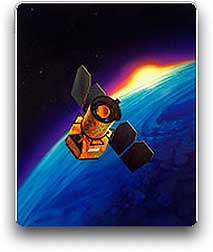
GALEX NASA’s Galaxy Evolution Explorer Mission marks its sixth anniversary studying galaxies beyond our Milky Way through its sensitive ultraviolet telescope, the only such far-ultraviolet detector in space.

The Galaxy Evolution Explorer (GALEX) is an orbiting space telescope observing galaxies in ultraviolet light across 10 billion years of cosmic history. A Pegasus rocket launched GALEX into orbit at 8 a.m. EDT on April 28th, 2003. Although originally planned as a 29-month mission, the NASA Senior Review Panel in 2006 recommended that the mission lifetime be extended.

The mission studies the shape, brightness, size and distance of galaxies across 10 billion years of cosmic history, giving scientists a wealth of data to help us better understand the origins of the universe. One such object is pictured here, the galaxy NGC598, more commonly known as M33.
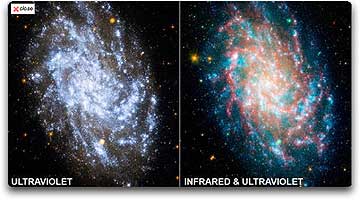
Evolution e mision In these side-by-side images of M33, the ultraviolet image on the left was taken by the Galaxy Evolution Explorer, while the ultraviolet and infrared image on the right is a blend of the mission’s M33 image and another taken by NASA’s Spitzer Space Telescope. M33, one of our closest galactic neighbors, is about 2.9 million light-years away in the constellation Triangulum, part of what’s known as our Local Group of galaxies.

The Galaxy Evolution Explorer has two detectors: one in far-ultraviolet, which reveals stars younger than about 10 million years old, and another in near-ultraviolet, which detects stars younger than about 100 million years old. The left ultraviolet image shows a map of the recent star formation history of M33. The bright blue and white areas are where star formation has been extremely active over the past few million years. The patches of yellow and gold are regions where star formation was more active around 100 million years ago.

The ultraviolet image highlights the most massive young stars in M33. These stars burn their large supply of hydrogen fuel quickly, burning hot and bright while emitting most of their energy at ultraviolet wavelengths. Compared with low-mass stars like our sun, which live for billions of years, these massive stars never reach old age, having a lifespan as short as a few million years.

Together, the Galaxy Evolution Explorer and Spitzer can see a larger range of the full spectrum of the sky. Spitzer, for example, can detect mid-infrared radiation from dust that has absorbed young stars’ ultraviolet light. That’s something the Galaxy Evolution Explorer cannot see. The combined image on the right shows in amazing detail the beautiful and complicated interlacing of hot dust and young stars. In some regions of M33, dust gathers where there is very little far-ultraviolet light, suggesting that the young stars are obscured or that stars farther away are heating the dust. In some of the outer regions of the galaxy, just the opposite is true: There are plenty of young stars and very little dust.

In the combined image, far-ultraviolet light from young stars glimmers blue, near-ultraviolet light from intermediate age stars glows green, near-infrared light from old stars burns yellow and orange, and dust rich in organic molecules burns red. The small blue flecks outside the spiral disk of M33 are most likely distant background galaxies. This image is a four-band composite that, in addition to the two ultraviolet bands, includes near infrared as yellow/orange and far infrared as red.

Since its launch from a Pegasus rocket on April 28, 2003, the Galaxy Evolution Explorer has imaged more than a half-billion objects across two-thirds of the sky. Highlights over the past six years include detecting star formation in unexpected regions of the universe and spotting Mira, a fast-moving older star called a red giant. Astronomers say that studying Mira’s gargantuan cosmic tail is helping us learn how stars like our sun die and ultimately seed new solar systems.

The California Institute of Technology, in Pasadena, California, leads the Galaxy Evolution Explorer mission and is responsible for science operations and data analysis. NASA’s Jet Propulsion Laboratory, also in Pasadena, manages the mission and built the science instrument. The mission was developed under NASA’s Explorers Program managed by the Goddard Space Flight Center, Greenbelt, Md. South Korea and France are the mission’s international partners.

Filed Under: Exploration & Science Missions

Primary Sidebar

Coverage

  • Missions & Constellations
  • Business & Finance
  • Military & Defense
  • Launch
  • Software Automation & Ground Systems
  • Government & Regulation
  • Services & Applications

Most Read Stories

  • NASA Shuts Off Instrument on Voyager 1 to Extend Interstellar Mission
  • Bad news, but good news followed
  • Amazon to Acquire Globalstar for $11.6 Billion to Fuel D2D Expansion
  • Blue Origin Achieves First Booster Reuse but Satellite Enters Off-Nominal Orbit
  • AST SpaceMobile Pivots to SpaceX for Mid-June Launch of Three BlueBird Satellites

Secondary Sidebar

Footer


Satnews is a leading provider of satellite news, events, publications, research and other satellite industry information in both commercial and military enterprises worldwide.

Stories By Category

  • Business & Finance
  • Government & Regulation
  • Launch
  • Military & Defense
  • Missions & Constellations
  • Services & Applications
  • Software Automation & Ground Systems
  • Spectrum & Licensing
  • Startups & NewSpace Business

About Us

  • Leadership & Editorial Team
  • SatNews History
  • Free Satnews Subscription
  • SatNews Events
  • Magazines

Navigation

  • Latest Stories
  • Magazines
  • Events
  • Contact
  • Cookie & Privacy Policy for Satnews

We use cookies to ensure that we give you the best experience on our website. If you continue to use this site we will assume that you are happy with it.
x
Sign up Now (For Free)
Access daily or weekly satellite news updates covering all aspects of the commercial and military satellite industry.
Invalid email address
Notify Me Regarding ( At least one ):
We value your privacy and will not sell or share your email or other information with any other company. You may also unsubscribe at anytime.

Click Here to see our full privacy policy.
Thanks for subscribing!