

RTX Corporation secured a $2.01 billion ceiling increase on its Advanced Extremely High Frequency (AEHF) terminal contract with the U.S. Air Force, raising the total contract value to $2.97 billion — more than triple the original $960 million ceiling set when the deal was awarded in August 2021.
The modification, announced March 13 by the Department of Defense, covers AEHF terminal production, sustainment, and support work at RTX facilities in Marlboro, Massachusetts, and Largo, Florida. The Air Force Nuclear Weapons Center Strategic Communications Division in Bedford, Massachusetts, is the contracting activity. Work runs through August 2031.
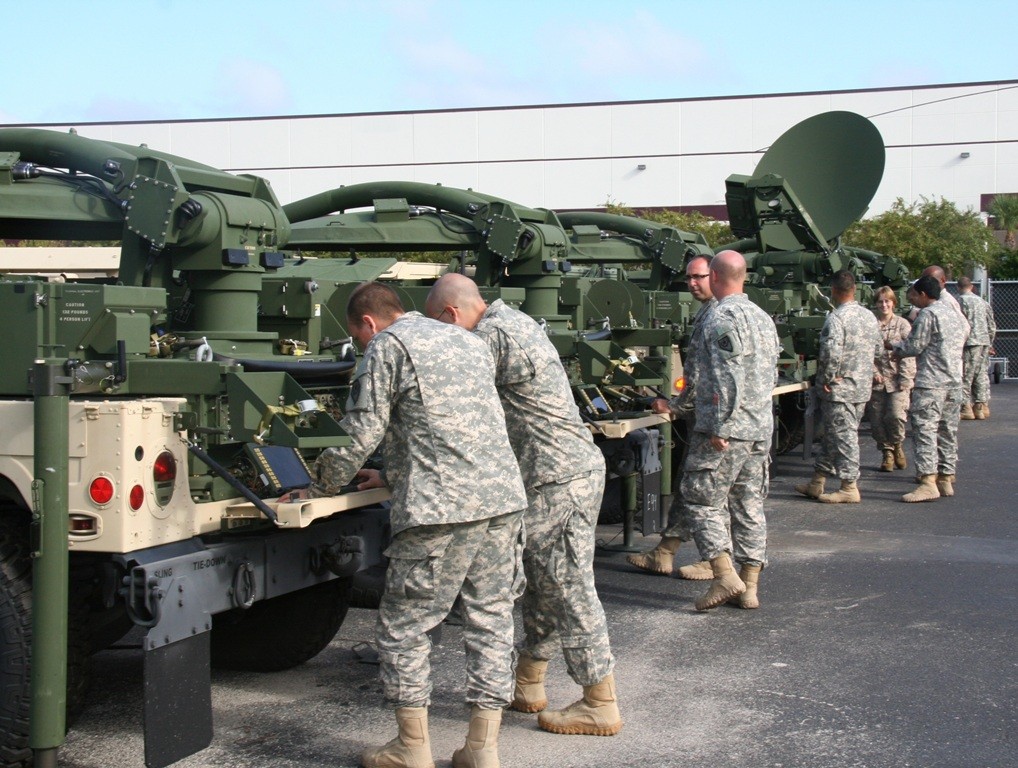
AEHF terminals are the ground-segment link to the Air Force’s six-satellite AEHF constellation, which provides jam-resistant, nuclear-survivable communications for strategic and tactical military users across the U.S. armed forces and allied nations. RTX — listed under its legacy name Raytheon Co. on the contract — is the sole supplier of all three fielded AEHF terminal variants: the Army’s Secure Mobile Anti-Jam Reliable Tactical-Terminal (SMART-T), the Air Force’s Family of Advanced Beyond Line-of-Sight Terminal (FAB-T) for strategic bombers and reconnaissance aircraft, and the Global Advanced Satellite Terminal (Global ASNT) for nuclear mission emergency messaging.
The ceiling increase does not obligate funds at time of award. As an indefinite-delivery, indefinite-quantity (IDIQ) contract, the modification sets spending authority for future task orders rather than committing near-term dollars — but the scale of the increase signals growing demand for terminal production and sustainment across multiple service branches.
The expansion comes as the broader protected SATCOM architecture continues to evolve around AEHF. Boeing won a $2.8 billion contract last year for the Evolved Strategic Satellite Communications (ESS) program, the space-based successor to AEHF under the Pentagon’s nuclear command, control, and communications (NC3) modernization effort. The Arctic Satellite Broadband Mission — carrying Northrop Grumman’s EPS-Recapitalization payloads to extend protected communications coverage into polar regions — launched aboard a SpaceX Falcon 9 in 2024.
Even as next-generation space systems advance, the AEHF constellation and its terminal infrastructure remain central to the military’s protected SATCOM architecture through the end of the decade. The tripling of RTX’s contract ceiling suggests the ground segment will demand sustained investment long after the satellites themselves have successors on orbit.
