

TAFUNA, AMERICAN SAMOA – On Tuesday, March 10, 2026, the Port Administration of American Samoa and Michigan-based ATLAS Space Operations finalized an agreement to host advanced satellite tracking antenna systems at the Pago Pago International Airport facility in Tafuna.
The project establishes American Samoa as a critical nexus for satellite ground-station services in the South Pacific, bridging a vital geographical gap in global space communications.
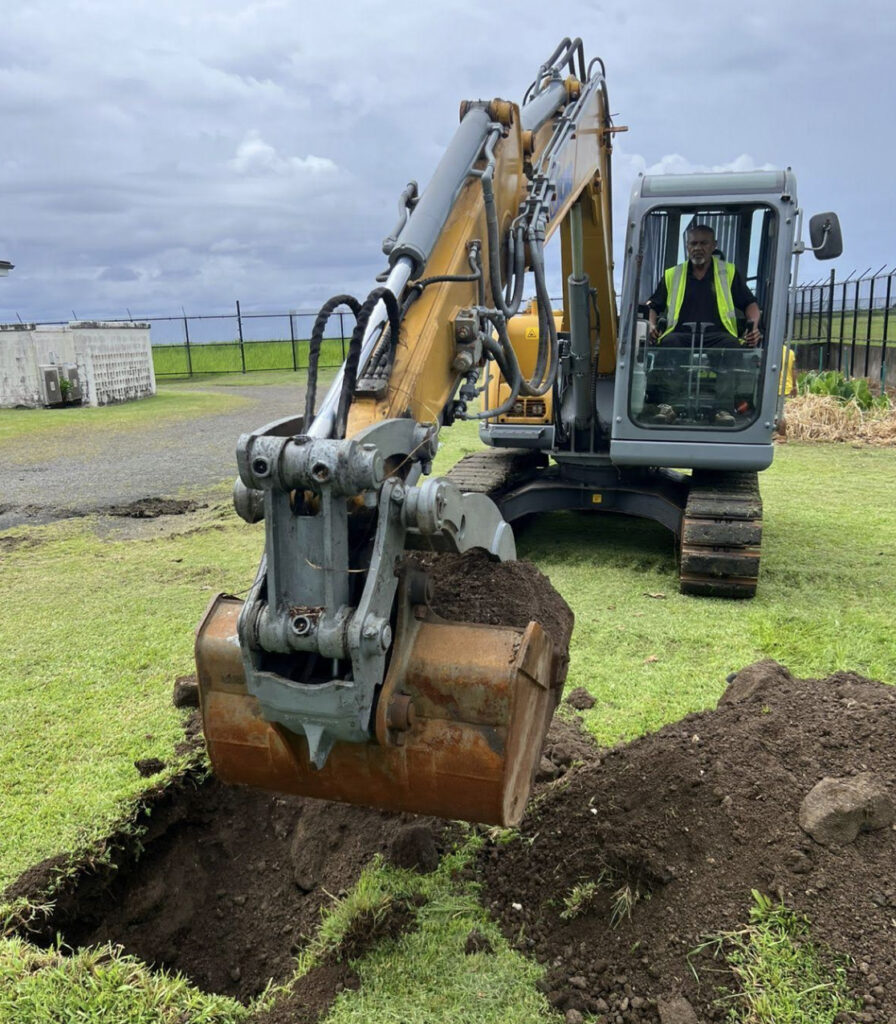
Construction on the antenna foundation and associated data facility upgrades commenced on March 2, 2026. This expansion is integrated into the Territory’s Airport Master Plan (Vision 2030), with lease proceeds earmarked to fund future infrastructure improvements for the Government of American Samoa.
Strategic Context: Closing the South Pacific Gap
The new site is a strategic expansion of the ATLAS Global Federated Network, which utilizes the proprietary Freedom® Software as a Service (GSaaS) platform. By adding American Samoa, ATLAS significantly enhances its “line-of-sight” continuity between existing stations in:
- Guam (Harmon)
- Hawaii (Paumalu/Kapolei)
- New Zealand (Awarua)
- Australia (Mingenew/Alice Springs)
This mid-latitude placement is particularly valuable for the National Oceanic and Atmospheric Administration (NOAA) and the U.S. Military, providing near real-time telemetry and data-collection services for satellites in polar and sun-synchronous orbits.
Technical Specs: S/X-Band Hybrid Capabilities
The Tafuna facility will feature a high-performance 3.7-meter antenna system capable of multi-band operations.
- Frequency Bands: S-Band (TT&C) and X-Band (high-speed payload downlink).
- Data Backhaul: The American Samoa Telecommunications Authority (ASTCA) is providing dedicated high-speed fiber-optic links to ensure sub-second data delivery to global Mission Operations Centers (MOCs).
- Automation: The site will be fully integrated into the Freedom software ecosystem, allowing for automated pass scheduling and machine-to-machine (M2M) network management without on-site personnel.
Rationale and Regional Impact
“Working with the American Samoa Government to install this 3.7-meter S/X-Band antenna adds a significant enhancement to the ATLAS Enterprise Network,” said Stephen Jackson, Chief Engineer of ATLAS Space Operations. “This location is highly strategic, allowing us to better serve remote sensing customers who require near real-time satellite data.”
The project also aligns with broader U.S. national security interests in the South Pacific, providing a resilient communications node that supports Space Domain Awareness (SDA) and maritime security monitoring in the region.
Next Step: Site Commissioning
Following the completion of the foundation and structural assembly, ATLAS and ASTCA will begin RF Characterization and Testing in late April 2026. The station is expected to enter full operational service for commercial and government clients by June 2026.
