

SAN FRANCISCO – Southern California startup General Galactic announced on Thursday, March 5, 2026, plans to launch its first tech-demonstrator satellite, Trinity, later this year. The 500-kilogram spacecraft will serve as the debut flight for the company’s Genesis propulsion platform, a novel multimode system designed to use water as its sole propellant for both high-thrust and high-efficiency maneuvers.
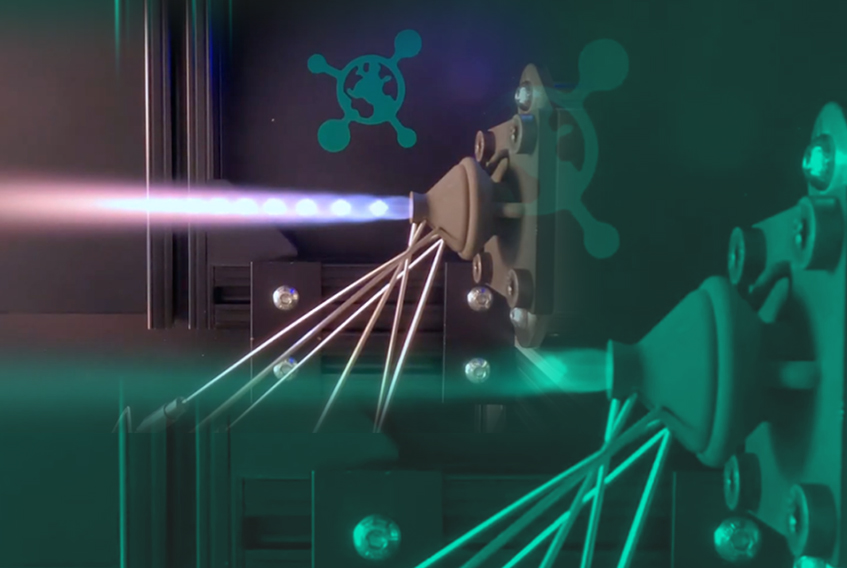
The mission is manifested on the SpaceX Transporter-18 rideshare, currently scheduled for launch no earlier than October 2026. General Galactic aims to validate its vision of becoming an “energy logistics” provider, creating a standardized fueling infrastructure that spans from Low Earth Orbit (LEO) to the lunar surface.
Technical Specs: The Genesis Platform
The Genesis system is designed to overcome the “sitting duck” vulnerability of modern satellites by providing an order of magnitude more delta-V (${\Delta}v$) than traditional systems. Its core architecture includes:
- Multimode Capability: The system pairs a high-thrust chemical engine with a high-efficiency electric thruster.
- Propellant: Uses water ($H_{2}O$) exclusively.
- Chemical Mode: An onboard electrolyzer splits water into hydrogen and oxygen, which are then combusted for rapid maneuvers.
- Electric Mode: Oxygen derived from the electrolysis process is converted into plasma and accelerated via magnetic fields for sustained, high-efficiency station-keeping.
- Maneuverability: The company claims the system can provide 5–10 times the maneuverability of legacy hypergolic or cold-gas systems, critical for Space Force requirements regarding “dynamic space operations” and threat avoidance.
Strategic Context: From LEO to Cislunar Logistics
Founded by former SpaceX engineer Halen Mattison and former Varda Space engineer Luke Naise, General Galactic is positioning itself to solve the “propellant gap” in deep space exploration. While initial testing will occur in LEO, the company’s roadmap involves deploying “gas stations” on the Moon and Mars that utilize In-Situ Resource Utilization (ISRU) to harvest water and convert it into fuel.
The company has secured approximately $10 million in venture capital to date. This demonstration comes at a pivotal time for the U.S. Space Force, which is currently drafting guidance for maneuverable satellite refueling and orbital warfare tactics. Unlike traditional cryogenic fuels (like methane) which suffer from “boil-off,” water is stable for long-term storage in the harsh thermal environments of cislunar space.
Mission Timeline and Roadmap
Following the Trinity launch in late 2026, General Galactic plans to transition to operational missions in 2027.
- 2026: Trinity LEO demonstration flight.
- 2027: Start of operational LEO/MEO/GEO mobility services.
- 2028: First missions to lunar orbit and deployment of early cargo delivery systems.
- 2035: Full deployment of propellant infrastructure on the Moon and Mars.
