

• Skip to primary navigation
  • Skip to main content
  • Skip to primary sidebar
  • Skip to secondary sidebar
  • Skip to footer
  • NEWS:
  • SatNews
  • SatMagazine
  • MilSatMagazine
  • SmallSat News
  • |     EVENTS:
  • SmallSat Symposium
  • Satellite Innovation
  • MilSat Symposium
  • SmallSat Europe

SatNews

Satellite Industry Intelligence Since 1983

Subscribe
  • LATEST
  • SatNews Events
  • Magazines
  • Calendar
  • Subscribe
  • Missions & Constellations
    • Exploration & Science Missions
    • In-Orbit Servicing & Orbital Operations
    • LEO Constellations
    • Mission Autonomy & Onboard Systems
    • Mission Deployments & Manifests
    • Navigation & PNT
    • SmallSat
    • Spacecraft & Payload Technology
    View All in Missions & Constellations →
    NASA Shuts Off Instrument on Voyager 1 to Extend Interstellar MissionNASA Shuts Off Instrument on Voyager 1 to Extend Interstellar Mission
    Starlink Outages Disrupt Navy Drone Tests as Pentagon Dependency GrowsStarlink Outages Disrupt Navy Drone Tests as Pentagon Dependency Grows
    Iridium Unveils Role in Artemis II and Next-Gen PNT at Space Symposium 2026Iridium Unveils Role in Artemis II and Next-Gen PNT at Space Symposium 2026
    Boeing and Millennium Unveil Resolute Mid-Class Satellite PlatformBoeing and Millennium Unveil Resolute Mid-Class Satellite Platform
  • Business
    • Contracts & Commercial Deals
    • Earnings & Financial Reporting
    • Events & Conferences
    • Funding & Venture Capital
    • Market Forecasts
    • Mergers & Acquisitions
    • Personnel Moves & Appointments
    View All in Business & Finance →
    Meink: Space Force Programs Ready to Execute Once FY27 Budget LandsMeink: Space Force Programs Ready to Execute Once FY27 Budget Lands
    SDA’s Sandhoo: Tranche 1 Launches Resume in May or JuneSDA’s Sandhoo: Tranche 1 Launches Resume in May or June
    Gen. Stephen Whiting: First USSPACECOM Operational Staff Arrive at Redstone This WeekGen. Stephen Whiting: First USSPACECOM Operational Staff Arrive at Redstone This Week
    Saltzman Rolls Out Space Force Objective Force, Flags CR as Top RiskSaltzman Rolls Out Space Force Objective Force, Flags CR as Top Risk
  • Defense
    • Counterspace & ASAT
    • Defense Budgets & Procurement
    • ISR & Reconnaissance
    • MILSATCOM
    • Missile Warning & Defense
    • National Security Programs
    • Space Domain Awareness
    View All in Military & Defense →
    GMV Secures Lead Role in Seven 2025 European Defence Fund InitiativesGMV Secures Lead Role in Seven 2025 European Defence Fund Initiatives
    SmallSat Europe Speaker Focus: Gen. Michel Friedling, Look Up SpaceSmallSat Europe Speaker Focus: Gen. Michel Friedling, Look Up Space
    Saltzman Unveils 2040 Blueprint to Scale Space Force for Great Power CompetitionSaltzman Unveils 2040 Blueprint to Scale Space Force for Great Power Competition
    The Rise of Grey Zone Satellites: Ambiguity as a Tactical AdvantageThe Rise of Grey Zone Satellites: Ambiguity as a Tactical Advantage
  • Gov
    • Export Controls & Compliance
    • International Space Agreements
    • National Space Policy
    • Space Law & Treaties
    • Space Sustainability & Debris Policy
    • Space Traffic Management / Debris Removal
    View All in Government & Regulation →
    SmallSat Europe Speaker Focus: Col. Marcin Mazur, Polish Space AgencySmallSat Europe Speaker Focus: Col. Marcin Mazur, Polish Space Agency
    SmallSat Europe Speaker Focus: Chris Quilty, Quilty SpaceSmallSat Europe Speaker Focus: Chris Quilty, Quilty Space
    NRL to Showcase Sovereign Space Capabilities at 41st Space SymposiumNRL to Showcase Sovereign Space Capabilities at 41st Space Symposium
    FCC Modernizes Satellite Spectrum Rules to Unleash Next-Generation BroadbandFCC Modernizes Satellite Spectrum Rules to Unleash Next-Generation Broadband
  • Launch
    • Launch Providers
    • Launch Schedule & Calendars
    • Launch Sites & Infrastructure
    • Rocket Technology & Vehicles
    View All in Launch →
    Blue Origin Achieves First Booster Reuse but Satellite Enters Off-Nominal OrbitBlue Origin Achieves First Booster Reuse but Satellite Enters Off-Nominal Orbit
    Ensign-Bickford Hardware Supports Successful Artemis II Lunar MissionEnsign-Bickford Hardware Supports Successful Artemis II Lunar Mission
    China Accelerates Orbital Internet Deployment with Successful Smart Dragon-3 Sea LaunchChina Accelerates Orbital Internet Deployment with Successful Smart Dragon-3 Sea Launch
    What the SpaceX IPO Changes for Every Satellite OperatorWhat the SpaceX IPO Changes for Every Satellite Operator
  • Software
    • Autonomous Ground Operations
    • Data Processing & AI/ML
    • Digital Twins & Modeling
    • Ground Segment & Teleports
    • Mission Planning & Simulation
    • Space Systems Software Engineering
    • Spectrum & Licensing
    View All in Software Automation & Ground Systems →
    Sat-Lite Technologies adds  Richard Rader to Spearhead Sales ExpansionSat-Lite Technologies adds Richard Rader to Spearhead Sales Expansion
    Blue Origin Unveils Project Quartz Global Ground Station NetworkBlue Origin Unveils Project Quartz Global Ground Station Network
    Cloudcomputing Targets 1.5M Identities in Spain and Finalizes Innovate IT AcquisitionCloudcomputing Targets 1.5M Identities in Spain and Finalizes Innovate IT Acquisition
    Archangel Lightworks Secures £10M Series A to Scale Optical Ground InfrastructureArchangel Lightworks Secures £10M Series A to Scale Optical Ground Infrastructure
  • Services & Apps
    • Climate & Environmental Monitoring
    • Disaster Response & Security Mapping
    • Earth Observation & Imaging
    • Maritime & Aviation Satcom
    • Satellite Communications
    View All in Services & Applications →
    SmallSat Europe Speaker Focus: Martin Langer, OroraTechSmallSat Europe Speaker Focus: Martin Langer, OroraTech
    SmallSat Europe Speaker Focus: Jaume Sanpera, SateliotSmallSat Europe Speaker Focus: Jaume Sanpera, Sateliot
    NASA Targets Commercial Relays to Replace Aging TDRSS InfrastructureNASA Targets Commercial Relays to Replace Aging TDRSS Infrastructure
    OQ Technology Awarded ESA Contract to Adapt 5G Beamforming for SpaceOQ Technology Awarded ESA Contract to Adapt 5G Beamforming for Space

Arianespace plans November 4 launch of Copernicus Sentinel-1D, why two satellites are better than one

October 23, 2025

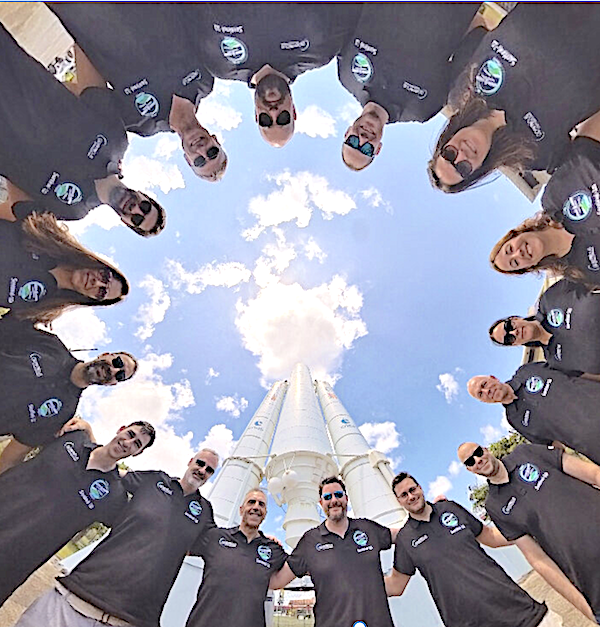
Copernicus Sentinel-1D team group photo

The Copernicus Sentinel-1 mission is soon get its fourth satellite after having undergone the checks and functional tests prior to its integration with Ariane 6. Plans for the launch are on Tuesday, 4 November 2025. The Copernicus Sentinel-1 mission is based on a constellation of two identical satellites flying in the same orbit but 180° apart, to optimise global coverage and data delivery for Copernicus.

Functional checks have been performed on the spacecraft to confirm the spacecraft is in working order after being transported to Kourou.

These tests started with a pressurization and leak check before the spacecraft was switched on. Afterwards several tests were performed to assess the spacecraft’s health status and the correct functionality of all sub-systems. The AIS antenna assemblies, which were transported to the launch site in separate containers, have also been integrated onto the spacecraft and the final connectivity test to ensure their correct electrical connection concluded the spacecraft functional testing.

The spacecraft is now ready for the next steps, including spacecraft finalization before fueling.

Sentinel-1A was the first satellite in the series, launched in April 2014, followed by the launch of Sentinel-1B in 2016. The Sentinel-1B mission came to an end in August 2022 after experiencing a technical fault that rendered it unable to acquire data. The satellite has been successfully de-orbited and will re-enter Earth’s atmosphere within 25 years. Sentinel-1C was launched in December 2024 to take over the role of Sentinel-1B.

The launch of Copernicus Sentinel-1D will provide a much-needed replacement to Sentinel-1A, which has been in orbit for 11 years now, well beyond its planned lifetime. Sentinel-1C was placed in orbit in December 2024, Sentinel-1D will significantly enhance the capabilities of the Copernicus Earth observation program.
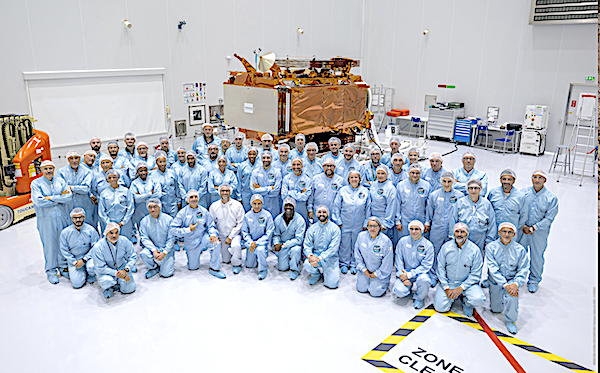
Ramón Torres, Sentinel-1 Satellite Mission Director at ESA, commented, “This time we are launching the fourth Sentinel-1 satellite, and last of the first generation, on an Ariane 6, which will be an important moment for the whole of our space community. To see this mission, the first of the Copernicus programme family and a cornerstone of the Earth observation component of Europe’s space programme, be lifted into orbit on Europe’s newest heavy lift rocket, feels quite momentous. I would like to thank and congratulate all Sentinel-1 team members and our partners who have worked so diligently to make this milestone a huge success.”

Sentinel-1C has been fully commissioned and currently operates with Sentinel-1A to deliver radar images of Earth’s surface, performing in all weathers, day-and-night. This service is vital for disaster response teams, environmental agencies, maritime authorities, climate scientists — and other users who depend on frequent updates of critical data.

Having two satellites in operation at any one time is essential for providing timely data and can mean a significant difference between a late warning and a critical early warning. The arrival of Sentinel-1D will enhance the Sentinel-1 mission’s performance in several ways:

  1. Better revisit time and coverage: With two satellites in the same orbit 180° apart, the revisit rate over any location on Earth improves. This means more frequent imaging, faster change detection, better monitoring.
  2. Enhanced features working in synergy: Both satellites have a C-band Synthetic Aperture Radar (SAR) instrument on board, which allows it to capture high-resolution imagery of Earth’s surface. They are also equipped with an Automatic Identification System (AIS) instrument to improve detection and tracking of ships. When both are operational, more frequent AIS observations are possible.
  3. Streamlined operations and cost savings: Because Sentinel-1C has just gone through commissioning, lessons learned can be applied to Sentinel-1D, reducing time and risk.
  4. GNSS compatibility: There are other improved onboard capabilities for Sentinel-1. For example, while Sentinel-1A and -1B were compatible only with the Global Positioning System (GPS), Sentinel-1C and -1D are compatible with the whole Global Navigation Satellite System (GNSS), including Galileo.
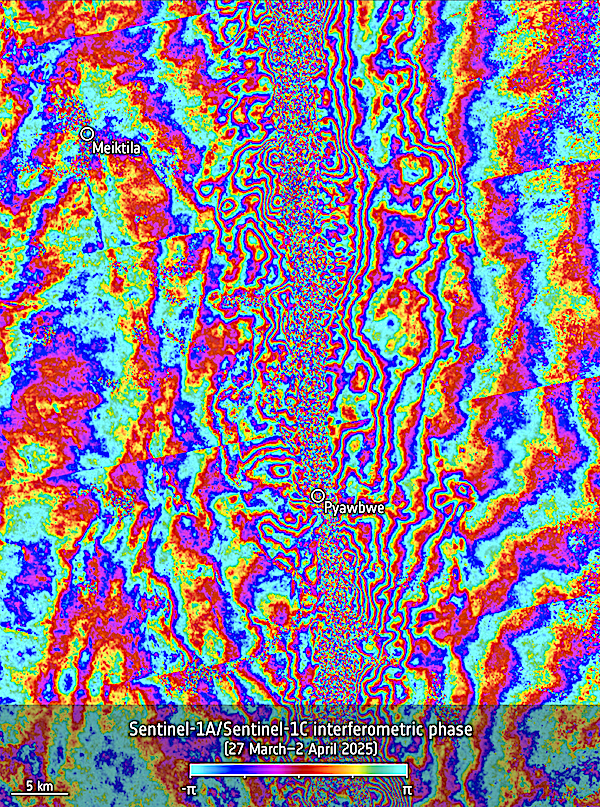
Sentinel-1 interferogram of Myanmar earthquake

Meanwhile, the Sentinel-1 mission will continue to deliver a supply of radar images of Earth’s surface, performing in all weathers, day-and-night. It makes a key contribution to Europe’s Copernicus program by supporting a broad range of applications that help manage the environment, understand and tackle the effects of climate change and safeguard everyday lives.

Simonetta Cheli, Director of Earth Observation Programs at ESA, added, “It is really a credit to the strong partnership between ESA and the European Commission that we are now preparing to launch another satellite for the Copernicus program. Sentinel-1 has provided vital radar data that has been used in emergency responses, in scientific studies and in climate observation — a range of use-cases that highlights just how invaluable Copernicus is to our society.”

The Sentinel-1 mission has contributed data to scientific studies on a wide range of topics, including these recent examples:

  • An analysis of flooding beneath the Greenland ice sheet
  • Destructive fires in South America’s endangered forests
  • Ground movement following a powerful earthquake
  • Measuring one of the biggest ever methane releases related to human activity

Filed Under: Business & Finance

Primary Sidebar

Coverage

  • Missions & Constellations
  • Business & Finance
  • Military & Defense
  • Launch
  • Software Automation & Ground Systems
  • Government & Regulation
  • Services & Applications

Most Read Stories

  • SpaceX Loses Contact With Starlink Satellite
  • Rocket Lab Emerging as Potential Bus Provider for 2,800-Satellite Equatys Constellation
  • SpaceX Accelerates Record-Breaking IPO Following Trillion-Dollar xAI Merger
  • Planet Labs Imposes Indefinite Blackout on Iran Satellite Imagery at U.S. Request
  • Amazon in Reported Talks to Acquire Globalstar in $9 Billion Move to Challenge Starlink

Secondary Sidebar

Footer


Satnews is a leading provider of satellite news, events, publications, research and other satellite industry information in both commercial and military enterprises worldwide.

Stories By Category

  • Business & Finance
  • Government & Regulation
  • Launch
  • Military & Defense
  • Missions & Constellations
  • Services & Applications
  • Software Automation & Ground Systems
  • Spectrum & Licensing
  • Startups & NewSpace Business

About Us

  • Leadership & Editorial Team
  • SatNews History
  • Free Satnews Subscription
  • SatNews Events
  • Magazines

Navigation

  • Latest Stories
  • Magazines
  • Events
  • Contact
  • Cookie & Privacy Policy for Satnews

We use cookies to ensure that we give you the best experience on our website. If you continue to use this site we will assume that you are happy with it.
x
Sign up Now (For Free)
Access daily or weekly satellite news updates covering all aspects of the commercial and military satellite industry.
Invalid email address
Notify Me Regarding ( At least one ):
We value your privacy and will not sell or share your email or other information with any other company. You may also unsubscribe at anytime.

Click Here to see our full privacy policy.
Thanks for subscribing!