

By Sean Payne – SatNews Events Reporter
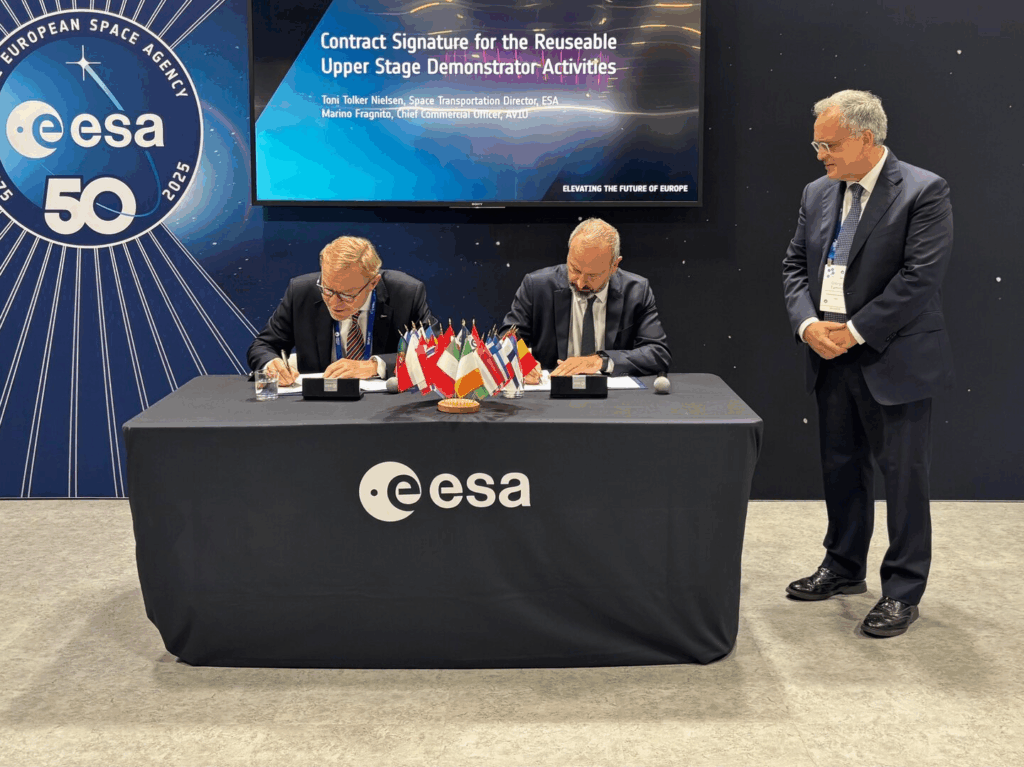
The European Space Agency (ESA) has awarded Italian aerospace manufacturer Avio a €40 million contract to design and develop a reusable upper stage demonstrator. Signed at the 76th International Astronautical Congress (IAC) in Sydney, the 24-month agreement tasks Avio with defining the system requirements and maturing technologies for an orbital stage capable of atmospheric reentry and landing.
Technical Configuration and Scope
The contract covers the preliminary design review (PDR) and technology maturation for both flight and ground segments. According to Avio and ESA technical disclosures at IAC, the demonstrator will integrate several critical subsystems:
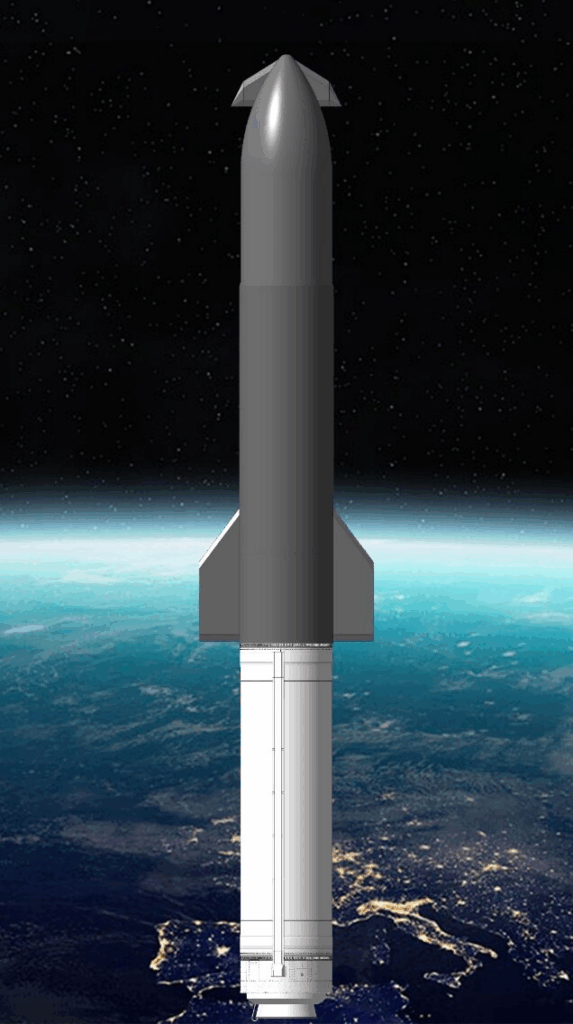
- Propulsion: The stage will utilize liquid oxygen-methane (methalox) propulsion, leveraging the MR10 engine architecture currently under development for the Vega-E launcher.
- Reentry Technologies: Avio will adapt guidance, navigation, and control (GNC) and thermal protection systems derived from the Space Rider reentry vehicle program.
- Architecture: Concept renderings released by ESA depict a stage resembling a scaled-down version of the SpaceX Starship upper stage, suggesting a propulsive vertical landing capability.
Strategic Relevance to European Launch
This initiative addresses the “European Launcher Challenge” resolution to secure independent, reusable access to space. While Europe’s Themis program targets reusable first stages, this contract focuses on the more complex challenge of recovering orbital hardware. The technology is intended to be platform-agnostic, supporting future evolutions of the Vega family (Vega-E) or other European heavy-lift vehicles.
ESA Directorate Commentary
Toni Tolker-Nielsen, ESA’s director of space transportation, emphasized the program’s dual role in immediate and future architectures.
“I am glad to sign this contract since its importance is two-fold: on one side it addresses technological criticalities in the short-term; on the other side, it paves the way for the preparation of Europe’s long-term future in space,” Tolker-Nielsen said.
Program Timeline
The design phase is scheduled to last 24 months, concluding in late 2027 with an integrated preliminary system design. This milestone will inform subsequent decisions regarding the manufacturing and flight testing of the demonstrator, with operational capability targeted for the 2030s.
