

• Skip to primary navigation
  • Skip to main content
  • Skip to primary sidebar
  • Skip to secondary sidebar
  • Skip to footer
  • NEWS:
  • SatNews
  • SatMagazine
  • MilSatMagazine
  • SmallSat News
  • |     EVENTS:
  • SmallSat Symposium
  • Satellite Innovation
  • MilSat Symposium
  • SmallSat Europe

SatNews

Satellite Industry Intelligence Since 1983

Subscribe
  • LATEST
  • SatNews Events
  • Magazines
  • Calendar
  • Subscribe
  • Missions & Constellations
    • Exploration & Science Missions
    • In-Orbit Servicing & Orbital Operations
    • LEO Constellations
    • Mission Autonomy & Onboard Systems
    • Mission Deployments & Manifests
    • Navigation & PNT
    • SmallSat
    • Spacecraft & Payload Technology
    View All in Missions & Constellations →
    Rohde & Schwarz Introduces Pulsar Signal Simulation to Advance Next-Gen PNT TestingRohde & Schwarz Introduces Pulsar Signal Simulation to Advance Next-Gen PNT Testing
    China Accelerates Orbital Internet Deployment with Successful Smart Dragon-3 Sea LaunchChina Accelerates Orbital Internet Deployment with Successful Smart Dragon-3 Sea Launch
    Smallsats Dominate 2025 Launch Landscape as Mass Efficiency PeaksSmallsats Dominate 2025 Launch Landscape as Mass Efficiency Peaks
    MIT STAR Lab Expands Scope from Lasercom Innovation to Space Policy ArchitectureMIT STAR Lab Expands Scope from Lasercom Innovation to Space Policy Architecture
  • Business
    • Contracts & Commercial Deals
    • Earnings & Financial Reporting
    • Events & Conferences
    • Funding & Venture Capital
    • Market Forecasts
    • Mergers & Acquisitions
    • Personnel Moves & Appointments
    View All in Business & Finance →
    Global Defense Leaders Convene as Space Symposium 41 Addresses Orbital SecurityGlobal Defense Leaders Convene as Space Symposium 41 Addresses Orbital Security
    SmallSat Europe Speaker Focus: Chris Quilty, Quilty SpaceSmallSat Europe Speaker Focus: Chris Quilty, Quilty Space
    “SpaceX and the biggest IPO in history”“SpaceX and the biggest IPO in history”
    SmallSat Europe Speaker Focus: Chiara Manfletti, NeuraspaceSmallSat Europe Speaker Focus: Chiara Manfletti, Neuraspace
  • Defense
    • Counterspace & ASAT
    • Defense Budgets & Procurement
    • ISR & Reconnaissance
    • MILSATCOM
    • Missile Warning & Defense
    • National Security Programs
    • Space Domain Awareness
    View All in Military & Defense →
    NRL to Showcase Sovereign Space Capabilities at 41st Space SymposiumNRL to Showcase Sovereign Space Capabilities at 41st Space Symposium
    Northrop Grumman Minotaur IV Lofted USSF Tech Demonstration Payloads to OrbitNorthrop Grumman Minotaur IV Lofted USSF Tech Demonstration Payloads to Orbit
    The End of the VSAT Parts BinThe End of the VSAT Parts Bin
    Procurement Lag vs. Conflict Speed: Can Defense Buying Cycles Keep Up with Space Innovation?Procurement Lag vs. Conflict Speed: Can Defense Buying Cycles Keep Up with Space Innovation?
  • Gov
    • Export Controls & Compliance
    • International Space Agreements
    • National Space Policy
    • Space Law & Treaties
    • Space Sustainability & Debris Policy
    • Space Traffic Management / Debris Removal
    View All in Government & Regulation →
    FCC Modernizes Satellite Spectrum Rules to Unleash Next-Generation BroadbandFCC Modernizes Satellite Spectrum Rules to Unleash Next-Generation Broadband
    SmallSat Europe Speaker Focus: Daniel Bock, Morpheus SpaceSmallSat Europe Speaker Focus: Daniel Bock, Morpheus Space
    SmallSat Europe Speaker Focus: Dr. Ane Aanesland, ThrustMeSmallSat Europe Speaker Focus: Dr. Ane Aanesland, ThrustMe
    Isaacman’s Budget Math: How NASA Plans to Reach the Moon With a Quarter Less MoneyIsaacman’s Budget Math: How NASA Plans to Reach the Moon With a Quarter Less Money
  • Launch
    • Launch Providers
    • Launch Schedule & Calendars
    • Launch Sites & Infrastructure
    • Rocket Technology & Vehicles
    View All in Launch →
    What the SpaceX IPO Changes for Every Satellite OperatorWhat the SpaceX IPO Changes for Every Satellite Operator
    €30 million Financing for PLD Space’s Small Satellite Launcher€30 million Financing for PLD Space’s Small Satellite Launcher
    Satellite Deployers to be Used on JAXA Small Satellite Mission by ExolaunchSatellite Deployers to be Used on JAXA Small Satellite Mission by Exolaunch
    CAS Space Successfully Launches Kinetica-2, Aiming for Global Cost LeadershipCAS Space Successfully Launches Kinetica-2, Aiming for Global Cost Leadership
  • Software
    • Autonomous Ground Operations
    • Data Processing & AI/ML
    • Digital Twins & Modeling
    • Ground Segment & Teleports
    • Mission Planning & Simulation
    • Space Systems Software Engineering
    • Spectrum & Licensing
    View All in Software Automation & Ground Systems →
    Cloudcomputing Targets 1.5M Identities in Spain and Finalizes Innovate IT AcquisitionCloudcomputing Targets 1.5M Identities in Spain and Finalizes Innovate IT Acquisition
    Archangel Lightworks Secures £10M Series A to Scale Optical Ground InfrastructureArchangel Lightworks Secures £10M Series A to Scale Optical Ground Infrastructure
    Keysight and Sateliot Win ESA and GSMA Foundry Challenge for 6G InnovationKeysight and Sateliot Win ESA and GSMA Foundry Challenge for 6G Innovation
    Automation and Agility: How SSC Space Go is Designed for the New Age of GroundAutomation and Agility: How SSC Space Go is Designed for the New Age of Ground
  • Services & Apps
    • Climate & Environmental Monitoring
    • Disaster Response & Security Mapping
    • Earth Observation & Imaging
    • Maritime & Aviation Satcom
    • Satellite Communications
    View All in Services & Applications →
    Kraken Robotics Integrates KATFISH Sonar on SEFINE RD-22 USV Following Multi-Naval DemonstrationsKraken Robotics Integrates KATFISH Sonar on SEFINE RD-22 USV Following Multi-Naval Demonstrations
    Astroscale Plans World-First Multi-Orbit Satellite Inspection MissionAstroscale Plans World-First Multi-Orbit Satellite Inspection Mission
    The Downlink Deficit: The Pentagon’s Optical Mesh Network and the Terrestrial BottleneckThe Downlink Deficit: The Pentagon’s Optical Mesh Network and the Terrestrial Bottleneck
    Cinemo Reimagines the Vehicle as a Software-Defined Entertainment HubCinemo Reimagines the Vehicle as a Software-Defined Entertainment Hub

Deep Space Advanced Radar capability makes tremendous progress in the first year

February 27, 2025

Just one year after signing a ground-breaking trilateral agreement, the Deep Space Advanced Radar Capability (DARC) partnership is completing facilities construction at the first of three sites that will host a global network of advanced ground-based sensors.
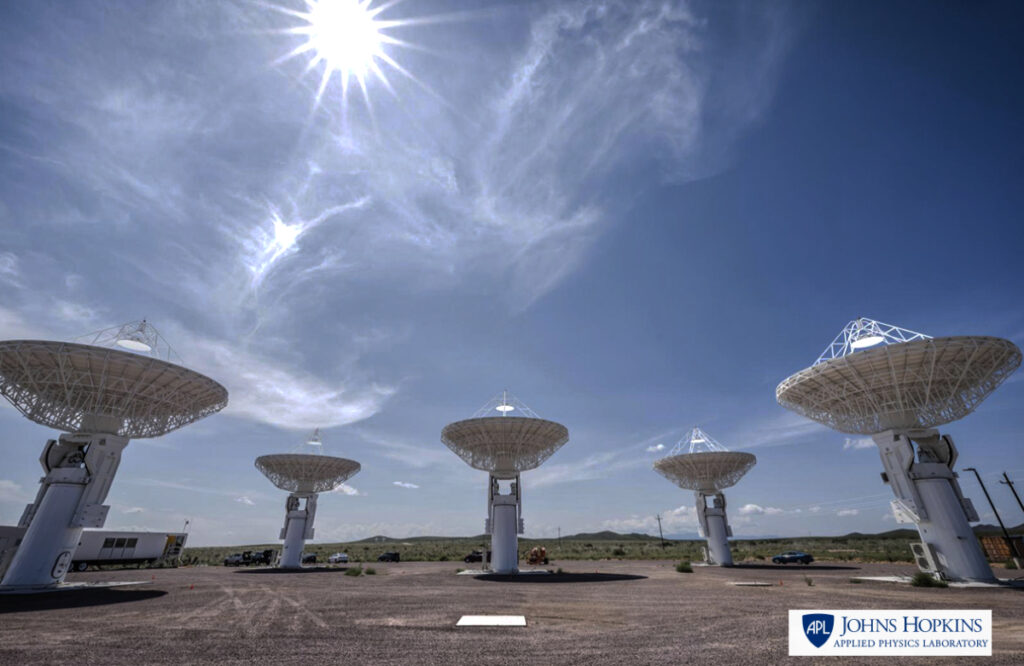
Based on technology and a reference system design developed by APL, the Deep Space Advanced Radar Capability (DARC) will help solve the challenge of locating and tracking active satellites in and on the way to geosynchronous orbit, more than 22,000 miles above Earth.

DARC is a partnership between the United States, the United Kingdom and Australia, designed to create an all-weather, global system to track very small objects in GEO to protect critical U.S. and allied satellite services. The trilateral Memorandum of Understanding was signed September 27, 2023, will last 22 years, and is a practical example of what the partners can achieve when working together to enhance mutual defense capabilities in the Indo-Pacific region. Construction of the first site, in Western Australia, was completed in December of 2024, three months ahead of schedule, with mission system integration and test activities now underway.

Allied partnerships in space are increasingly critical, given emerging threats from adversaries and pacing challengers, noted Lt. Col. Nicholas Yeung, chief of Capabilities Development for Space Systems Command’s International Affairs office. DARC is just one of several key partnership efforts facilitated by SSC’s IA office, and it’s particularly critical as it addresses innate challenges in GEO coverage.

At 22,236 miles above the Earth, an object in GEO takes 24 hours to orbit the planet. This keeps the satellite “parked” in the same spot, appearing stationary to ground sensors. This makes GEO important “real estate” for several satellites, but because GEO is so far above the Earth, it’s more difficult to monitor space debris and/or adversarial actions that could potentially disrupt or deny space-based capabilities in that orbit.

Yet another challenge is that the U.S. can only cover a limited portion of the sky based on its geography, which is one of the reasons international partnerships are so important. The DARC program demonstrates how allied partnerships can overcome both technical and geographic challenges while accelerating the delivery of advanced space technology in support of combined operations.

DARC is a unique collaboration between the three countries to get after first-of-its-kind capability that can do something that not only is needed from an operational perspective, but has never been done before.

One of the main benefits of radar is that it operates 24 hours a day, in all weather and can make observations through clouds and during the daytime—something optical telescopes cannot do. An ongoing challenge of radar versus telescope, however, is that the further out your radar goes, the larger the power required to transmit and the bigger the receiver arrays must be. DARC addresses this challenge by using multiple smaller arrays that combine the signals from space to act as one large array. This ground-breaking concept was initially demonstrated by the USSF through its DARC technology demonstration at White Sands Missile Range in 2021.

Construction of the first site in Exmouth in Western Australia began in October of 2023. The site infrastructure has been completed, including the radar power plant. Spectrum licenses and airspace approvals for the Australian site also have been completed, as well as the first receiver and transmitter antennas. The first open-air transmit of the first antenna was completed in September 2024 and the Australian site is expected to become fully operational in 2027.

The speed at which the DARC construction and commissioning has occurred could only have been achieved through an open and collaborative relationship between the three nations and Australian industry.

“The collaboration between all parties for the DARC project has been outstanding and is an example of what can be done when we work with our partners on a common goal for the advancement of Space Domain Awareness across our three nations,” said Michael Hunt, assistant secretary Space Systems Branch for the Australian Department of Defence, who also serves as the Australian representative on the DARC steering committee.

Commodore Dave Moody, head of Space Capability for U.K. Space Command, said, “DARC leverages the geography and commitment of key partner nations to deliver persistent, comprehensive space domain awareness. One year on, the talent harnessed between the nations has begun to field a more capable technology that will protect and defend the international ways of life. Alongside the United States and Australia, the United Kingdom will continue to take deliberate steps that ensure DARC enables a collective ability to operate decisively in space.”

“The completed DARC system will enhance our Space Domain Awareness enterprise architecture by adding a critical element,” said Brig. Gen. Chandler Atwood, deputy commander of Space Operations Command. “DARC will ensure the U.S., its allies, and partners can effectively characterize the movement of objects traveling in, from and to space, allowing us to mitigate the risk of debris-causing events that could hold the world’s space-enabled capabilities at risk. Increased Space Domain Awareness will also bolster our vital ability to attribute malign activity from irresponsible actors in the space domain when and if necessary.”

Author: Lisa Sodders, Space Systems Command Public Affairs

Filed Under: International Space Agreements, National Security Programs

Primary Sidebar

Coverage

  • Missions & Constellations
  • Business & Finance
  • Military & Defense
  • Launch
  • Software Automation & Ground Systems
  • Government & Regulation
  • Services & Applications

Most Read Stories

  • L3Harris Unveils XL-300P: The First P25 Handheld with 5G and Satellite Direct-to-Device Connectivity
  • SpaceX Loses Contact With Starlink Satellite
  • Rheinmetall Walked Away. Germany Should Take the Hint.
  • Rocket Lab Emerging as Potential Bus Provider for 2,800-Satellite Equatys Constellation
  • SpaceX Accelerates Record-Breaking IPO Following Trillion-Dollar xAI Merger

Secondary Sidebar

Footer


Satnews is a leading provider of satellite news, events, publications, research and other satellite industry information in both commercial and military enterprises worldwide.

Stories By Category

  • Business & Finance
  • Government & Regulation
  • Launch
  • Military & Defense
  • Missions & Constellations
  • Services & Applications
  • Software Automation & Ground Systems
  • Spectrum & Licensing
  • Startups & NewSpace Business

About Us

  • Leadership & Editorial Team
  • SatNews History
  • Free Satnews Subscription
  • SatNews Events
  • Magazines

Navigation

  • Latest Stories
  • Magazines
  • Events
  • Contact
  • Cookie & Privacy Policy for Satnews

We use cookies to ensure that we give you the best experience on our website. If you continue to use this site we will assume that you are happy with it.
x
Sign up Now (For Free)
Access daily or weekly satellite news updates covering all aspects of the commercial and military satellite industry.
Invalid email address
Notify Me Regarding ( At least one ):
We value your privacy and will not sell or share your email or other information with any other company. You may also unsubscribe at anytime.

Click Here to see our full privacy policy.
Thanks for subscribing!