

• Skip to primary navigation
  • Skip to main content
  • Skip to primary sidebar
  • Skip to secondary sidebar
  • Skip to footer
  • NEWS:
  • SatNews
  • SatMagazine
  • MilSatMagazine
  • SmallSat News
  • |     EVENTS:
  • SmallSat Symposium
  • Satellite Innovation
  • MilSat Symposium
  • SmallSat Europe

SatNews

Satellite Industry Intelligence Since 1983

Subscribe
  • LATEST
  • Missions & Constellations
    • Exploration & Science Missions
    • In-Orbit Servicing & Orbital Operations
    • LEO Constellations
    • Mission Autonomy & Onboard Systems
    • Mission Deployments & Manifests
    • Navigation & PNT
    • SmallSat
    • Spacecraft & Payload Technology
    View All in Missions & Constellations →
    SES Activates Latest O3b mPOWER Satellites; Constellation Reaches 10-Unit Operational MilestoneSES Activates Latest O3b mPOWER Satellites; Constellation Reaches 10-Unit Operational Milestone
    Mynaric Secures ESA HydRON Element 3 Contract for High-Throughput Optical User SegmentMynaric Secures ESA HydRON Element 3 Contract for High-Throughput Optical User Segment
    Kongsberg Discovery and Silicon Sensing Unveil Tactical-Grade North-Seeking MEMS GyroscopeKongsberg Discovery and Silicon Sensing Unveil Tactical-Grade North-Seeking MEMS Gyroscope
    PwC Projects $127 Billion Moon Economy by 2050; Energy Infrastructure Cited as Primary BottleneckPwC Projects $127 Billion Moon Economy by 2050; Energy Infrastructure Cited as Primary Bottleneck
  • Business
    • Contracts & Commercial Deals
    • Earnings & Financial Reporting
    • Events & Conferences
    • Funding & Venture Capital
    • Market Forecasts
    • Mergers & Acquisitions
    • Personnel Moves & Appointments
    View All in Business & Finance →
    SatNews Launches New Website: 52,000 Stories, Zero Left BehindSatNews Launches New Website: 52,000 Stories, Zero Left Behind
    MDA Space Delivers Record $1.6 Billion Revenue in 2025; Unveils $40 Billion Opportunity PipelineMDA Space Delivers Record $1.6 Billion Revenue in 2025; Unveils $40 Billion Opportunity Pipeline
    Blue Origin Accelerates New Glenn 9×4 Production and TeraWave Constellation DevelopmentBlue Origin Accelerates New Glenn 9×4 Production and TeraWave Constellation Development
    EchoStar Details $42 Billion Strategic Shift via SpaceX and AT&T Asset DivestituresEchoStar Details $42 Billion Strategic Shift via SpaceX and AT&T Asset Divestitures
  • Defense
    • Counterspace & ASAT
    • Defense Budgets & Procurement
    • ISR & Reconnaissance
    • MILSATCOM
    • Missile Warning & Defense
    • National Security Programs
    • Space Domain Awareness
    View All in Military & Defense →
    Sierra Space Secures $550 Million Series C to Scale Defense-Tech and Dream Chaser OperationsSierra Space Secures $550 Million Series C to Scale Defense-Tech and Dream Chaser Operations
    The Iran Precedent: Operation Epic Fury and the Law of Armed Conflict in SpaceThe Iran Precedent: Operation Epic Fury and the Law of Armed Conflict in Space
    GomSpace Secures €7.6 Million Contract for Defense-Grade RF Monitoring ClusterGomSpace Secures €7.6 Million Contract for Defense-Grade RF Monitoring Cluster
    Telespazio Deploys LEO-Based Mobile Satcom for Brazil’s Presidential Security OfficeTelespazio Deploys LEO-Based Mobile Satcom for Brazil’s Presidential Security Office
  • Gov
    • Export Controls & Compliance
    • International Space Agreements
    • National Space Policy
    • Space Law & Treaties
    • Space Sustainability & Debris Policy
    • Space Traffic Management / Debris Removal
    View All in Government & Regulation →
    The Iran Precedent: Operation Epic Fury and the Law of Armed Conflict in SpaceThe Iran Precedent: Operation Epic Fury and the Law of Armed Conflict in Space
    Geopolitical Scrutiny: The Strategic Implications of APT Satellite’s Chinese State OwnershipGeopolitical Scrutiny: The Strategic Implications of APT Satellite’s Chinese State Ownership
    Sovereign Checkpoints and Debt CliffsSovereign Checkpoints and Debt Cliffs
    Securing the Future of the Orbital EnvironmentSecuring the Future of the Orbital Environment
  • Launch
    • Launch Providers
    • Launch Schedule & Calendars
    • Launch Sites & Infrastructure
    • Rocket Technology & Vehicles
    View All in Launch →
    Times Microwave Systems Launches Levitate™ Ultra-Lightweight Cables for UAV and Defense AvionicsTimes Microwave Systems Launches Levitate™ Ultra-Lightweight Cables for UAV and Defense Avionics
    Blue Origin Accelerates New Glenn 9×4 Production and TeraWave Constellation DevelopmentBlue Origin Accelerates New Glenn 9×4 Production and TeraWave Constellation Development
    PLD Space Secures €180 Million Series C Led by Mitsubishi Electric to Scale MIURA 5 ProductionPLD Space Secures €180 Million Series C Led by Mitsubishi Electric to Scale MIURA 5 Production
    SpaceX Lunar Manufacturing Proposal Triggers Surge in APT Satellite SharesSpaceX Lunar Manufacturing Proposal Triggers Surge in APT Satellite Shares
  • Software
    • Autonomous Ground Operations
    • Data Processing & AI/ML
    • Digital Twins & Modeling
    • Ground Segment & Teleports
    • Mission Planning & Simulation
    • Space Systems Software Engineering
    • Spectrum & Licensing
    View All in Software Automation & Ground Systems →
    Orbital Edge AI: Axelera AI and ESA Partner to Standardize Space-Based InferenceOrbital Edge AI: Axelera AI and ESA Partner to Standardize Space-Based Inference
    Rohde & Schwarz and Qualcomm Validate Advanced 5×5 MIMO for Wi-Fi 8 NetworkingRohde & Schwarz and Qualcomm Validate Advanced 5×5 MIMO for Wi-Fi 8 Networking
    wolfSSL Aligns Embedded Security Portfolio with EU Cyber Resilience Act MandateswolfSSL Aligns Embedded Security Portfolio with EU Cyber Resilience Act Mandates
    Gilat Demonstrates 3GPP-Compliant 5G NTN Connectivity Over GEO SatelliteGilat Demonstrates 3GPP-Compliant 5G NTN Connectivity Over GEO Satellite
  • Services & Apps
    • Climate & Environmental Monitoring
    • Disaster Response & Security Mapping
    • Earth Observation & Imaging
    • Maritime & Aviation Satcom
    • Satellite Communications
    View All in Services & Applications →
    Axian Telecom and AST SpaceMobile to Launch Africa’s First Direct-to-Device Mobile NetworkAxian Telecom and AST SpaceMobile to Launch Africa’s First Direct-to-Device Mobile Network
    The Iran Precedent: Operation Epic Fury and the Law of Armed Conflict in SpaceThe Iran Precedent: Operation Epic Fury and the Law of Armed Conflict in Space
    Planet Labs Imagery Verifies Smoke over Central Tehran Following Leadership StrikesPlanet Labs Imagery Verifies Smoke over Central Tehran Following Leadership Strikes
    ICEYE Launches SAR-Powered Deforestation Monitoring to Counter Tropical Forest LossICEYE Launches SAR-Powered Deforestation Monitoring to Counter Tropical Forest Loss
  • SatNews Events
  • Magazines
  • Calendar
  • Jobs

50 years have passed for NASA’s Copernicus satellite which set the bar for space astronomy

August 22, 2022

At 6:28 a.m. EDT, on August 21, 1972, NASA’s Copernicus satellite, the heaviest and most complex space telescope of its time, lit up the sky as it ascended into orbit from Launch Complex 36B at what is now Cape Canaveral Space Force Station, Florida.
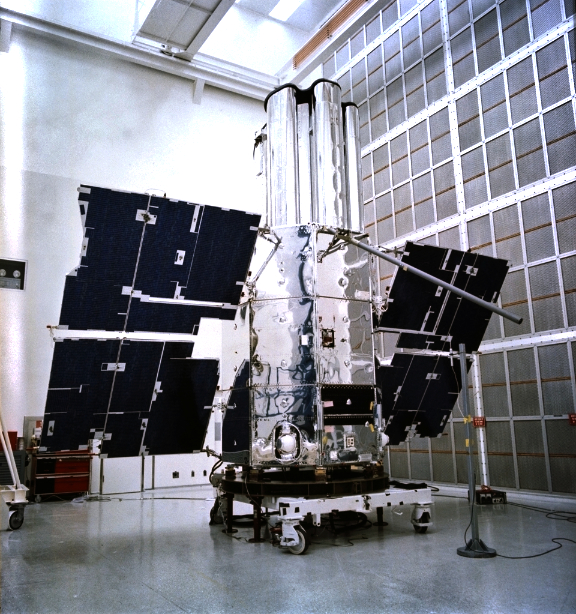
Blue-black solar panels extend from the spacecraft’s metal body, which reflects the brightly lit interior of its clean room. Orbiting Astronomical Observatory C – named Copernicus on-orbit – stands in the Hangar AE clean room at Cape Canaveral Air Force Station, Florida, following the mounting of its stationary solar panels. Copernicus was the only member of the series sporting the large cylindrical structures at the top of the spacecraft, which kept stray light from reaching the instruments. of the Orbiting Astronomical Observatory, renamed Copernicus once on-orbit.
Image is courtesy of NASA.

Initially known as Orbiting Astronomical Observatory (OAO) C, it became OAO 3 once on-orbit in the fashion of the time. But it was also renamed to honor the 500th anniversary of the birth of Nicolaus Copernicus (1473–1543). The Polish astronomer formulated a model of the solar system with the Sun in the central position instead of Earth, breaking with 1,300 years of tradition and triggering a scientific revolution.

Fitted with the largest ultraviolet telescope ever orbited at the time as well as four co-aligned X-ray instruments, Copernicus was arguably NASA’s first dedicated multiwavelength astronomy observatory. This makes it a forebear of operating satellites such as NASA’s Neil Gehrels Swift Observatory, which watches the sky in visible, ultraviolet and X-ray light. (Download an HD video and high-resolution images from NASA’s Scientific Visualization Studio)

“The two spacecraft share institutional connections, too,” said Swift Principal Investigator, S. Bradley Cenko at NASA’s Goddard Space Flight Center in Greenbelt, Maryland. “Goddard managed both missions, and the X-ray experiment on Copernicus was provided by the Mullard Space Science Laboratory at University College London, which also contributed Swift’s Ultraviolet/Optical Telescope.”

Learning to point and hold an orbiting telescope on a star long enough for the detectors to capture its light proved much more difficult than expected. Satellites designed to study the Sun at the time had a built-in advantage – they targeted the solar system’s brightest object. Copernicus flew with a new inertial reference unit (IRU) developed by the Massachusetts Institute of Technology. Gyroscopes in the IRU sped up the process of acquiring targets, while other systems kept the satellite locked on. In a study of the mission’s first 500 days, one engineer summed it up by noting that the IRU had made flying Copernicus “a boring operation.”

In NASA’s early days, astronomers emphasized the need for ultraviolet (UV) studies, which could not be made from the ground, and this became the primary focus of the OAO program. Of four satellites launched, one failed after three days in space, and another never reached orbit at all. OAO 2, launched in 1968 and named Stargazer, provided years of observations, including low-resolution stellar spectra, which spread out wavelengths much like a rainbow to reveal the UV fingerprints of specific molecules and atoms. Copernicus went deeper still, capturing spectra with up to 200 times better detail in some wavelengths.

“This mission obtained high-resolution spectra of many stars in the UV and provided information at the shortest wavelengths reached for many years,” wrote Nancy Grace Roman, the first chief of astronomy in the Office of Space Science at NASA Headquarters, Washington, and the program scientist for Copernicus. During the mission, Roman became one of the driving forces behind the Large Space Telescope project, now known as NASA’s Hubble Space Telescope. She is also the namesake of NASA’s Roman Space Telescope, which is expected to take flight in a few years.

https://www.nasa.gov/sites/default/files/thumbnails/image/zetaoph_lg.jpg
A bright bluish star appears at the center of an arc-shape, red and green gas cloud. The hot, young star Zeta Ophiuchi is seen here in infrared (green and red) and X-ray light (blue) from NASA’s Spitzer and Chandra space telescopes. The star is partly veiled by an interstellar cloud. Its stellar outflows and motion through space combine to produce the red and green shock wave. Copernicus measured the star’s ultraviolet light, finding evidence that most interstellar gas comes in the form of molecular hydrogen. Credit: X-ray: NASA/CXC/Dublin Inst. Advanced Studies/S. Green et al.; Infrared: NASA/JPL/Spitzer

The primary instrument aboard Copernicus was the Princeton Experiment Package, which captured UV light using a 32-inch (0.8-meter) mirror about a third the size of Hubble’s. Led by Lyman Spitzer Jr. at Princeton University in New Jersey, the instrument produced a treasure trove of information about interstellar gas and the ionized outflows of hot stars. Its first target, a star named Zeta Ophiuchi that’s partly veiled by an interstellar cloud, showed strong absorption from hydrogen molecules. Measurements from dozens of other stars confirmed a theory predicting that most of the hydrogen in gas clouds existed in this form.

In 1946, Spitzer began speculating about the kinds of science that might be possible with a large orbiting telescope, later becoming the catalyst for the development of Hubble. NASA’s Spitzer Space Telescope, which operated from 2003 to 2020 and explored, among other sources, the cold clouds where stars are born, was named in his honor.

At the time when NASA was considering instrument proposals for Copernicus, only one celestial object, the Sun, was known to emit X-rays. That changed in 1962. Flying new X-ray detectors on a suborbital rocket, a research team led by Riccardo Giacconi at American Science and Engineering Inc., then in Cambridge, Massachusetts, discovered the first X-ray source beyond the solar system, named Scorpius X-1. Additional flights uncovered more cosmic sources, including Cygnus X-1, long suspected and now known to host a stellar-mass black hole.

With this breakthrough, Giaconni proposed the first satellite dedicated to mapping the X-ray sky. Launched in 1970 and operating for three years, NASA’s Uhuru satellite mapped more than 300 sources, showed that many are neutron stars or black holes fueled by gas streaming from stellar companions, and discovered X-rays from the hot gas in galaxy clusters. Giaconni would go on to propose more powerful X-ray satellites – NASA’s Einstein Observatory, which operated from 1978 to 1981, and NASA’s current X-ray flagship, the Chandra X-ray Observatory, launched in 1999.
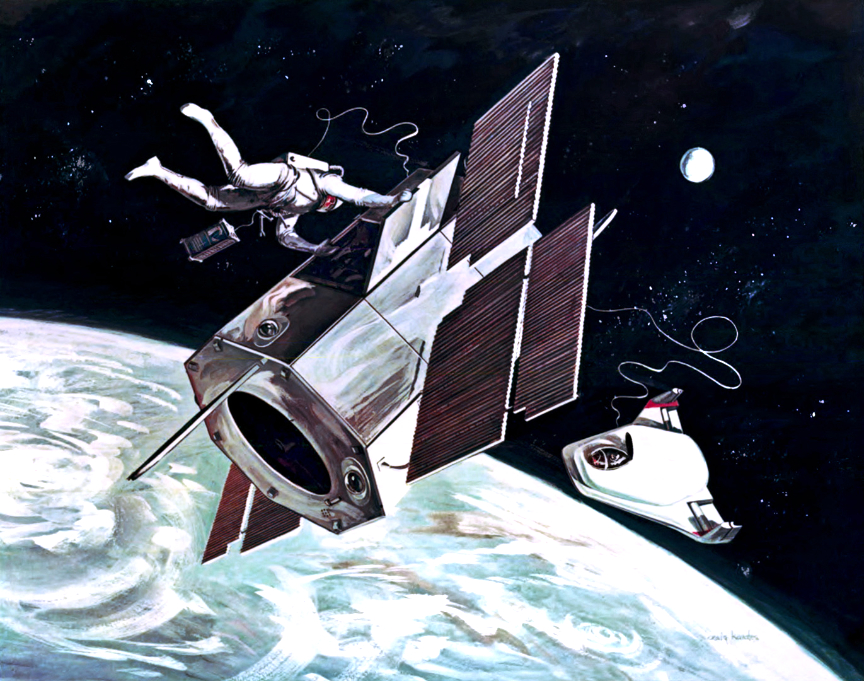
An astronaut tethered to a small, white, winged spacecraft has opened a panel on a a future OAO satellite. The blue-green limb of Earth, a bright gibbous Moon, and a starry sky make up the background. This mid-1960s illustration shows an astronaut servicing a future OAO satellite. Astronauts made orbital repairs to Skylab, NASA’s first space station, in 1973 and to the Solar Maximum Mission satellite in 1984. But the vision illustrated here found its ultimate realization with the five successful missions to service and upgrade NASA’s Hubble Space Telescope from 1993 to 2009. Credit: NASA

The X-ray experiment aboard Copernicus was led by Robert Boyd at University College London, and the three telescopes experienced significant challenges. Longer-wavelength detectors were swamped by an unexpectedly high level of background radiation. It proved to come from a vast comet-shaped cloud of hydrogen atoms surrounding Earth, called the geocorona, that scatters far-ultraviolet sunlight. Later instruments added a filter tuned to absorb the UV but let X-rays pass through.

In June 1973, scientists at Goddard noticed a problem with a shutter in the X-ray telescopes. The device was used to periodically block X-rays from reaching the detector so scientists could track the changing background radiation from charged particles in different parts of the orbit. Now its operation had become hesitant. Concerned that the shutter might remain permanently in the closed position, the instrument team had decided to stop using it. But a final command made it through – and the sticky shutter stuck closed, blinding the instruments.

A fourth detector unattached to a telescope continued working for the duration of the mission. This X-ray counter measured radiation from 1 to 3 angstroms over a wide field of view – 2.5 by 3.5 degrees, about 40 times the apparent area of a full Moon.

The X-ray experiment discovered several long-period pulsars, including X Persei. Pulsars – typically, spinning neutron stars – swing a beam of radiation in our direction each time they rotate, usually at tens to thousands of times a second. Oddly, the X Persei pulsar takes a leisurely 14 minutes per spin.

Copernicus performed long-term monitoring of pulsars and other bright sources, and it observed Nova Cygni 1975, an explosion on the white dwarf in a close binary system. The experiment discovered curious dips in X-ray absorption at Cygnus X-1, likely caused by cool, dense clumps in the gas flowing away from the star. And the satellite recorded varying X-rays from the black-hole-powered galaxy Centaurus A, located about 12 million light-years away.

Copernicus returned UV and X-ray observations for 8.5 years before its retirement in 1981, and it still orbits Earth today. It departed space astronomy’s center stage as more advanced observatories appeared, notably Einstein and the International Ultraviolet Explorer, which launched in 1978 and operated for nearly 19 years. Copernicus observations appear in more than 650 scientific papers. Its instruments studied some 450 unique objects targeted by more than 160 investigators in the United States and 13 other countries.
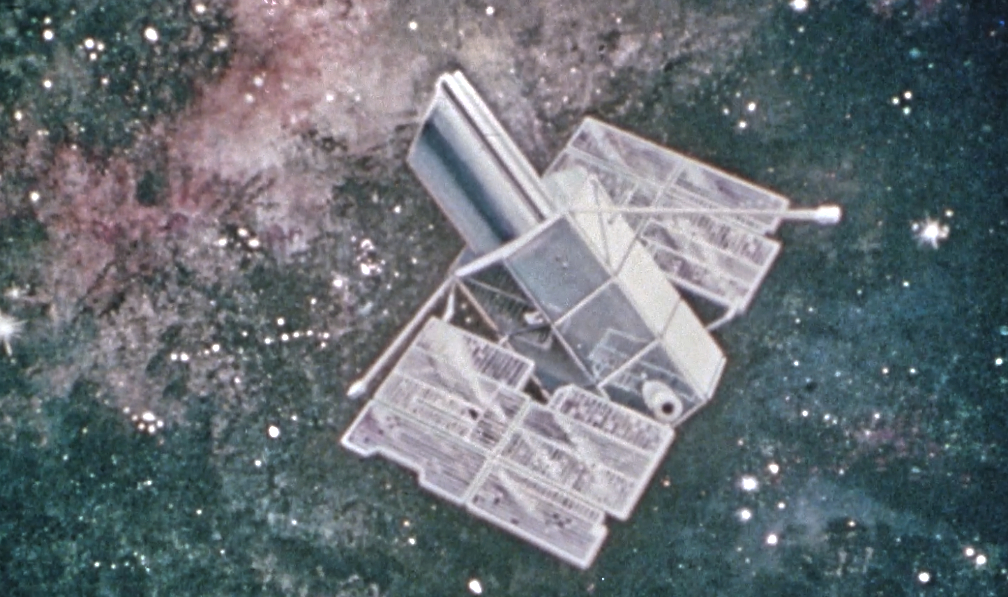
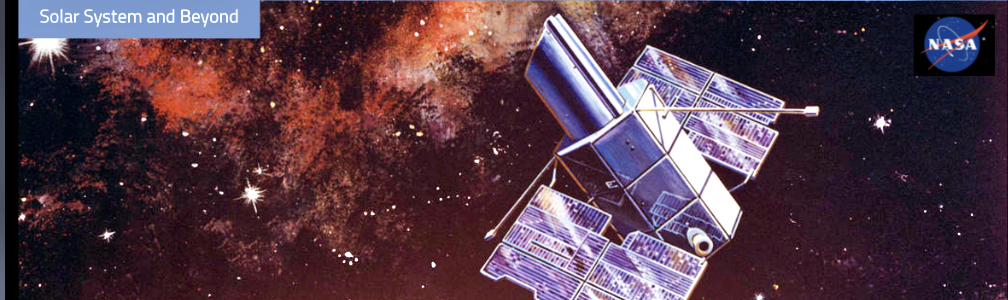
Artistic rendition of Copernicus on-orbit, courtesy of NASA.

Article author: Francis Reddy, NASA’s Goddard Space Flight Center, Greenbelt, Maryland.

Filed Under: Earth Observation & Imaging, Exploration & Science Missions

Primary Sidebar

Coverage

  • Missions & Constellations
  • Business & Finance
  • Military & Defense
  • Launch
  • Software Automation & Ground Systems
  • Government & Regulation
  • Services & Applications

Most Read Stories

  • Global Shift Toward Sovereign Launch Gains Momentum Amid Geopolitical Tensions
  • FCC Authorizes Logos Space to Deploy 3,960-Satellite Mega-Constellation for Enterprise Connectivity
  • SES Executive Confirms End of the 15-Year Satellite Era
  • SpaceX Unveils ‘Stargaze’ System to Revolutionize Space Traffic Management
  • The Space Data Layer is Coming, Just Not as Fast or as Small as You Think

Secondary Sidebar

Footer


Satnews is a leading provider of satellite news, events, publications, research and other satellite industry information in both commercial and military enterprises worldwide.

Stories By Category

  • Business & Finance
  • Government & Regulation
  • Launch
  • Military & Defense
  • Missions & Constellations
  • Services & Applications
  • Software Automation & Ground Systems
  • Spectrum & Licensing
  • Startups & NewSpace Business

About Us

  • Leadership & Editorial Team
  • SatNews History
  • Free Satnews Subscription
  • SatNews Events
  • Magazines

Navigation

  • Latest Stories
  • Magazines
  • Events
  • Contact
  • Cookie & Privacy Policy for Satnews

We use cookies to ensure that we give you the best experience on our website. If you continue to use this site we will assume that you are happy with it.
x
Sign up Now (For Free)
Access daily or weekly satellite news updates covering all aspects of the commercial and military satellite industry.
Invalid email address
Notify Me Regarding ( At least one ):
We value your privacy and will not sell or share your email or other information with any other company. You may also unsubscribe at anytime.

Click Here to see our full privacy policy.
Thanks for subscribing!