


Apollo 11 crew of (left to right) Armstrong, Collins, and Aldrin.
An estimated one million people gathered on the beaches of central Florida to witness first-hand the launch of Apollo 11, while around the world watched the event live on television. Officially named as a crew (https://www.nasa.gov/feature/50-years-ago-n just six months earlier, Commander Neil A. Armstrong, Lunar Module Pilot (LMP) Edwin E. “Buzz” Aldrin, and Command Module were prepared to undertake the historic mission. Previous Apollo crews had tested the spacecraft in Earth orbit and around the earlier, Apollo 10 (https://www.nasa.gov/feature/50-years-ago-apollo-10-clears-the-way-for-the-first-moon-landing) had complete out all the unknowns for the lunar landing. Now it was time to attempt the landing itself.

Apollo 11 crew patch.
The astronauts’ day on July 16, 1969, began with a 4 AM wake-up call from Chief of the Astronaut Office Donald K. “Deke” Slayt prelaunch breakfast with Slayton and backup CMP William A. Anders, the crew members donned their spacesuits and took the A Center’s (KSC) Launch Pad 39A.
Workers in the White Room assisted them into their seats in the Command Module (CM) Columhand couch, Collins into the right, and finally Aldrin into the middle. After the pad workers closed the hatch to the capsule, the a final two hours of the trouble-free countdown. As Armstrong noted just before liftoff, “It’s been a real smooth countdown.”
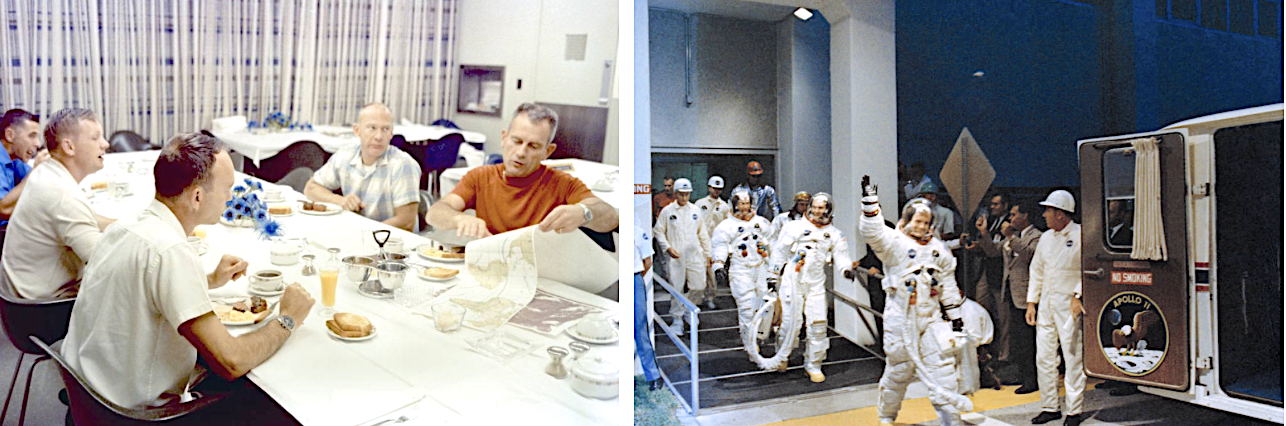
Left: Prelaunch breakfast in crew quarters (left to right) Anders, Armstrong, Collins, Aldrin, and Slayton. Right: Apollo 11 astronauts (left to right) Aldrin, Collins, and Armstrong leaving crew quarters to enter the Astrovan for the ride to Launch Pad 39A.
At precisely 9:32 AM EDT, Apollo 11 lifted off from Launch Pad 39A to begin humanity’s first attempt at a lunar landing. Engineers in KSC’s Firing Room 1 who had managed the countdown handed over control of the flight to the Mission Control Center (MCC) at the Manned Spacecraft Center (MSC), now the Johnson Space Center in Houston, as soon as the rocket cleared the launch tower. In MCC, the Green Team led by Flight Director Clifford E. Charlesworth took over control of the mission.
The Capcom, or capsule communicator, the astronaut in MCC who spoke directly with the crew, during launch was Bruce McCandless. The three stages of the Saturn V performed flawlessly and successfully placed Apollo 11 into low Earth orbit. For the next two and a half hours, as the Apollo spacecraft still attached to its S-IVB third stage orbited the Earth, the astronauts and MCC verified that all systems were functioning properly. McCandless then called up to the crew, “Apollo 11, you’re go for TLI,” the Trans Lunar Injection, the second burn of the third stage engine to send them on their way to the Moon.

Two hours and 44 minutes after liftoff, the third stage engine ignited for the six-minute TLI burn, increasing the spacecraft’s velocity to more than 24,000 miles per hour, enough to escape Earth’s gravity.
Armstrong called down to the ground after the burn, “That Saturn gave us a magnificent ride. It was beautiful.” A little over three hours after launch, and already more than 3,000 miles from Earth, the Command and Service Module (CSM) separated from the spent third stage to begin the transposition and docking maneuver.
Collins flew the CSM Columbia out to a distance of about 100 feet and turned it around to face the now exposed LM Eagle still tucked into the top of the third stage. He slowly guided Columbia to a docking with Eagle, then extracted it from the third stage which was sent on a path past the Moon and into orbit around the Sun. During the maneuver, the spacecraft had traveled another three thousand miles away from Earth.

Left: Flight Director Charlesworth in MCC during Apollo 11 launch. Right: Engineers in KSC’s Firing Room watch the launch after Apollo 11 cleared the launch tower.
Two hours and 44 minutes after liftoff, the third stage engine ignited for the six-minute TLI burn, increasing the spacecraft’s velocity to more than 24,000 miles per hour, enough to escape Earth’s gravity. Armstrong called down to the ground after the burn, “That Saturn gave us a magnificent ride. It was beautiful.” A little over three hours after launch, and already more than 3,000 miles from Earth, the Command and Service Module (CSM) separated from the spent third stage to begin the transposition and docking maneuver. Collins flew the CSM Columbia out to a distance of about 100 feet and turned it around to face the now exposed LM Eagle still tucked into the top of the third stage. He slowly guided Columbia to a docking with Eagle, then extracted it from the third stage which was sent on a path past the Moon and into orbit around the Sun. During the maneuver, the spacecraft had traveled another three thousand miles away from Earth.
During the rest of their first day in space, MCC informed the crew that because the launch and TLI had been so precise, the planned first midcourse correction would not be needed. The astronauts were finally able to remove the spacesuits they’d been wearing since before launch. Armstrong called down with birthday wishes for the state of California (200 years old) and for Dr. George E. Mueller, NASA Associate Administrator for Manned Space Flight (stated as “not that old”). In MCC, Flight Director Eugene F. Kranz’s White Team of controllers took over, with astronaut Charles M. Duke as the new Capcom. The astronauts provided a pleasant surprise with an unscheduled 16-minute color television broadcast, treating viewers on Earth with spectacular scenes of their home planet. They then placed their spacecraft in the Passive Thermal Control (PTC) or barbecue mode, rotating at three revolutions per hour, to evenly distribute temperature extremes. Finally, about 13 hours after launch and a very long day, the crew began its first sleep period, with Apollo 11 about 63,000 miles from Earth.
Overnight, Flight Director Glynn S. Lunney’s Black Team of controllers, with astronaut Ronald E. Evans as Capcom, watched over the spacecraft’s systems. By the time the astronauts awoke, now almost 110,000 miles from Earth, Charlesworth’s Green Team was back on console. Capcom McCandless provided a morning news update to the crew, including a status of the Soviet Luna 15 robotic spacecraft that had launched three days before Apollo 11 and was still on its way to the Moon. About the time Apollo 11 reached the halfway mark in distance between Earth and Moon, the following light-hearted exchange took place between backup Apollo 11 Commander James A. Lovell in MCC and Armstrong aboard Columbia:
Lovell: Is the Commander aboard? This is Jim Lovell calling Apollo 11.
Armstrong: This is the Commander.
Lovell: I was a little worried. This is the backup Commander still standing by. You haven't given me the word yet. Are you Go?
Armstrong: You've lost your chance to take this one, Jim.
Lovell: Okay. I concede.
The crew conducted the only midcourse correction needed during the coast to the Moon, a three-second burn of the Service Propulsion System (SPS) engine to lower the closest point to the Moon from 200 miles to 69 miles. McCandless informed the astronauts that Luna 15 had entered an elliptical orbit around the Moon, but that its objectives were still not clear.

Photographs taken from Apollo 11 showing the receding Earth (left to right) shortly after the transposition and docking maneuver; from 113,000 miles; from 144,300 miles; and from 234,800 miles.
The crew conducted a scheduled TV broadcast from about 150,000 miles, showing views of a much smaller Earth with Armstrong providing a detailed description of the planet. He then turned the camera inside the cabin for views of the astronauts and showing viewers their food pantry, concluding with filming the Apollo 11 mission patch on their flight suits. The broadcast lasted 35 minutes.
The crew soon after settled down for its second night’s sleep in space, which MCC extended since another midcourse correction the next morning was not needed as their trajectory remained very precise.
In Houston, astronaut Frank Borman and Christopher C. Kraft, Director of Flight Crew Operations, held a press conference about Luna 15. NASA managers were concerned that with Luna 15 now in orbit around the Moon and its objectives still not clear, it might interfere in some way with Apollo 11. Borman had visited Moscow earlier in July and met with Academician Mstislav V. Keldysh, President of the Soviet Academy of Sciences. Taking advantage of this new acquaintance, Borman telephoned Keldysh and expressed NASA’s concerns. Keldysh assured Borman that Luna 15 would not interfere with Apollo 11 and in an unprecedented action in American-Soviet space relations he telegraphed Luna 15’s precise orbital parameters to Borman. The Soviets didn’t divulge Luna 15’s true intentions, stating only that it would stay in lunar orbit for two days.
The major activity for Apollo 11’s third day in space was the first activation and inspection of the LM Eagle, which the crew televised to the ground from about 201,000 miles away. Armstrong described the status of the docking mechanism, “Mike must have done a smooth job in that docking. There isn't a dent or a mark on the probe” – a compliment of Collins’ excellent piloting skills. When they opened the hatch to Eagle, the lights came on automatically, prompting Capcom Duke to say, “How about that. Just like the refrigerator.” Aldrin floated into the LM, taking the TV camera with him, and provided viewers with an excellent tour of all of its systems, as well as the astronauts’ spacesuit helmet visors and backpacks. The broadcast lasted one hour and 36 minutes, after which Aldrin and Armstrong returned to Columbia and closed the hatches. Soon after, Apollo 11 passed into the Moon’s gravitational sphere of influence, 214,086 miles from Earth and 38,929 miles from the Moon. The crew settled down for its third sleep period of the flight.
While the crew slept, MCC decided that a planned midcourse correction that day would also not be required and they extended the crew’s rest. Shortly after they woke for their fourth day in space, Apollo 11 crossed into the Moon’s shadow and they could observe the solar corona. They could see the Moon’s surface lit by Earthshine, and for the first time they could see stars and constellations clearly. Capcom astronaut and backup Apollo 11 LMP Fred W. Haise read up the morning news to the crew. An item of interest was that in its reporting of the mission, the Soviet newspaper Pravda called Armstrong the “Czar of The Ship.” The Soviet press was indicating that Luna 15 would accomplish everything that all previous Luna spacecraft had done, the first public hint that it might be trying to return samples from the Moon. Armstrong provided the following description of the Moon, which the astronauts were seeing for the first time:

Three views of the lunar far side. Left: Crater Glazenap. Middle: Crater King. Right: Looking toward the Moon’s limb over the rim of Crater Mendeleev.
The view of the Moon that we've been having recently is really spectacular. It fills about three-quarters of the hatch window, and of course, we can see the entire circumference, even though part of it is in complete shadow and part of it's in Earthshine. It's a view worth the price of the trip.
Shortly after, as Apollo 8 and 10 had done before, Apollo 11 sailed behind the Moon and all contact with Earth was cut off. Eight minutes later, they fired the SPS engine for the six-minute Lunar Orbit Insertion-1 (LOI-1) burn, and Apollo 11 entered into an elliptical lunar orbit.
As Apollo 11 came around from the backside of the Moon, the crew members saw their first Earth rise and Aldrin reported their status to MCC, “The LOI-1 burn just nominal as all get out, and everything's looking good.”

Two views of the Moon from Apollo 11’s first TV broadcast from lunar orbit. Left: The Crater Langrenus. Right: The Mare Fecunditatis.
A few minutes later, the astronauts got their first view of the approach to their landing site in the Sea of Tranquility, which was still in darkness. By the time of the landing the next day, the Sun will have risen at the landing site, the low angle illumination providing optimal lighting for the landing. Of the approach Armstrong commented, “It looks very much like the pictures, but like the difference between watching a real football game and one on TV. There's no substitute for actually being here.”
During their second lunar orbit, the crew televised views of the Moon across much of the near side. At the end of that revolution, and once again behind the Moon, they fired the SPS engine for the 17-second LOI-2 burn to circularize their orbit. Armstrong and Aldrin entered the LM Eagle for the second time to begin activation and transfer of equipment such as cameras. Aldrin reported that he could see the entire landing area as they flew over it. They returned to Columbia and the entire crew settled down for its first sleep period in lunar orbit. It was also their final night before attempting the first Moon landing the next day.
John Uri NASA Johnson Space Center
Last Updated: July 16, 2019
Editor: Kelli Mars
NASA Official: Brian Dunbar
