

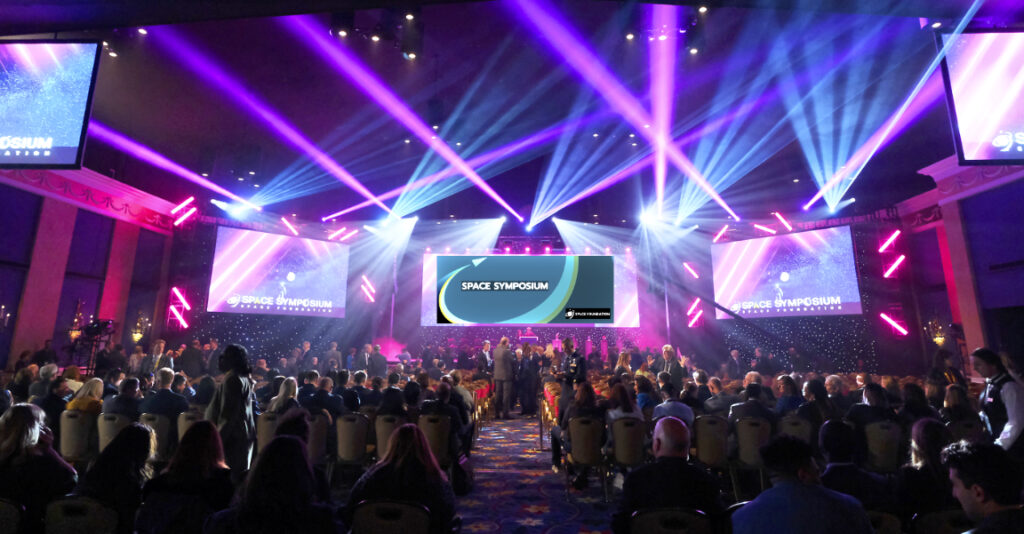
In a shift from traditional exploration-centric agendas, the 41st Space Symposium opened Monday at the Broadmoor in Colorado Springs with a stark focus on the militarization of Earth’s orbits. The gathering of NASA, U.S. Space Force (USSF), and major defense contractors arrives as the Pentagon accelerates the “Golden Dome” missile defense architecture—a $175 billion initiative mandated by Executive Order 14186 to shield the United States from hypersonic and ballistic threats.
Strategic Transition to Combat-Ready Architectures
The symposium serves as the primary forum for the U.S. Department of Defense to signal its transition toward Proliferated Warfighter Space Architecture (PWSA). While past years focused on the Artemis program’s lunar milestones, the 2026 agenda is dominated by the requirement for resilient, low-Earth orbit (LEO) sensor layers capable of tracking “dark” targets.
This strategic pivot follows the successful Artemis II mission, which solidified the lunar transport layer and allowed NASA to refocus on deep-space logistics. However, for the defense giants in attendance—including Lockheed Martin, Northrop Grumman, and Boeing—the immediate priority is the “Golden Dome.” The program office, led by USSF Gen. Michael Guetlein, is currently navigating a $25 billion funding injection from the “One Big Beautiful Bill” Act to deploy space-based interceptors and air-moving-target-indicator satellites.
NASA Budget and Appropriations
Senator Jerry Moran (R-Kan.) signaled a robust defense of NASA’s budget, flatly rejecting the White House’s proposed cuts for Fiscal Year 2027. Moran, who chairs the Senate Appropriations subcommittee responsible for NASA’s funding, emphasized his intention to maintain agency resources at levels consistent with the previous year. His remarks specifically addressed the administration’s request to slash the Science Mission Directorate by nearly 50%—a proposal that space policy experts have described as a potentially devastating blow to American leadership in planetary science and astrophysics.
Senator Moran’s stance highlights a growing bipartisan effort in Congress to provide “continuity and reaffirmation” for the agency following the successful launch of Artemis II earlier this year. During the roundtable, which included NASA Administrator Jared Isaacman and various defense industry leaders, Moran noted that he plans to draft a spending bill that restores funding to key mission areas, particularly science and exploration. By prioritizing a balanced budget, Moran aim to ensure that while the Space Force and Artemis programs expand, critical scientific research and international partnerships—such as the Dragonfly mission to Titan and the NEO Surveyor—remain on schedule despite the current fiscal climate.
Executive Perspective on Superiority
“You have space superiority if you can use space the way you want, and the adversary cannot use space the way they want,” stated Gen. B. Chance Saltzman, Chief of Space Operations. “We are moving beyond the status quo of lengthy requirements to target specific mission outcomes that can sense, decide, and act at machine speeds.”
Industrial Base Diversification
A significant theme of the 2026 summit is the “Anyone but Musk” doctrine, as the Department of Defense seeks to foster a secondary industrial base. Following the public 2025 fallout between the administration and SpaceX, Amazon’s Project Kuiper has emerged as a key participant in the Golden Dome’s hybrid space architecture.
Amazon is reportedly developing an optical backplane intended to bridge the communication gap between disparate military constellations. This comes as the U.S. Naval Research Laboratory (NRL) prepares to demonstrate robotic satellite servicing capabilities later this week, aimed at extending the lifespan of high-value national security assets already in orbit.
Integration and Deployment
The Pentagon is facing pressure to demonstrate “Golden Dome” capabilities before 2029. While Lockheed Martin is set to open its first dedicated production plant for the Next Generation Interceptor later this year, technical hurdles remain regarding the SDA’s ability to synchronize optical links between different vendors. The symposium is expected to conclude with the release of a refined spending plan that will distribute the next phase of sensor funding to commercial partners by late Q3 2026.
