

Chris Forrester — The giant Barcelona Mobile World Congress was this year as buoyant and spectacular as ever with some 100,000 delegates filling the show’s aisles and occupying hotel rooms for miles around. Normally the headliners are drawn from Europe’s telcos and while the key speakers might be known in their local markets, their names tend not to extend beyond their local border. But this year that all changed.
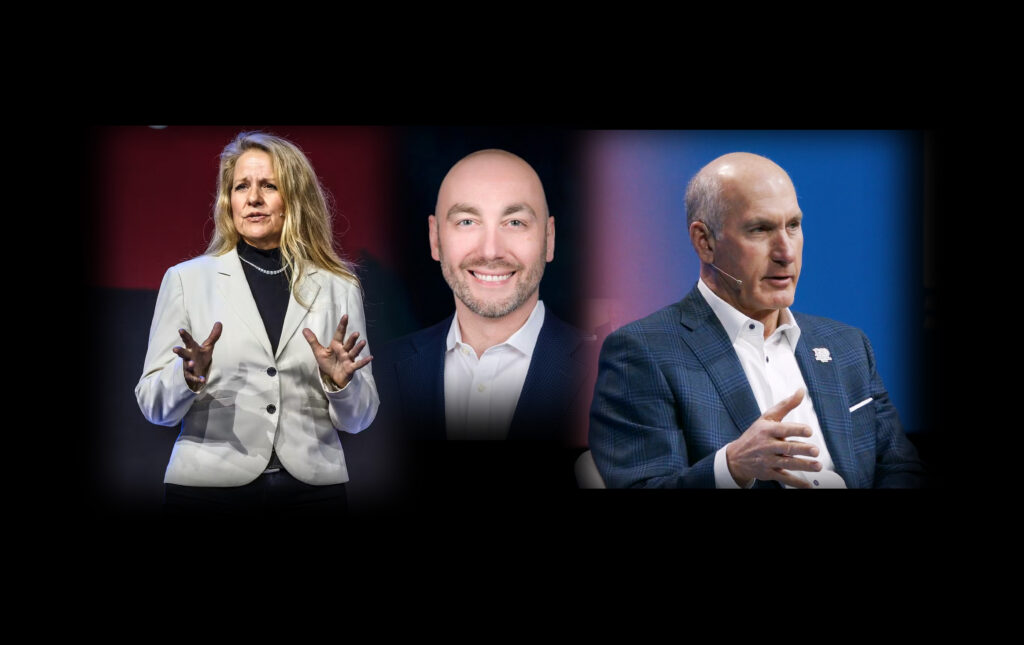
Top of the list and speaking on the main stages were SpaceX’s president and COO Gwynne Shotwell, AT&T’s Chairman & CEO John Stankey and AST SpaceMobile’s (AST) Scott Wisniewski. ‘Breaking Bad’ star Aaron Paul delivered a slice of Hollywood glamour to help the event’s headlines. The other major sat-companies were in the halls including SES, Eutelsat, Viasat and Iridium to name just a few, but while Shotwell and Wisniewski were much too polite to criticise each other’s offerings, it was very clear that they were pitching ferociously to the assembled thousands.
Indeed, the show’s focus was almost completely focussed on Direct-to-Consumer (and with a dash of AI). AT&T’s Stankey addressed the future for cellular and the prospects for 5G but he was equally bullish about the prospects for satellite as part of the telco’s portfolio.
“One of the things that’s oftentimes brushed over is what 5G did in the consumer space to make more effective use of spectral efficiency, and what that did in opening up new markets for just simple things like fixed broadband that has driven an awful lot of innovation, both in the consumer market and in the backup business and primary for business customers,” Stankey told delegates.
Stankey used his session to deliberately back satellite as part of AT&T’s next frontier, touting its potential as “one of those great moments of innovation for the consumer, for businesses, and for the industry. It is clearly going to open up some uncharted territory that we’re all going to have to work our way through. But I think the promise of it is just so amazing,” Stankey said. “We should all be thinking about how do we bring that promise to our customers? And I can think of no group of companies that are probably better positioned to figure out how to do that than the ones that already have significant relationships with our customers.”
AT&T’s relationship, as is well-known, is with AST SpaceMobile, but he cautioned against one size fitting all. “There should be multiple constellations in the sky, not one. And I think that to the extent that all of us manage our businesses and think about it that way, that will be an outcome that allows us to make sure we do things the way that we can continue to have a role with the customer moving forward,” Stankey added.
AST’s Scott Wisniewski echoed those sentiments although probably not showing quite the same degree of enthusiasm for Stankey’s ‘multiple constellations’ comment. Wisniewski’s presentation clashed with AST’s end-of-year results statement, but he explained that AST had managed a well-diversified set of initial gateway deliveries across nine different customers across five continents, which starts to paint the picture of its initial commercial markets in the US, Canada, Europe, Japan, the Middle East, and Africa.
In terms of signing contracts, the major customer deals for 2025 were definitive commercial agreements with Verizon and STC Group, joining AT&T and Vodafone. “We continue to see heavy engagement from MNOs, resulting in good progress deepening and growing our partner ecosystem, taking advantage of our base of over 50 global MNOs with nearly 3 billion subscribers,” he explained.
“Looking ahead to 2027, with a large-scale constellation in orbit, we see a really, really strong outlook for both commercial and government service revenue. 2027 will be the first full-year impact of commercial service revenue, as the AST cellular broadband service becomes available in some of the best markets worldwide to hundreds of millions of subscribers via a low-friction service offering provided when the subscriber needs it most,” he suggested.
However, perhaps the star turn – and not to be outdone by anyone – was SpaceX’s Gwynne Shotwell (President & COO). She showcased her company’s new name for Starlink’s Direct-to-Device offering. The new name – hardly a surprise – is Starlink Mobile. The aim is to deliver 5G speeds to mobile devices anywhere in the world. The technology will work within homes, offices and shops, it is claimed.
Her presentation highlighted the massive engineering leap from the first to the second generation of satellite mobile connectivity from Starlink. This evolution relies heavily on the globally harmonised S-band satellite spectrum. SpaceX acquired spectrum rights – from EchoStar subject to regulatory approval – last year and plans to scale them globally to offer a consistent level of service everywhere.
Her presentation began with the story of Starlink’s massive achieved by deploying the entire first generation of 650 satellites in just 18 months. The resulting network already supports 16 million unique users and 10 million active monthly users. To optimize connection quality and ensure space safety, this constellation flies at a low altitude of 350 kms.
Building on this orbital foundation the company is preparing a major technological upgrade to deliver true broadband directly to unmodified smartphones, it is claimed. These new second-generation satellites feature a phased array antenna five times larger than the previous version. This creates a smaller spot beam on the ground and allows for 16-times the number of beams per satellite, say the engineers.
This structural upgrade delivers nearly 100 times the data density and 20 times the overall link performance. The satellites will also feature four times the bandwidth per beam using 20 by 20 MHz beams. This enables claimed download speeds up to 150 megabits per second in ideal conditions. Furthermore, each individual satellite will handle over 100 gigabits on download and 50 gigabits on upload. This makes their capacity comparable to the dedicated Starlink broadband satellites flying today.
To launch these massive new satellites efficiently, SpaceX will rely entirely on its next-generation Starship. This fully reusable rocket is the absolute key to deploying the upgraded network quickly, but while there have been plenty of test flights, SpaceX is depending on very frequent flights of Starship and successful landings of the massive rocket.
Shotwell listed her existing partner telcos and said that new partner announcements in Mexico and Costa Rica were pending. There are more than 32 countries signed up for Starlink Mobile, covering some 1.7 billion people. However, it has emerged that Starlink Mobile’s new system would not fully work with current smart phones, and it would take around 2 years for the industry to catch up with new chipsets. Elon Musk, speaking away from Barcelona, said of Starlink Mobile: “It will allow SpaceX delivery high bandwidth connectivity directly from the satellites to the phone. But there are hardware changes that need to happen in the phones since these frequencies aren’t supported in current phones— the chipset needs to be modified to add these frequencies. That is probably a two-year timeframe.”
In other words, for Starlink Mobile’s full 5G service it is still ‘jam tomorrow’ and something of a wait for consumers to fully get their hands on the technology. Meanwhile, Musk and Shotwell have a probable IPO to focus on. Stankey will be super-ready to add a new tier to AT&T’s pricing models. But AST is ready to launch services – once it gets 45-60 more satellites into orbit, that is. Whether Starlink’s massive lead in the market, the hare in this two-company race, will be caught by the tortoise in the shape of AST SpaceMobile, only time will tell. Of course, Amazon LEO might just disturb both SpaceX and AST. By Mobile World Congress 2027 the industry might have better answers.
