

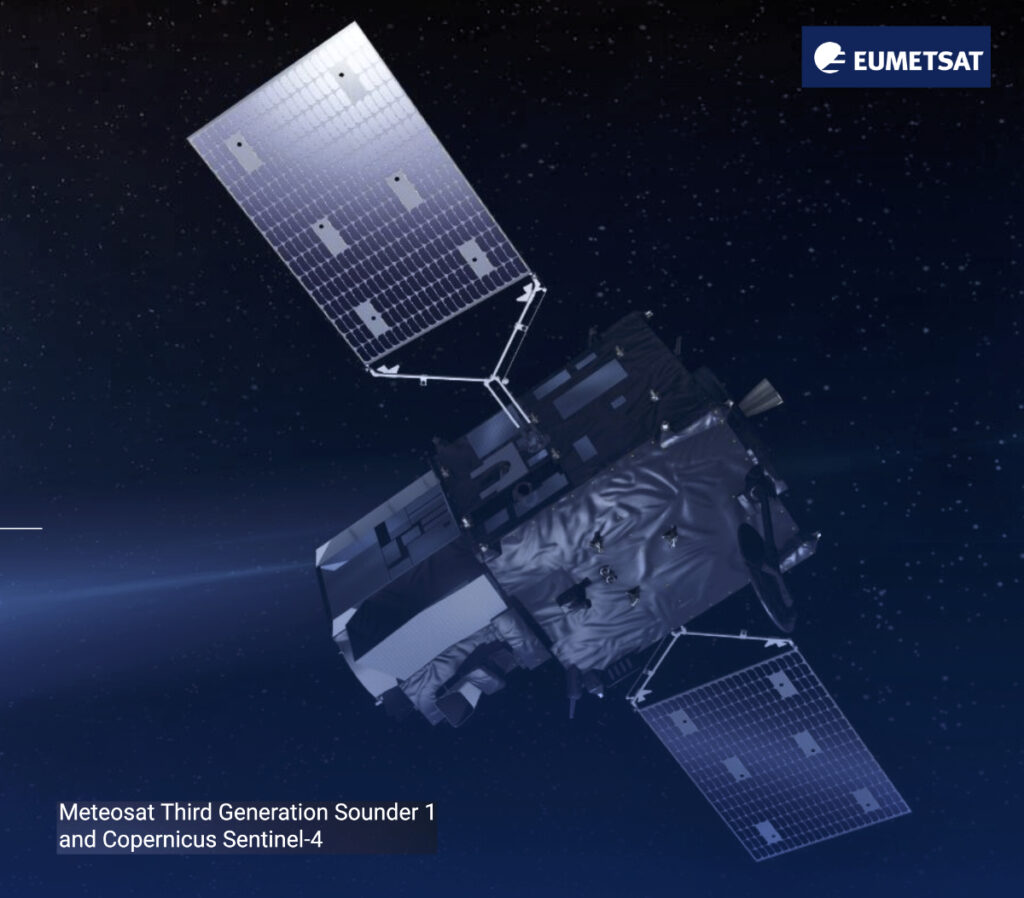
The new Copernicus Sentinel-4 mission has delivered its first images, highlighting concentrations of atmospheric nitrogen dioxide, sulphur dioxide and ozone.
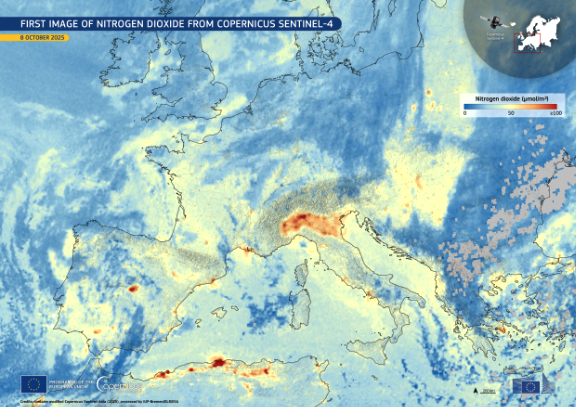
courtesy of the Copernicus program of the European Union
This image, based on the Sentinel-4’s first measurements that were acquired on October 8, 2025, depicts tropospheric nitrogen dioxide with clear pollution hotspots visible along the Mediterranean coast and over Italy’s Po Valley.
As a major air pollutant released during the combustion of fossil fuels, such as in vehicle engines, power plants and heating systems, concentrations of nitrogen dioxide can change rapidly. It is toxic on its own and also contributes to the formation of secondary pollutants like ozone and particulate matter both of which have serious impacts on human health and the environment.
Despite being preliminary, these images mark a major milestone in Europe’s ability to monitor air quality all the way from geostationary orbit (GEO), 36,000 kilometers above Earth.
Air pollution is one of Europe’s most pressing environmental and public health challenges. To ensure the continued growth of Copernicus Earth Observation (EO) data and services, the European Commission is expanding the Copernicus constellation with new satellite missions in 2024 and 2025.
Copernicus Sentinel-4 is Europe’s first geostationary air quality monitoring mission, providing hourly, high-resolution data on pollutants such as ozone (O₃), nitrogen dioxide (NO₂), formaldehyde (HCHO), and sulphur dioxide (SO₂).
Unlike previous Sentinel missions, Sentinel-4 does not rely on its own spacecraft but is a hosted payload aboard EUMETSAT’s MTG-Sounder satellite, operating alongside the Infrared Sounder (IRS) instrument. This innovative and efficient, “one satellite, two missions” approach allows for continuous air quality monitoring alongside meteorological observations, delivering crucial atmospheric composition data to improve pollution forecasting, support policy initiatives, and contribute to efforts to mitigate pollution-related health risks.
