

• Skip to primary navigation
  • Skip to main content
  • Skip to primary sidebar
  • Skip to secondary sidebar
  • Skip to footer
  • NEWS:
  • SatNews
  • SatMagazine
  • MilSatMagazine
  • SmallSat News
  • |     EVENTS:
  • SmallSat Symposium
  • Satellite Innovation
  • MilSat Symposium
  • SmallSat Europe

SatNews

Satellite Industry Intelligence Since 1983

Subscribe
  • LATEST
  • Missions & Constellations
    • Exploration & Science Missions
    • In-Orbit Servicing & Orbital Operations
    • LEO Constellations
    • Mission Autonomy & Onboard Systems
    • Mission Deployments & Manifests
    • Navigation & PNT
    • SmallSat
    • Spacecraft & Payload Technology
    View All in Missions & Constellations →
    Voyager Technologies Executes Strategic Investment in Max Space Expandable Habitat ArchitectureVoyager Technologies Executes Strategic Investment in Max Space Expandable Habitat Architecture
    Titans of LEO in a Heavenly Price battleTitans of LEO in a Heavenly Price battle
    Satellite Connectivity in a Post Capacity EraSatellite Connectivity in a Post Capacity Era
    MTN Launches Click-to-Deploy StarEdge Horizon Satellite Service on AWS MarketplaceMTN Launches Click-to-Deploy StarEdge Horizon Satellite Service on AWS Marketplace
  • Business
    • Contracts & Commercial Deals
    • Earnings & Financial Reporting
    • Events & Conferences
    • Funding & Venture Capital
    • Market Forecasts
    • Mergers & Acquisitions
    • Personnel Moves & Appointments
    View All in Business & Finance →
    Air Force Triples AEHF Terminal Contract Ceiling to Nearly $3 BillionAir Force Triples AEHF Terminal Contract Ceiling to Nearly $3 Billion
    York Space Systems Acquires Orbion Space Technology to Deepen Vertical Integration for SDA ConstellationsYork Space Systems Acquires Orbion Space Technology to Deepen Vertical Integration for SDA Constellations
    Rheinmetall Withdraws From Mynaric Bidding Process; Rocket Lab Acquisition Clears Major Competitive HurdleRheinmetall Withdraws From Mynaric Bidding Process; Rocket Lab Acquisition Clears Major Competitive Hurdle
    MTN Launches Click-to-Deploy StarEdge Horizon Satellite Service on AWS MarketplaceMTN Launches Click-to-Deploy StarEdge Horizon Satellite Service on AWS Marketplace
  • Defense
    • Counterspace & ASAT
    • Defense Budgets & Procurement
    • ISR & Reconnaissance
    • MILSATCOM
    • Missile Warning & Defense
    • National Security Programs
    • Space Domain Awareness
    View All in Military & Defense →
    Air Force Triples AEHF Terminal Contract Ceiling to Nearly $3 BillionAir Force Triples AEHF Terminal Contract Ceiling to Nearly $3 Billion
    Your Teleport Can’t Dodge a MissileYour Teleport Can’t Dodge a Missile
    BAE Systems Completes Preliminary Design Review for $1.2 Billion Space Force Epoch 2 ProgramBAE Systems Completes Preliminary Design Review for $1.2 Billion Space Force Epoch 2 Program
    Guardians in the Kill Chain: How the Space Force Led the Opening Salvo of Operation Epic FuryGuardians in the Kill Chain: How the Space Force Led the Opening Salvo of Operation Epic Fury
  • Gov
    • Export Controls & Compliance
    • International Space Agreements
    • National Space Policy
    • Space Law & Treaties
    • Space Sustainability & Debris Policy
    • Space Traffic Management / Debris Removal
    View All in Government & Regulation →
    Saying Goodbye to the ISS, and Hello to the Orbital Tenancy Trap Saying Goodbye to the ISS, and Hello to the Orbital Tenancy Trap 
    FAA Rescinds Proposed Orbital Debris Rule Amid Industry Pressure and Regulatory ReassessmentFAA Rescinds Proposed Orbital Debris Rule Amid Industry Pressure and Regulatory Reassessment
    The Iran Precedent: Operation Epic Fury and the Law of Armed Conflict in SpaceThe Iran Precedent: Operation Epic Fury and the Law of Armed Conflict in Space
    Geopolitical Scrutiny: The Strategic Implications of APT Satellite’s Chinese State OwnershipGeopolitical Scrutiny: The Strategic Implications of APT Satellite’s Chinese State Ownership
  • Launch
    • Launch Providers
    • Launch Schedule & Calendars
    • Launch Sites & Infrastructure
    • Rocket Technology & Vehicles
    View All in Launch →
    Firefly Aerospace Returns to Flight with Successful “Stairway to Seven” MissionFirefly Aerospace Returns to Flight with Successful “Stairway to Seven” Mission
    SpaceX Evolves Beyond Broadband with “Million-Satellite” AI Data Center Plan; Amazon Mounts Legal ChallengeSpaceX Evolves Beyond Broadband with “Million-Satellite” AI Data Center Plan; Amazon Mounts Legal Challenge
    Times Microwave Systems Launches Levitate™ Ultra-Lightweight Cables for UAV and Defense AvionicsTimes Microwave Systems Launches Levitate™ Ultra-Lightweight Cables for UAV and Defense Avionics
    Blue Origin Accelerates New Glenn 9×4 Production and TeraWave Constellation DevelopmentBlue Origin Accelerates New Glenn 9×4 Production and TeraWave Constellation Development
  • Software
    • Autonomous Ground Operations
    • Data Processing & AI/ML
    • Digital Twins & Modeling
    • Ground Segment & Teleports
    • Mission Planning & Simulation
    • Space Systems Software Engineering
    • Spectrum & Licensing
    View All in Software Automation & Ground Systems →
    Your Teleport Can’t Dodge a MissileYour Teleport Can’t Dodge a Missile
    Missile Strike Targets Strategic SES Ha’Ela Teleport in Central IsraelMissile Strike Targets Strategic SES Ha’Ela Teleport in Central Israel
    ATLAS Space Operations Establishes South Pacific Hub with New Ground Station in American SamoaATLAS Space Operations Establishes South Pacific Hub with New Ground Station in American Samoa
    Danish Army Selects BAE Systems OneArc for 7-Year Simulation Modernization ProgramDanish Army Selects BAE Systems OneArc for 7-Year Simulation Modernization Program
  • Services & Apps
    • Climate & Environmental Monitoring
    • Disaster Response & Security Mapping
    • Earth Observation & Imaging
    • Maritime & Aviation Satcom
    • Satellite Communications
    View All in Services & Applications →
    Your Teleport Can’t Dodge a MissileYour Teleport Can’t Dodge a Missile
    Jazz Secures Industry-Leading 190 MHz in Pakistan’s Landmark $507M 5G Spectrum AuctionJazz Secures Industry-Leading 190 MHz in Pakistan’s Landmark $507M 5G Spectrum Auction
    Spring Forward: Legacy Operators Are Killing GEO. That’s the Plan.Spring Forward: Legacy Operators Are Killing GEO. That’s the Plan.
    Synthetic Aperture Radar as the Modern Backbone of Maritime Domain AwarenessSynthetic Aperture Radar as the Modern Backbone of Maritime Domain Awareness
  • SatNews Events
  • Magazines
  • Calendar
  • Jobs

Aerojet Rocketdyne’s SLS propulsion systems successfully debut in Artemis I mission

November 22, 2022

Powering NASA’s Space Launch System
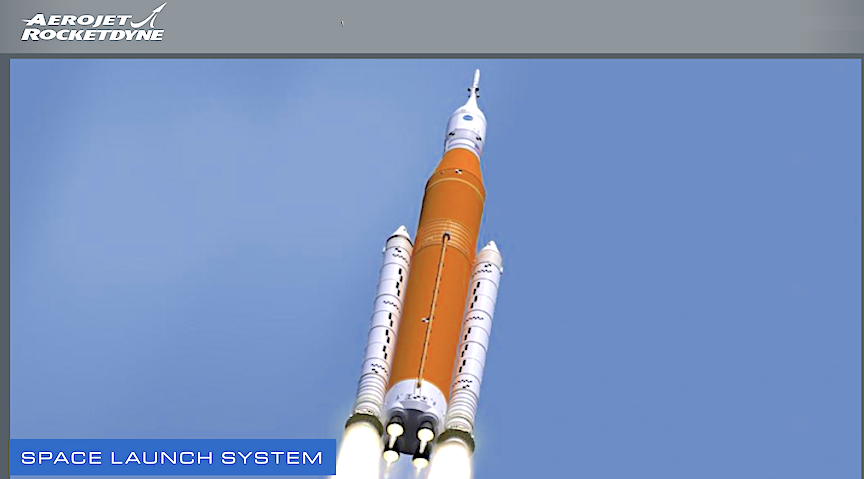
NASA’s Space Launch System (SLS), America’s next-generation heavy-lift rocket, is powered by Aerojet Rocketdyne. Our propulsion plays a critical role in SLS’s ability to successfully launch the heaviest, largest, and most valuable payloads, including the Orion spacecraft, to deep space.

Aerojet Rocketdyne played a central role in “enabling humanity’s next giant leap” with the successful launch of NASA’s super-heavy lift Space Launch System (SLS) exploration rocket. The company provided critical elements to the Artemis I mission with propulsion on both the SLS rocket and the uncrewed Orion spacecraft.

“All of our propulsion systems, including the SLS first- and second-stage engines, performed magnificently today,” said Eileen P. Drake, Aerojet Rocketdyne CEO and president. “I want to offer my heartfelt congratulations to NASA for bringing the world’s most powerful rocket into service and look forward to the successful completion of the Artemis I mission.”
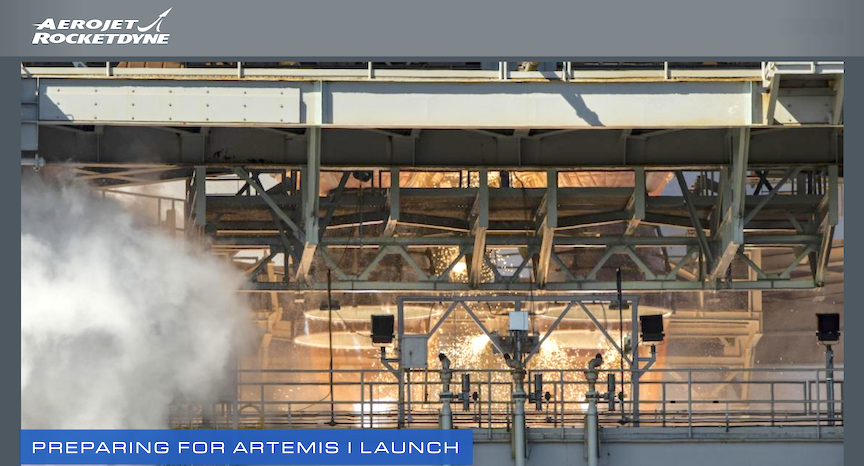
In total, Aerojet Rocketdyne provided 39 propulsive elements for the Artemis I mission (38 liquid engines and one solid rocket motor), as well as 14 high pressure tanks.

Artemis I is the first in a series of missions that will lead to the return of astronauts — including the first woman and first person of color — to the lunar surface and establish a sustained human presence on and around the Moon. During the 25-day Artemis I mission, Orion will enter into a lunar distant retrograde orbit before returning to Earth and splashing down in the Pacific Ocean for recovery.
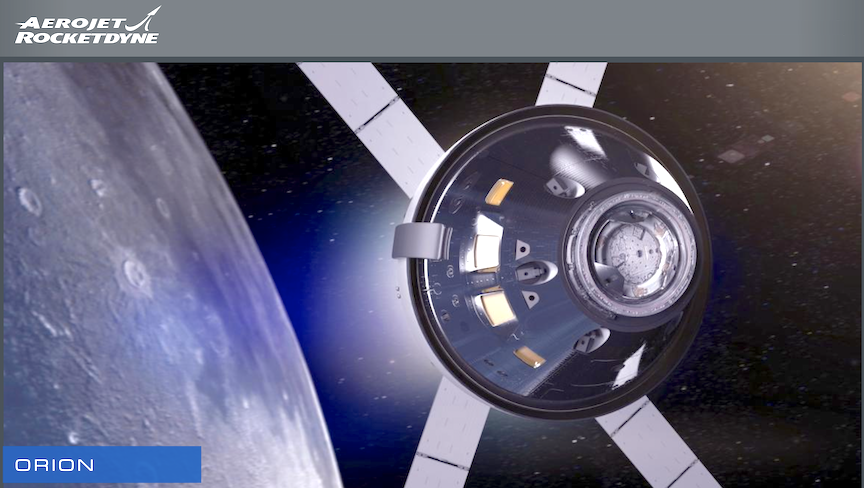
Safely carrying humans to deep space
NASA’s Orion spacecraft will be capable of taking crews to deep space destinations and returning them safely to Earth. Launched on NASA’s new Space Launch System (SLS) heavy-lift rocket, Orion is designed to carry people farther into space for longer periods of time than ever before, withstanding higher levels of radiation and re-entry speeds than any previous human-rated spacecraft.

SLS and Orion are the foundational elements for the Artemis missions, which will help pave the way for human missions to Mars. Both systems rely on Aerojet Rocketdyne propulsion, continuing the company’s rich legacy of supporting NASA’s human spaceflight endeavors, including the Apollo, Space Shuttle and International Space Station programs.

The Artemis era got underway in earnest in the early morning hours when the rocket’s four shuttle-derived RS-25 core-stage engines, built and upgraded by Aerojet Rocketdyne, roared to life, helping the massive SLS rocket lift off from Launch Complex 39B. The liquid oxygen and liquid hydrogen-powered engines, generating 500,000 pounds of thrust each, performed flawlessly during their prescribed burn of 8 minutes and 2 seconds.
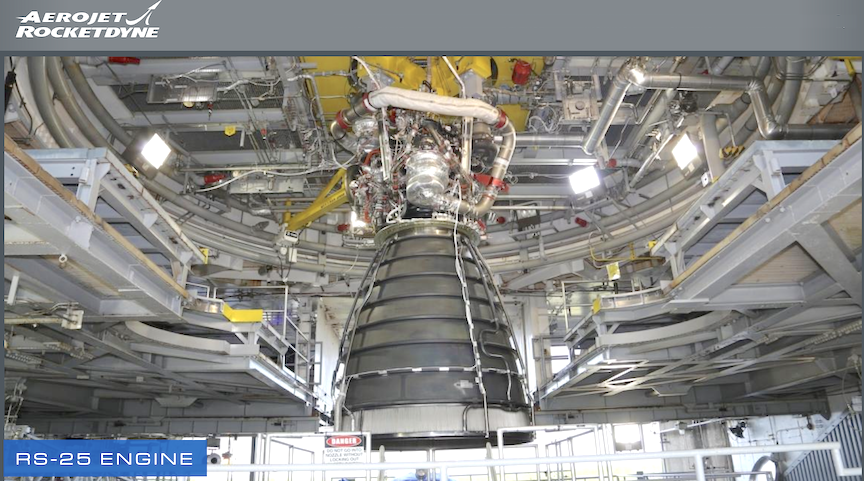
Powering Deep Space Exploration
Aerojet Rocketdyne is the prime contractor for the flight proven, high-performance RS-25 engines used to propel America’s next-generation heavy lift launch vehicle, NASA’s Space Launch System (SLS). Four RS-25 engines located at the bottom of the core stage will power the rocket on its eight and a half minute climb to space with more than 2 million pounds of thrust.

Not quite halfway through that burn, and shortly after separation of the SLS’s twin solid rocket boosters, the Orion Launch Abort System’s (LAS) Jettison Motor ignited. Generating 40,000 pounds of thrust, the Jettison Motor separated the LAS from Orion, allowing the spacecraft to continue its journey into space. The Jettison Motor is the only LAS motor that fires in both successful launch and abort scenarios.

Following core stage separation and a roughly 40-minute coast phase, the SLS’s Interim Cryogenic Propulsion Stage (ICPS), powered by an Aerojet Rocketdyne-built RL10B-2 engine generating 24,750 pounds of thrust, took over, performing the first of two planned burns to put Orion in a stable orbit above Earth. The RL10, variants of which have been flying since the 1960s, is the world’s most reliable upper-stage engine and is used for multiple government and commercial missions. The ICPS also features 12 Aerojet Rocketdyne-built MR-106 reaction control system thrusters providing pitch, yaw and roll control for the upper stage, as well as settling burns. Eight composite overwrapped pressure vessels (COPVs) produced by Aerojet Rocketdyne’s ARDÉ subsidiary also support operation of the stage.

The second ICPS firing occurred about an hour and a half after liftoff and lasted for about 18 minutes, propelling Orion out of Earth’s orbit and on its way to cislunar space. After another brief coast period, the SLS portion of the mission came to an end as Orion and its service module separated from the ICPS to continue on toward the Moon.

As it continues its journey, Orion, built by Lockheed Martin, will rely on Aerojet Rocketdyne propulsion systems for maneuvering and orientation. On the Orion service module, Aerojet Rocketdyne provides the Orion Main Engine, which is a 6,000 pounds of thrust engine derived from the Space Shuttle’s Orbital Maneuvering System and eight 100 pounds of thrust auxiliary engines with heritage back to Apollo. On the crew module, Aerojet Rocketdyne provides twelve 160 pounds of thrust reaction control thrusters that will control the crew module’s orientation for re-entry into Earth’s atmosphere.

Upon splashdown, Orion will deploy its self-righting flotation system which will be inflated with helium stored in five COPVs. This system will enable crews on future missions, beginning with Artemis II, to safely exit Orion after splashdown. ARDÉ also supplied a single nitrogen tank that pressurized Orion’s crew module.

The Artemis I mission is a national effort with contributions from Aerojet Rocketdyne sites located in Los Angeles, California; Sacramento, California; Redmond, Washington; West Palm Beach, Florida; Stennis, Mississippi; Carlstadt, New Jersey; Huntsville, Alabama; Orange, Virginia; Camden, Arkansas; and small and large Aerojet Rocketdyne suppliers in more than 40 states.

Filed Under: Contracts & Commercial Deals, Exploration & Science Missions

Primary Sidebar

Coverage

  • Missions & Constellations
  • Business & Finance
  • Military & Defense
  • Launch
  • Software Automation & Ground Systems
  • Government & Regulation
  • Services & Applications

Most Read Stories

  • Global Shift Toward Sovereign Launch Gains Momentum Amid Geopolitical Tensions
  • SpaceX Unveils ‘Stargaze’ System to Revolutionize Space Traffic Management
  • AST SpaceMobile Encapsulates BlueBird 7 Satellite for Inaugural New Glenn Mission
  • SpaceX Prepares for Record-Breaking $1.75 Trillion Confidential IPO Filing in March
  • Bidding War Intensifies for Mynaric as Rheinmetall Challenges Rocket Lab Acquisition

Secondary Sidebar

Footer


Satnews is a leading provider of satellite news, events, publications, research and other satellite industry information in both commercial and military enterprises worldwide.

Stories By Category

  • Business & Finance
  • Government & Regulation
  • Launch
  • Military & Defense
  • Missions & Constellations
  • Services & Applications
  • Software Automation & Ground Systems
  • Spectrum & Licensing
  • Startups & NewSpace Business

About Us

  • Leadership & Editorial Team
  • SatNews History
  • Free Satnews Subscription
  • SatNews Events
  • Magazines

Navigation

  • Latest Stories
  • Magazines
  • Events
  • Contact
  • Cookie & Privacy Policy for Satnews

We use cookies to ensure that we give you the best experience on our website. If you continue to use this site we will assume that you are happy with it.
x
Sign up Now (For Free)
Access daily or weekly satellite news updates covering all aspects of the commercial and military satellite industry.
Invalid email address
Notify Me Regarding ( At least one ):
We value your privacy and will not sell or share your email or other information with any other company. You may also unsubscribe at anytime.

Click Here to see our full privacy policy.
Thanks for subscribing!