


• Skip to primary navigation
  • Skip to main content
  • Skip to primary sidebar
  • Skip to secondary sidebar
  • Skip to footer
  • NEWS:
  • SatNews
  • SatMagazine
  • MilSatMagazine
  • SmallSat News
  • |     EVENTS:
  • SmallSat Symposium
  • Satellite Innovation
  • MilSat Symposium
  • SmallSat Europe

SatNews

Satellite Industry Intelligence Since 1983

Subscribe
  • LATEST
  • Missions & Constellations
    • Exploration & Science Missions
    • In-Orbit Servicing & Orbital Operations
    • LEO Constellations
    • Mission Autonomy & Onboard Systems
    • Mission Deployments & Manifests
    • Navigation & PNT
    • SmallSat
    • Spacecraft & Payload Technology
    View All in Missions & Constellations →
    Lynk Global Files for FCC Experimental License to Test Multi-Orbit D2D RelayLynk Global Files for FCC Experimental License to Test Multi-Orbit D2D Relay
    Hanwha Re-Enters KAI Shareholder Registry to Accelerate ‘Korean SpaceX’ StrategyHanwha Re-Enters KAI Shareholder Registry to Accelerate ‘Korean SpaceX’ Strategy
    Voyager Technologies Executes Strategic Investment in Max Space Expandable Habitat ArchitectureVoyager Technologies Executes Strategic Investment in Max Space Expandable Habitat Architecture
    Titans of LEO in a Heavenly Price battleTitans of LEO in a Heavenly Price battle
  • Business
    • Contracts & Commercial Deals
    • Earnings & Financial Reporting
    • Events & Conferences
    • Funding & Venture Capital
    • Market Forecasts
    • Mergers & Acquisitions
    • Personnel Moves & Appointments
    View All in Business & Finance →
    Nigus and Elmirate Partner on $200 Million Defense and Satellite Manufacturing Initiative in NigeriaNigus and Elmirate Partner on $200 Million Defense and Satellite Manufacturing Initiative in Nigeria
    Rheinmetall Walked Away. Germany Should Take the Hint.Rheinmetall Walked Away. Germany Should Take the Hint.
    Lynk Global Files for FCC Experimental License to Test Multi-Orbit D2D RelayLynk Global Files for FCC Experimental License to Test Multi-Orbit D2D Relay
    MDA Space Completes $300 Million U.S. IPO and NYSE Dual-ListingMDA Space Completes $300 Million U.S. IPO and NYSE Dual-Listing
  • Defense
    • Counterspace & ASAT
    • Defense Budgets & Procurement
    • ISR & Reconnaissance
    • MILSATCOM
    • Missile Warning & Defense
    • National Security Programs
    • Space Domain Awareness
    View All in Military & Defense →
    Rheinmetall Walked Away. Germany Should Take the Hint.Rheinmetall Walked Away. Germany Should Take the Hint.
    ICEYE Targets €1 Billion Revenue Threshold as Defense Demand Drives Production ScalingICEYE Targets €1 Billion Revenue Threshold as Defense Demand Drives Production Scaling
    Air Force Triples AEHF Terminal Contract Ceiling to Nearly $3 BillionAir Force Triples AEHF Terminal Contract Ceiling to Nearly $3 Billion
    Your Teleport Can’t Dodge a MissileYour Teleport Can’t Dodge a Missile
  • Gov
    • Export Controls & Compliance
    • International Space Agreements
    • National Space Policy
    • Space Law & Treaties
    • Space Sustainability & Debris Policy
    • Space Traffic Management / Debris Removal
    View All in Government & Regulation →
    Rheinmetall Walked Away. Germany Should Take the Hint.Rheinmetall Walked Away. Germany Should Take the Hint.
    Saying Goodbye to the ISS, and Hello to the Orbital Tenancy Trap Saying Goodbye to the ISS, and Hello to the Orbital Tenancy Trap 
    FAA Rescinds Proposed Orbital Debris Rule Amid Industry Pressure and Regulatory ReassessmentFAA Rescinds Proposed Orbital Debris Rule Amid Industry Pressure and Regulatory Reassessment
    The Iran Precedent: Operation Epic Fury and the Law of Armed Conflict in SpaceThe Iran Precedent: Operation Epic Fury and the Law of Armed Conflict in Space
  • Launch
    • Launch Providers
    • Launch Schedule & Calendars
    • Launch Sites & Infrastructure
    • Rocket Technology & Vehicles
    View All in Launch →
    L3Harris Honors Goddard Centennial with Advances in Nuclear and Electric PropulsionL3Harris Honors Goddard Centennial with Advances in Nuclear and Electric Propulsion
    Firefly Aerospace Returns to Flight with Successful “Stairway to Seven” MissionFirefly Aerospace Returns to Flight with Successful “Stairway to Seven” Mission
    SpaceX Evolves Beyond Broadband with “Million-Satellite” AI Data Center Plan; Amazon Mounts Legal ChallengeSpaceX Evolves Beyond Broadband with “Million-Satellite” AI Data Center Plan; Amazon Mounts Legal Challenge
    Times Microwave Systems Launches Levitate™ Ultra-Lightweight Cables for UAV and Defense AvionicsTimes Microwave Systems Launches Levitate™ Ultra-Lightweight Cables for UAV and Defense Avionics
  • Software
    • Autonomous Ground Operations
    • Data Processing & AI/ML
    • Digital Twins & Modeling
    • Ground Segment & Teleports
    • Mission Planning & Simulation
    • Space Systems Software Engineering
    • Spectrum & Licensing
    View All in Software Automation & Ground Systems →
    Your Teleport Can’t Dodge a MissileYour Teleport Can’t Dodge a Missile
    Missile Strike Targets Strategic SES Ha’Ela Teleport in Central IsraelMissile Strike Targets Strategic SES Ha’Ela Teleport in Central Israel
    ATLAS Space Operations Establishes South Pacific Hub with New Ground Station in American SamoaATLAS Space Operations Establishes South Pacific Hub with New Ground Station in American Samoa
    Danish Army Selects BAE Systems OneArc for 7-Year Simulation Modernization ProgramDanish Army Selects BAE Systems OneArc for 7-Year Simulation Modernization Program
  • Services & Apps
    • Climate & Environmental Monitoring
    • Disaster Response & Security Mapping
    • Earth Observation & Imaging
    • Maritime & Aviation Satcom
    • Satellite Communications
    View All in Services & Applications →
    L3Harris Unveils XL-300P: The First P25 Handheld with 5G and Satellite Direct-to-Device ConnectivityL3Harris Unveils XL-300P: The First P25 Handheld with 5G and Satellite Direct-to-Device Connectivity
    Your Teleport Can’t Dodge a MissileYour Teleport Can’t Dodge a Missile
    Jazz Secures Industry-Leading 190 MHz in Pakistan’s Landmark $507M 5G Spectrum AuctionJazz Secures Industry-Leading 190 MHz in Pakistan’s Landmark $507M 5G Spectrum Auction
    Spring Forward: Legacy Operators Are Killing GEO. That’s the Plan.Spring Forward: Legacy Operators Are Killing GEO. That’s the Plan.
  • SatNews Events
  • Magazines
  • Calendar
  • Jobs

Readying spacecraft to surf Venus’ atmosphere

July 31, 2022

Shuttle aglow with atomic oxygen

The culprit turned out to be highly reactive atomic oxygen — individual atoms of oxygen at the fringes of the atmosphere, the result of standard oxygen molecules of the kind found just above the ground being broken apart by powerful ultraviolet radiation from the Sun. …

EnVision: Understanding why Earth’s closest neighbour is so different

ESA’s EnVision mission to Venus will perform optical, spectral and radar mapping of Earth’s sister planet. But before getting down to work the van-sized spacecraft needs to ‘aerobrake’ — lowering its orbit with thousands of passages through the planet’s hot, thick atmosphere for up to two years. A unique ESA facility is currently testing candidate spacecraft materials to check they can safely withstand this challenging process of atmospheric surfing.

“EnVision as currently conceived cannot take place without this lengthy phase of aerobraking,” explains ESA’s EnVision study manager Thomas Voirin.

EnVision needs to ‘aerobrake’ through Venus’ atmosphere

“The spacecraft will be injected into Venus orbit at a very high altitude, at approximately 250 000 km, then we need to get down to a 500 km altitude polar orbit for science operations. Flying on an Ariane 62, we cannot afford all the extra propellant it would take to lower our orbit. Instead we will slow ourselves down through repeated passes through the upper atmosphere of Venus, coming as low as 130 km from the surface.”

EnVision’s predecessor spacecraft, Venus Express, performed experimental aerobraking during the final months of its mission in 2014, gathering valuable data on the technique. Aerobraking was used operationally for the first time in 2017 by ESA’s ExoMars Trace Gas Orbiter (TGO) to lower its orbit around the Red Planet over an 11 month period.
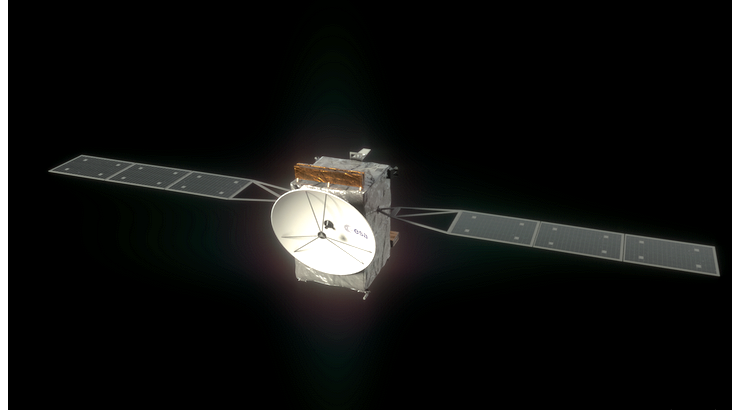
EnVision

Thomas notes, “Aerobraking around Venus is going to be much more challenging than for TGO. To begin with, the gravity of Venus is about 10 times higher than that of Mars. This means velocities about twice as high as for TGO will be experienced by the spacecraft when passing through the atmosphere – and heat is generated as a cube of velocity. Accordingly, EnVision has to target a lower aerobraking regime, resulting in an aerobraking phase twice as long.

“On top of that, we are also going to be much closer to the Sun, experiencing around double the solar intensity of Earth’s, with the thick white clouds of the atmosphere reflecting a lot of sunlight straight back to space, which additionally needs to be taken into account. Then on top of all that, we realised we had to reckon with another factor over the thousands of orbits we envisage, previously only experienced in low Earth orbit: highly-erosive atomic oxygen.”

This is a phenomenon that remained unknown during the first decades of the space age. It was only when early Space Shuttle flights returned from low orbit in the early 1980s that engineers received a shock: the spacecraft’s thermal blankets had been severely eroded.
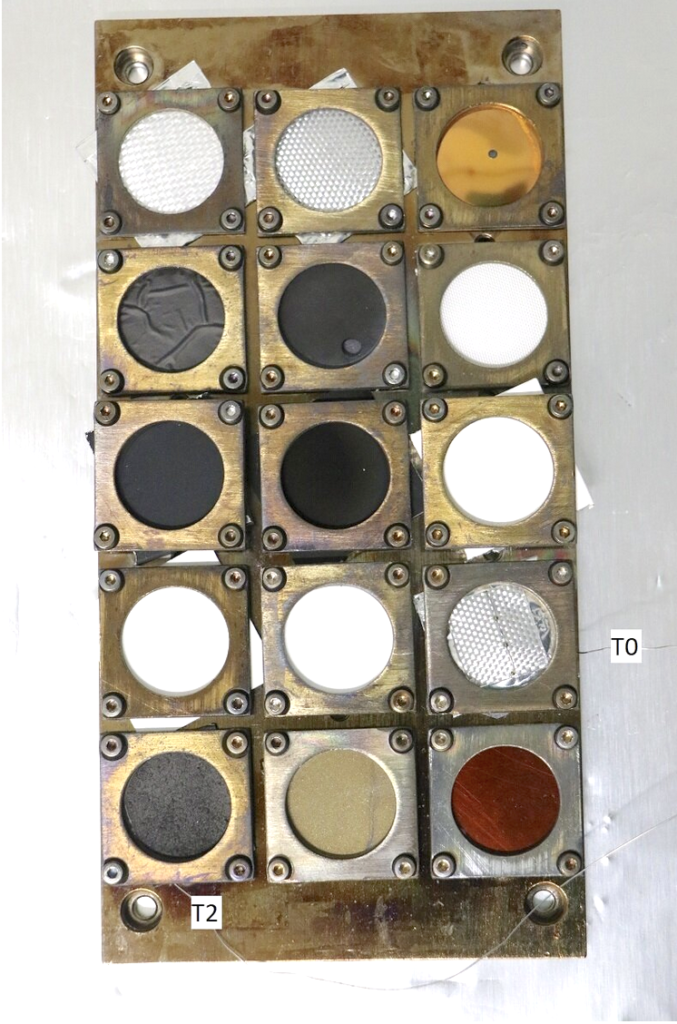
Samples for simulated aerobraking

The culprit turned out to be highly reactive atomic oxygen — individual atoms of oxygen at the fringes of the atmosphere, the result of standard oxygen molecules of the kind found just above the ground being broken apart by powerful ultraviolet radiation from the Sun. Today, all missions below about 1 000 km need to be designed to resist atomic oxygen, such as Europe’s Earth-watching Copernnicus Sentinels or any hardware built for the International Space Station.

Spectral observations by past Venus orbiters of airglow above the planet confirm that atomic oxygen is widespread at the top of the Venusian atmosphere too, which is more than 90 times thicker than Earth’s surrounding air.

Thomas says, “The concentration is quite high, with one pass it doesn’t matter so much but over thousands of times it starts to accumulate and ends up with a level of atomic oxygen fluence we have to take account of, equivalent to what we experience in low-Earth orbit, but at higher temperatures.”
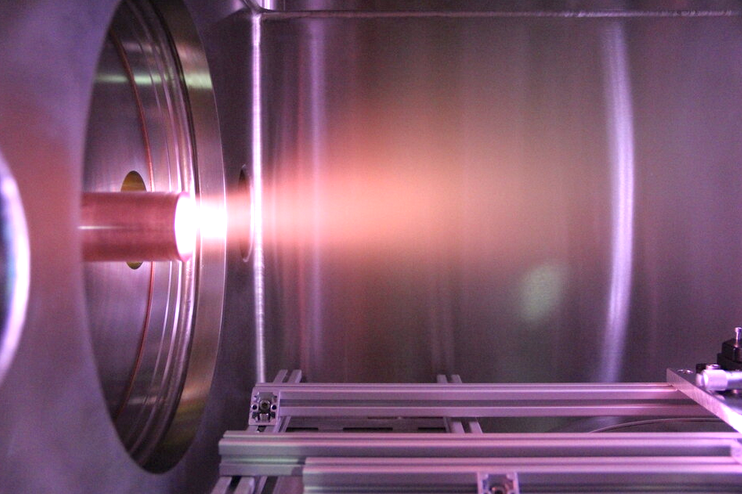
Atomic oxygen generator

The EnVision team turned to a unique European facility specifically built by ESA to simulate atomic oxygen in orbit. The Low Earth Orbit Facility, LEOX, is part of the Agency’s Materials and Electrical Components Laboratory, based at ESA’s ESTEC technical centre in the Netherlands.

ESA materials engineer Adrian Tighe explains, “LEOX generates atomic oxygen at energy levels that are equivalent to orbital speed. Purified molecular oxygen is injected into a vacuum chamber with a pulsing laser beam focused onto it. This converts the oxygen into a hot plasma whose rapid expansion is channelled along a conical nozzle. It then dissociates to form a highly energetic beam of atomic oxygen.

“To work reliably, the laser timing must stay precise to millisecond scale, and directed to an accuracy measured in thousandths of a millimetre, throughout the four-month duration of this current test campaign.
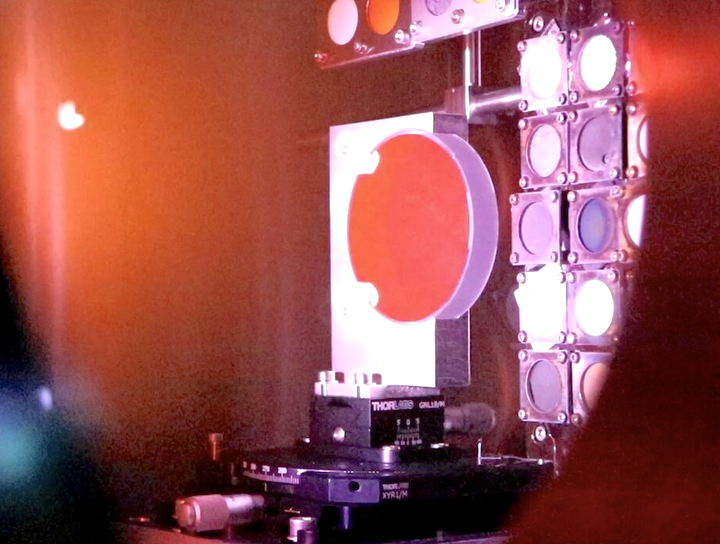
Samples exposed to atomic oxygen

“This isn’t the first time that the facility has been used to simulate an extraterrestrial orbital environment — we have previously performed atomic oxygen testing on candidate solar array materials for ESA’s Juice mission, because telescopic observations suggest atomic oxygen will be found in the atmospheres of Europa and Ganymede. However, for EnVision the heightened temperature during aerobraking poses an additional challenge, so the facility has been adapted to simulate this more extreme Venusian environment.”

A range of materials and coatings from different parts of the EnVision spacecraft, including multi-layer insulation, antenna parts and star tracker elements are placed within a plate to be exposed to the purple-glowing LEOX beam. At the same time this plate is being heated to mimic the expected thermal flux, up to 350°C.

Samples seen in infrared

Thomas adds, “We want to check that these parts are resistant to being eroded, and also maintain their optical properties — meaning they do not degrade or darken, which might have knock-on effects in terms of their thermal behavior, because we have delicate scientific instruments that must maintain a set temperature. We also need to avoid flaking or outgassing, which lead to contamination.”

This current test campaign is part of a larger panel looking into EnVision aerobraking, including the use of a Venus climate database developed from previous mission results to estimate the local variability of the planet’s atmosphere to set safe margins for the spacecraft.

The results of this test campaign are expected at the end of this year.

Filed Under: Government & Regulation

Primary Sidebar

Coverage

  • Missions & Constellations
  • Business & Finance
  • Military & Defense
  • Launch
  • Software Automation & Ground Systems
  • Government & Regulation
  • Services & Applications

Most Read Stories

  • Global Shift Toward Sovereign Launch Gains Momentum Amid Geopolitical Tensions
  • SpaceX Unveils ‘Stargaze’ System to Revolutionize Space Traffic Management
  • AST SpaceMobile Encapsulates BlueBird 7 Satellite for Inaugural New Glenn Mission
  • SpaceX Prepares for Record-Breaking $1.75 Trillion Confidential IPO Filing in March
  • Bidding War Intensifies for Mynaric as Rheinmetall Challenges Rocket Lab Acquisition

Secondary Sidebar

Footer


Satnews is a leading provider of satellite news, events, publications, research and other satellite industry information in both commercial and military enterprises worldwide.

Stories By Category

  • Business & Finance
  • Government & Regulation
  • Launch
  • Military & Defense
  • Missions & Constellations
  • Services & Applications
  • Software Automation & Ground Systems
  • Spectrum & Licensing
  • Startups & NewSpace Business

About Us

  • Leadership & Editorial Team
  • SatNews History
  • Free Satnews Subscription
  • SatNews Events
  • Magazines

Navigation

  • Latest Stories
  • Magazines
  • Events
  • Contact
  • Cookie & Privacy Policy for Satnews

We use cookies to ensure that we give you the best experience on our website. If you continue to use this site we will assume that you are happy with it.
x
Sign up Now (For Free)
Access daily or weekly satellite news updates covering all aspects of the commercial and military satellite industry.
Invalid email address
Notify Me Regarding ( At least one ):
We value your privacy and will not sell or share your email or other information with any other company. You may also unsubscribe at anytime.

Click Here to see our full privacy policy.
Thanks for subscribing!