

• Skip to primary navigation
  • Skip to main content
  • Skip to primary sidebar
  • Skip to secondary sidebar
  • Skip to footer
  • NEWS:
  • SatNews
  • SatMagazine
  • MilSatMagazine
  • SmallSat News
  • |     EVENTS:
  • SmallSat Symposium
  • Satellite Innovation
  • MilSat Symposium
  • SmallSat Europe

SatNews

Satellite Industry Intelligence Since 1983

Subscribe
  • LATEST
  • Missions & Constellations
    • Exploration & Science Missions
    • In-Orbit Servicing & Orbital Operations
    • LEO Constellations
    • Mission Autonomy & Onboard Systems
    • Mission Deployments & Manifests
    • Navigation & PNT
    • SmallSat
    • Spacecraft & Payload Technology
    View All in Missions & Constellations →
    MTN Launches Click-to-Deploy StarEdge Horizon Satellite Service on AWS MarketplaceMTN Launches Click-to-Deploy StarEdge Horizon Satellite Service on AWS Marketplace
    ATLAS Space Operations Establishes South Pacific Hub with New Ground Station in American SamoaATLAS Space Operations Establishes South Pacific Hub with New Ground Station in American Samoa
    Spring Forward: Legacy Operators Are Killing GEO. That’s the Plan.Spring Forward: Legacy Operators Are Killing GEO. That’s the Plan.
    A Satellite Crashes Home a Bit Too SoonA Satellite Crashes Home a Bit Too Soon
  • Business
    • Contracts & Commercial Deals
    • Earnings & Financial Reporting
    • Events & Conferences
    • Funding & Venture Capital
    • Market Forecasts
    • Mergers & Acquisitions
    • Personnel Moves & Appointments
    View All in Business & Finance →
    Rheinmetall Withdraws From Mynaric Bidding Process; Rocket Lab Acquisition Clears Major Competitive HurdleRheinmetall Withdraws From Mynaric Bidding Process; Rocket Lab Acquisition Clears Major Competitive Hurdle
    MTN Launches Click-to-Deploy StarEdge Horizon Satellite Service on AWS MarketplaceMTN Launches Click-to-Deploy StarEdge Horizon Satellite Service on AWS Marketplace
    Spring Forward: Legacy Operators Are Killing GEO. That’s the Plan.Spring Forward: Legacy Operators Are Killing GEO. That’s the Plan.
    Lockheed Martin Commits £100M to UK Space Hub; New Manufacturing Plant to Create 2,000 JobsLockheed Martin Commits £100M to UK Space Hub; New Manufacturing Plant to Create 2,000 Jobs
  • Defense
    • Counterspace & ASAT
    • Defense Budgets & Procurement
    • ISR & Reconnaissance
    • MILSATCOM
    • Missile Warning & Defense
    • National Security Programs
    • Space Domain Awareness
    View All in Military & Defense →
    BAE Systems Completes Preliminary Design Review for $1.2 Billion Space Force Epoch 2 ProgramBAE Systems Completes Preliminary Design Review for $1.2 Billion Space Force Epoch 2 Program
    Guardians in the Kill Chain: How the Space Force Led the Opening Salvo of Operation Epic FuryGuardians in the Kill Chain: How the Space Force Led the Opening Salvo of Operation Epic Fury
    BlackSky Awarded $99M Air Force Contract for Advanced Optical Testbed; Lockheed Martin Expands Missile ProductionBlackSky Awarded $99M Air Force Contract for Advanced Optical Testbed; Lockheed Martin Expands Missile Production
    Space Development Agency Faces “Growing Pains” as PWSA Scaling Hits ChokepointsSpace Development Agency Faces “Growing Pains” as PWSA Scaling Hits Chokepoints
  • Gov
    • Export Controls & Compliance
    • International Space Agreements
    • National Space Policy
    • Space Law & Treaties
    • Space Sustainability & Debris Policy
    • Space Traffic Management / Debris Removal
    View All in Government & Regulation →
    The Iran Precedent: Operation Epic Fury and the Law of Armed Conflict in SpaceThe Iran Precedent: Operation Epic Fury and the Law of Armed Conflict in Space
    Geopolitical Scrutiny: The Strategic Implications of APT Satellite’s Chinese State OwnershipGeopolitical Scrutiny: The Strategic Implications of APT Satellite’s Chinese State Ownership
    Sovereign Checkpoints and Debt CliffsSovereign Checkpoints and Debt Cliffs
    Securing the Future of the Orbital EnvironmentSecuring the Future of the Orbital Environment
  • Launch
    • Launch Providers
    • Launch Schedule & Calendars
    • Launch Sites & Infrastructure
    • Rocket Technology & Vehicles
    View All in Launch →
    SpaceX Evolves Beyond Broadband with “Million-Satellite” AI Data Center Plan; Amazon Mounts Legal ChallengeSpaceX Evolves Beyond Broadband with “Million-Satellite” AI Data Center Plan; Amazon Mounts Legal Challenge
    Times Microwave Systems Launches Levitate™ Ultra-Lightweight Cables for UAV and Defense AvionicsTimes Microwave Systems Launches Levitate™ Ultra-Lightweight Cables for UAV and Defense Avionics
    Blue Origin Accelerates New Glenn 9×4 Production and TeraWave Constellation DevelopmentBlue Origin Accelerates New Glenn 9×4 Production and TeraWave Constellation Development
    PLD Space Secures €180 Million Series C Led by Mitsubishi Electric to Scale MIURA 5 ProductionPLD Space Secures €180 Million Series C Led by Mitsubishi Electric to Scale MIURA 5 Production
  • Software
    • Autonomous Ground Operations
    • Data Processing & AI/ML
    • Digital Twins & Modeling
    • Ground Segment & Teleports
    • Mission Planning & Simulation
    • Space Systems Software Engineering
    • Spectrum & Licensing
    View All in Software Automation & Ground Systems →
    Missile Strike Targets Strategic SES Ha’Ela Teleport in Central IsraelMissile Strike Targets Strategic SES Ha’Ela Teleport in Central Israel
    ATLAS Space Operations Establishes South Pacific Hub with New Ground Station in American SamoaATLAS Space Operations Establishes South Pacific Hub with New Ground Station in American Samoa
    Danish Army Selects BAE Systems OneArc for 7-Year Simulation Modernization ProgramDanish Army Selects BAE Systems OneArc for 7-Year Simulation Modernization Program
    a.i. solutions Partners with USGS to Integrate AI into Landsat Flight Operationsa.i. solutions Partners with USGS to Integrate AI into Landsat Flight Operations
  • Services & Apps
    • Climate & Environmental Monitoring
    • Disaster Response & Security Mapping
    • Earth Observation & Imaging
    • Maritime & Aviation Satcom
    • Satellite Communications
    View All in Services & Applications →
    Jazz Secures Industry-Leading 190 MHz in Pakistan’s Landmark $507M 5G Spectrum AuctionJazz Secures Industry-Leading 190 MHz in Pakistan’s Landmark $507M 5G Spectrum Auction
    Spring Forward: Legacy Operators Are Killing GEO. That’s the Plan.Spring Forward: Legacy Operators Are Killing GEO. That’s the Plan.
    Synthetic Aperture Radar as the Modern Backbone of Maritime Domain AwarenessSynthetic Aperture Radar as the Modern Backbone of Maritime Domain Awareness
    High-Frequency EO Constellations Target Southeast Asia’s “Gray-Zone” Maritime Security GapHigh-Frequency EO Constellations Target Southeast Asia’s “Gray-Zone” Maritime Security Gap
  • SatNews Events
  • Magazines
  • Calendar
  • Jobs

NASA Prepares Three More CubeSat Payloads For Their Artemis I Mission

August 1, 2021

Two more secondary payloads that will travel to deep space on NASA’s Artemis I mission were integrated for launch on July 23 and another payload is ready for installation at the Kennedy Space Center in Florida.

These cubesats are roughly the size of a large shoe box and weigh no more than 30 pounds. Despite their small size, they enable science and technology experiments that may enhance our understanding of the deep space environment, expand our knowledge of the Moon, and demonstrate new technologies that could be used on future missions.
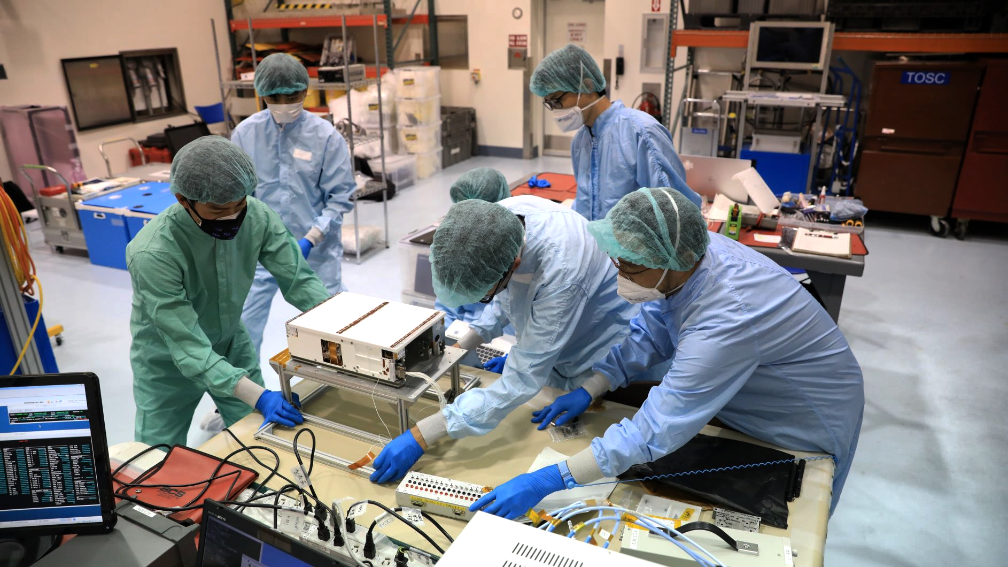
The OMOTENASHI (Outstanding MOon exploration Technologies demonstrated by NAno Semi-Hard Impactor) team prepares their secondary payload for a ride on NASA’s Space Launch System rocket during the Artemis I mission. If successful, OMOTENASHI will be the smallest spacecraft ever to land on the lunar surface and will mark Japan as the fourth nation to successfully land a craft on the Moon.

OMOTENASHI and ArgoMoon, which will both study the Moon, were integrated with their dispensers and installed on the Orion stage adapter along with seven other payloads for the Space Launch System (SLS) rocket’s first flight.

OMOTENASHI was developed by the Japan Aerospace Exploration Agency (JAXA). While OMOTENASHI is one of several Artemis I secondary payloads that are studying the Moon, it is the only one that will conduct a controlled landing on the Moon’s surface. Its primary objective is to test the technologies and trajectory maneuvers that allow a small lander to land on the Moon while keeping its systems – including power, communication, and propulsion systems – intact.

Photo of the OMOTENASHI smallsat is courtesy of JAXA.

Testing these systems around and on the Moon can help with development of similar small landers that could explore other planets. The spacecraft will also measure the radiation environment beyond LEO, providing data that will help develop technologies to manage radiation exposure for human exploration. If successful, OMOTENASHI will be the smallest spacecraft ever to land on the lunar surface and will mark Japan as the fourth nation to successfully land on the Moon.

ArgoMoon, developed by Italian company Argotec and sponsored by Agenzia Spaziale Italiana (ASI), Italy’s national space agency, was prepared for launch at NASA’s Kennedy Space Center in Florida. The smallsat was installed in the Space Launch System Orion stage adapter, where it will ride to space during the Artemis I mission.
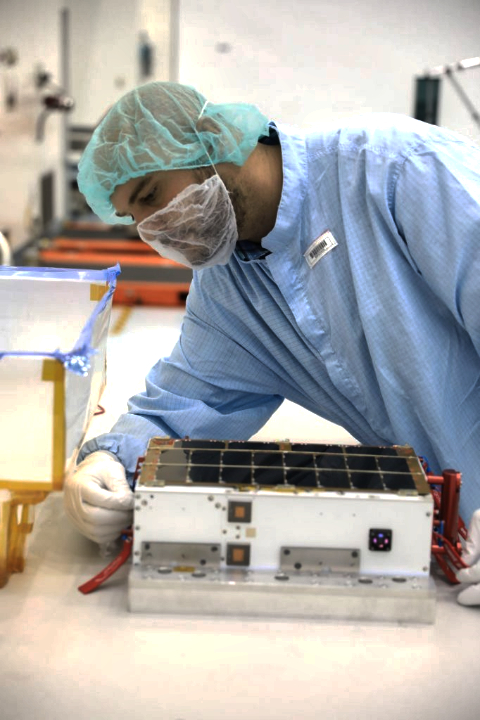
ArgoMoon, photo courtesy of Argotec.

The cubesat will use high-definition cameras and advanced imaging software to record images of the ICPS and later of the Earth and the Moon for historical documentation, provide mission data on the deployment of other smallsats and test optical communication capabilities between the smallsat and Earth.

ArgoMoon will use a hybrid micropropulsion system (MiPS) that combines green mono-propellant and cold gas propulsion in a single system to provide attitude control and orbital maneuvering using a small amount of power.

The enhanced attitude capabilities are also used to run and validate artificial intelligence-based algorithms for autonomous Failure Detection, Isolation and Recovery systems that perform continuous monitoring of the health of the satellite to detect any potential fault. In the case of fault detection, this service performs several operations to solve the problem. If the fault is not recoverable, the satellite goes in safe mode, which means that only the functionalities to keep the satellite alive and to communicate with ground are used.

ArgoMoon’s mission is a forerunner of technologies for deep space application that can be used for inspection of satellites not originally designed to be serviced, without the involvement of the ground segment.

A third payload, the BioSentinel cubesat is the only cubesat that will contain a biological experiment on Artemis I and will be the first smallsat to support biological research in deep space. The team placed it in its dispenser for the flight, and to preserve its biological contents, the smallsat is being kept in a controlled environment at NASA’s Kennedy Space Center in Florida. At a date closer to launch, it will be placed in the Orion stage adapter.

Inside an anechoic chamber at Ames, quality assurance engineer Austin Bowie inspects BioSentinel’s solar array after completion of a test to determine the effects of electromagnetic spacecraft emissions on spacecraft systems. Photo is courtesy of NASA/Dominic Hart.

BioSentinel will be the first long-duration biology experiment to take place in deep space and will be among the first studies of the biological response to space radiation outside LEO in nearly 50 years. Its primary objective is to measure the impact of space radiation on living organisms – in this case, yeast – over long durations beyond LEO.

The BioSentinel team prepares their cubesat to be the first long-duration biology experiment to take place in deep space, and the first study of the biological response to space radiation outside low-Earth orbit in nearly 50 years. The team placed the cubesat in its dispenser and to preserve its biological contents, it is being kept in a controlled environment at NASA’s Kennedy Space Center in Florida. It will be placed in the Orion stage adapter at date closer to launch.

Developed by NASA’s Ames Research Center in California’s Silicon Valley, BioSentinel will enter an orbit around the Sun via a lunar flyby. The experiment will use yeast as a “living radiation detector” to evaluate the effects of ambient space radiation on biology. Human cells and yeast cells have many similar biological mechanisms, including DNA damage and repair.

Photo of a microfluidic card is courtesy of NASA/Dominic Hart.

The payload carries dry yeast cells stored in microfluidic cards – custom hardware that allows for the controlled flow of extremely small volumes of liquids that will activate and sustain the yeast. These yeast-filled cards are situated alongside a physical radiation detection instrument – developed at NASA’s Johnson Space Center in Houston – that measures and characterizes the radiation environment. Results from the physical instrument will be compared to the payload’s biological response.

After completing a lunar flyby and spacecraft checkout, the yeast will be re-hydrated at various points during the six-month mission. As yeast cells activate in space, they will sense and respond to the radiation damage.

Experiments using the BioSentinel instruments will also take place on the International Space Station and on the ground to demonstrate how varied amounts of radiation affect the yeast. While Earth-bound research has helped identify some of the potential effects of space radiation on living organisms, no terrestrial source can fully simulate the unique radiation environment of deep space.

BioSentinel’s data will provide critical insight on the effects of deep space radiation on biology as NASA seeks to establish long-term human exploration of the Moon under Artemis and prepare us for human exploration on Mars.
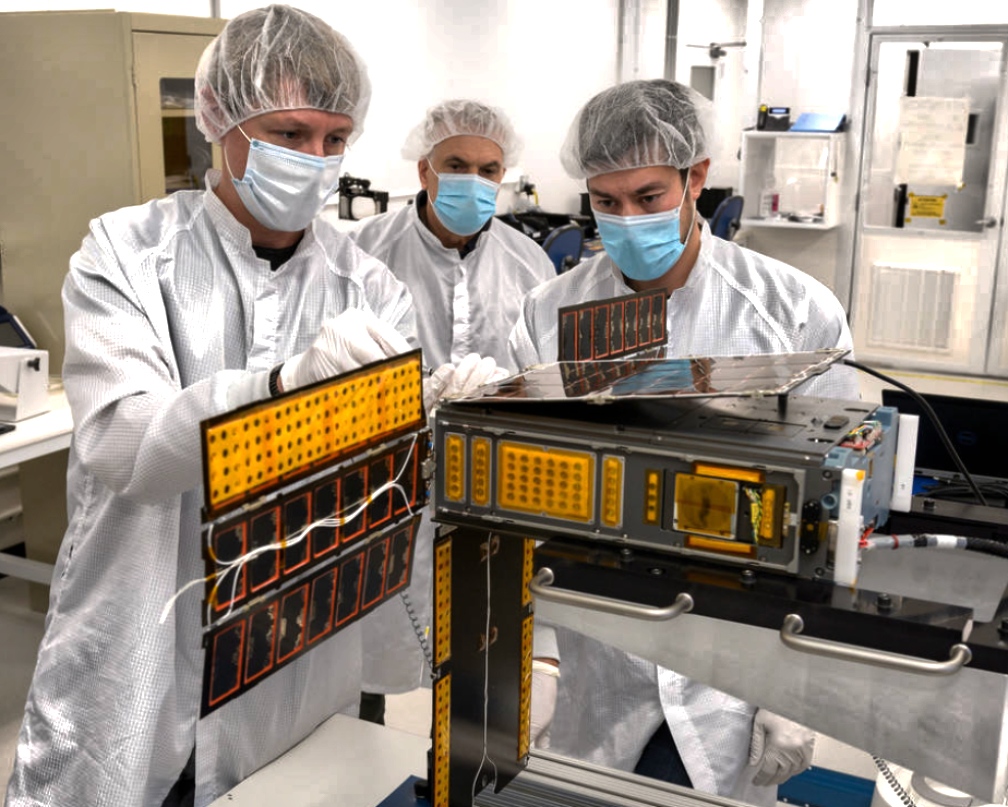
BioSentinel mechanical and structures lead Abraham Rademacher, left, integration and test lead Vaslie Manolescu, center, and electrical engineer James Milsk perform a solar array deployment and gimbal motion test on the spacecraft in a clean room at Ames. The test ensures that the spacecraft’s solar arrays will operate correctly in flight. Photo is courtesy of NASA/Dominic Hart.

SLS will launch America into a new era of exploration to destinations beyond LEO. On this first flight, NASA will demonstrate the rocket’s heavy-lift capability and send an uncrewed Orion spacecraft into deep space.
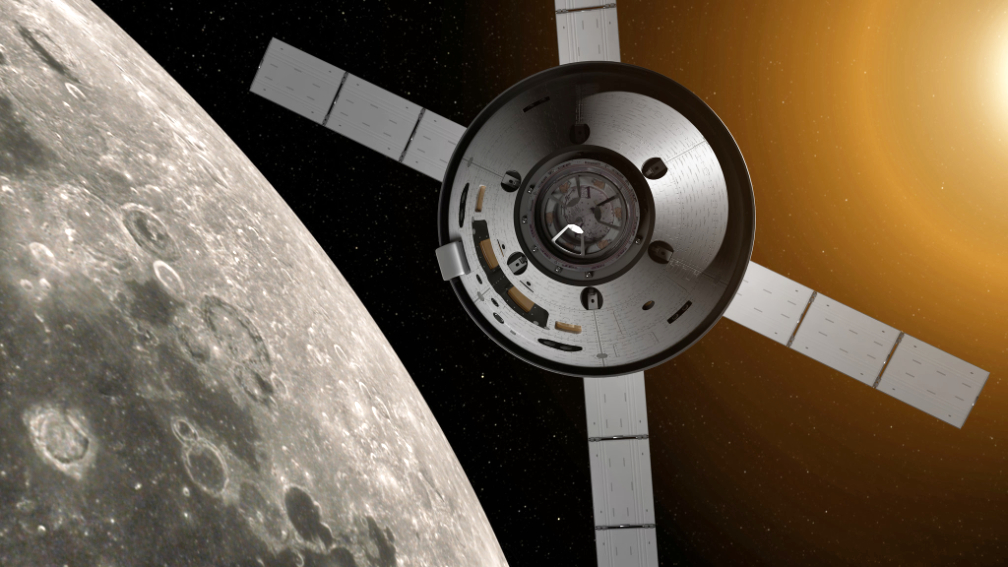
Artistic rendition of the Orion spacecraft, courtesy of NASA.

The agency is also taking advantage of additional available mass and space to provide the rare opportunity to send several cubesats to conduct science experiments and technology demonstrations in deep space. All smallsats are deployed after SLS completes its primary mission, launching the Orion spacecraft on a trajectory toward the Moon.

Filed Under: Business & Finance Tagged With: Featured

Primary Sidebar

Coverage

  • Missions & Constellations
  • Business & Finance
  • Military & Defense
  • Launch
  • Software Automation & Ground Systems
  • Government & Regulation
  • Services & Applications

Most Read Stories

  • Global Shift Toward Sovereign Launch Gains Momentum Amid Geopolitical Tensions
  • SES Executive Confirms End of the 15-Year Satellite Era
  • SpaceX Unveils ‘Stargaze’ System to Revolutionize Space Traffic Management
  • The Space Data Layer is Coming, Just Not as Fast or as Small as You Think
  • AST SpaceMobile Encapsulates BlueBird 7 Satellite for Inaugural New Glenn Mission

Secondary Sidebar

Footer


Satnews is a leading provider of satellite news, events, publications, research and other satellite industry information in both commercial and military enterprises worldwide.

Stories By Category

  • Business & Finance
  • Government & Regulation
  • Launch
  • Military & Defense
  • Missions & Constellations
  • Services & Applications
  • Software Automation & Ground Systems
  • Spectrum & Licensing
  • Startups & NewSpace Business

About Us

  • Leadership & Editorial Team
  • SatNews History
  • Free Satnews Subscription
  • SatNews Events
  • Magazines

Navigation

  • Latest Stories
  • Magazines
  • Events
  • Contact
  • Cookie & Privacy Policy for Satnews

We use cookies to ensure that we give you the best experience on our website. If you continue to use this site we will assume that you are happy with it.
x
Sign up Now (For Free)
Access daily or weekly satellite news updates covering all aspects of the commercial and military satellite industry.
Invalid email address
Notify Me Regarding ( At least one ):
We value your privacy and will not sell or share your email or other information with any other company. You may also unsubscribe at anytime.

Click Here to see our full privacy policy.
Thanks for subscribing!