

• Skip to primary navigation
  • Skip to main content
  • Skip to primary sidebar
  • Skip to secondary sidebar
  • Skip to footer
  • NEWS:
  • SatNews
  • SatMagazine
  • MilSatMagazine
  • SmallSat News
  • |     EVENTS:
  • SmallSat Symposium
  • Satellite Innovation
  • MilSat Symposium
  • SmallSat Europe

SatNews

Satellite Industry Intelligence Since 1983

Subscribe
  • LATEST
  • SatNews Events
  • Magazines
  • Calendar
  • Subscribe
  • Missions & Constellations
    • Exploration & Science Missions
    • In-Orbit Servicing & Orbital Operations
    • LEO Constellations
    • Mission Autonomy & Onboard Systems
    • Mission Deployments & Manifests
    • Navigation & PNT
    • SmallSat
    • Spacecraft & Payload Technology
    View All in Missions & Constellations →
    Iridium Unveils Core Role in Artemis II and Next-Gen PNT at Space Symposium 2026Iridium Unveils Core Role in Artemis II and Next-Gen PNT at Space Symposium 2026
    Boeing and Millennium Unveil Resolute Mid-Class Satellite PlatformBoeing and Millennium Unveil Resolute Mid-Class Satellite Platform
    NASA Shifts Focus to Permanent Lunar Base and Nuclear PropulsionNASA Shifts Focus to Permanent Lunar Base and Nuclear Propulsion
    Kepler and Astrolight Secure ESA Contract for HydRON Optical NetworkKepler and Astrolight Secure ESA Contract for HydRON Optical Network
  • Business
    • Contracts & Commercial Deals
    • Earnings & Financial Reporting
    • Events & Conferences
    • Funding & Venture Capital
    • Market Forecasts
    • Mergers & Acquisitions
    • Personnel Moves & Appointments
    View All in Business & Finance →
    SmallSat Europe Speaker Focus: Jaume Sanpera, SateliotSmallSat Europe Speaker Focus: Jaume Sanpera, Sateliot
    Ericsson Initiates SEK 15 Billion Share Buyback ProgramEricsson Initiates SEK 15 Billion Share Buyback Program
    Saltzman Unveils 2040 Blueprint to Scale Space Force for Great Power CompetitionSaltzman Unveils 2040 Blueprint to Scale Space Force for Great Power Competition
    SmallSat Europe Speaker Focus: Col. Marcin Mazur, Polish Space AgencySmallSat Europe Speaker Focus: Col. Marcin Mazur, Polish Space Agency
  • Defense
    • Counterspace & ASAT
    • Defense Budgets & Procurement
    • ISR & Reconnaissance
    • MILSATCOM
    • Missile Warning & Defense
    • National Security Programs
    • Space Domain Awareness
    View All in Military & Defense →
    The Rise of Grey Zone Satellites: Ambiguity as a Tactical AdvantageThe Rise of Grey Zone Satellites: Ambiguity as a Tactical Advantage
    US Space Force Awards $68.6M Modification to Lockheed Martin for Next-Gen OPIRUS Space Force Awards $68.6M Modification to Lockheed Martin for Next-Gen OPIR
    General Atomics Completes Pre-Ship Review for Space Force Weather PayloadGeneral Atomics Completes Pre-Ship Review for Space Force Weather Payload
    Global Defense Leaders Convene as Space Symposium 41 Addresses Orbital SecurityGlobal Defense Leaders Convene as Space Symposium 41 Addresses Orbital Security
  • Gov
    • Export Controls & Compliance
    • International Space Agreements
    • National Space Policy
    • Space Law & Treaties
    • Space Sustainability & Debris Policy
    • Space Traffic Management / Debris Removal
    View All in Government & Regulation →
    SmallSat Europe Speaker Focus: Chris Quilty, Quilty SpaceSmallSat Europe Speaker Focus: Chris Quilty, Quilty Space
    NRL to Showcase Sovereign Space Capabilities at 41st Space SymposiumNRL to Showcase Sovereign Space Capabilities at 41st Space Symposium
    FCC Modernizes Satellite Spectrum Rules to Unleash Next-Generation BroadbandFCC Modernizes Satellite Spectrum Rules to Unleash Next-Generation Broadband
    SmallSat Europe Speaker Focus: Daniel Bock, Morpheus SpaceSmallSat Europe Speaker Focus: Daniel Bock, Morpheus Space
  • Launch
    • Launch Providers
    • Launch Schedule & Calendars
    • Launch Sites & Infrastructure
    • Rocket Technology & Vehicles
    View All in Launch →
    Ensign-Bickford Hardware Supports Successful Artemis II Lunar MissionEnsign-Bickford Hardware Supports Successful Artemis II Lunar Mission
    China Accelerates Orbital Internet Deployment with Successful Smart Dragon-3 Sea LaunchChina Accelerates Orbital Internet Deployment with Successful Smart Dragon-3 Sea Launch
    What the SpaceX IPO Changes for Every Satellite OperatorWhat the SpaceX IPO Changes for Every Satellite Operator
    €30 million Financing for PLD Space’s Small Satellite Launcher€30 million Financing for PLD Space’s Small Satellite Launcher
  • Software
    • Autonomous Ground Operations
    • Data Processing & AI/ML
    • Digital Twins & Modeling
    • Ground Segment & Teleports
    • Mission Planning & Simulation
    • Space Systems Software Engineering
    • Spectrum & Licensing
    View All in Software Automation & Ground Systems →
    Cloudcomputing Targets 1.5M Identities in Spain and Finalizes Innovate IT AcquisitionCloudcomputing Targets 1.5M Identities in Spain and Finalizes Innovate IT Acquisition
    Archangel Lightworks Secures £10M Series A to Scale Optical Ground InfrastructureArchangel Lightworks Secures £10M Series A to Scale Optical Ground Infrastructure
    Keysight and Sateliot Win ESA and GSMA Foundry Challenge for 6G InnovationKeysight and Sateliot Win ESA and GSMA Foundry Challenge for 6G Innovation
    Automation and Agility: How SSC Space Go is Designed for the New Age of GroundAutomation and Agility: How SSC Space Go is Designed for the New Age of Ground
  • Services & Apps
    • Climate & Environmental Monitoring
    • Disaster Response & Security Mapping
    • Earth Observation & Imaging
    • Maritime & Aviation Satcom
    • Satellite Communications
    View All in Services & Applications →
    NASA Targets Commercial Relays to Replace Aging TDRSS InfrastructureNASA Targets Commercial Relays to Replace Aging TDRSS Infrastructure
    OQ Technology Awarded ESA Contract to Adapt 5G Beamforming for SpaceOQ Technology Awarded ESA Contract to Adapt 5G Beamforming for Space
    Kraken Robotics Integrates KATFISH Sonar on SEFINE RD-22 USV Following Multi-Naval DemonstrationsKraken Robotics Integrates KATFISH Sonar on SEFINE RD-22 USV Following Multi-Naval Demonstrations
    Astroscale Plans World-First Multi-Orbit Satellite Inspection MissionAstroscale Plans World-First Multi-Orbit Satellite Inspection Mission

Avoiding Low-Earth Orbit Collisions – The Clock Is Ticking

April 27, 2021

We’ve had a few scares recently, and the number of close calls requiring an automated or manual maneuver to avoid a collision will increase dramatically in the future…

There was a recent dispute between OneWeb and SpaceX regarding the possibility of a collision between two of their low-Earth orbit (LEO) satellites. OneWeb’s satellite (OneWeb-1078) was launched on March 25 and headed for its orbit at an altitude of 1,200 km when, in early April, it passed near a SpaceX satellite (Starlink-1546) in orbit at about 450 km.

There was no collision, but subsequently, OneWeb’s government affairs chief Chris McLaughlin said SpaceX had turned off their autonomous collision-avoidance system so OneWeb could maneuver around their satellite and SpaceX denied that they had switched the system off and said, “there was never a risk of collision.”

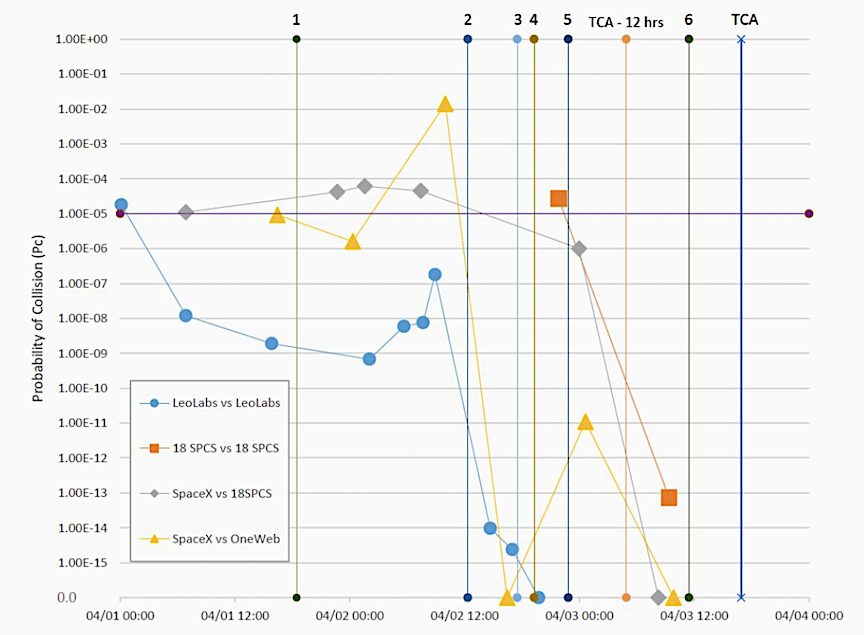
This sounds a little like a PR battle, but both sides may have been sincere because satellite tracking is imprecise. The satellites were being tracked by SpaceX, OneWeb, and two independent organizations, the Air Force 18th Space Control Squadron (18 SPCS) and LeoLabs which offers a commercial satellite tracking service. As we see in the plot shown below (source), their estimates of the probability of collision vary.

In addition to helping explain the dispute between SpaceX and OneWeb, the variance in these estimates illustrates the difficulty of accurately tracking and predicting satellite orbits. The incident also highlights the difficulty of communicating and cooperating in deciding on maneuvers to avoid collisions.

SpaceX and OneWeb began deploying their broadband Internet service constellations recently, but as of early 2020, LeoLabs was tracking about 14,000 objects in LEO that were 10 centimeters across and larger. About 1,700 were functional satellites working on other applications, and the rest were debris. We also had a debris-collision warning Last week when the astronauts en route to the International Space Station were instructed to put on their spacesuits due to the possibility of a collision with a piece of space junk.

Fast forward five years

The SpaceX-OneWeb and astronaut-debris events provide an early warning. There are around 3,000 satellites in LEO today, but how about five years from now? As shown below, the five would-be broadband constellation operators have the authorization to launch over 30,000 satellites and, if we add in pending requests for approval, the total increases to around 100,000. Furthermore, Russia and the European Union are working on broadband satellite plans, as are the US and Chinese militaries. And don’t forget the forthcoming large non-broadband constellations, like Geely’s Geespace constellation.

We’ve had a few scares recently, and the number of close calls requiring an automated or manual maneuver to avoid a collision will increase dramatically in the future. Runaway debris in LEO would cost us more than just having to give up the goal of global broadband service. It would disrupt critical applications we already depend upon in climate science, emergency response, agriculture, etc. I am confident that LEO broadband providers can find solutions to the technical problems they face, like low-cost antennas, inter-satellite laser links, and spectrum sharing. Still, collision avoidance is tougher because, in addition to technical innovation like improving the accuracy and resolution of terrestrial and space-based orbit tracking, it will take political action.

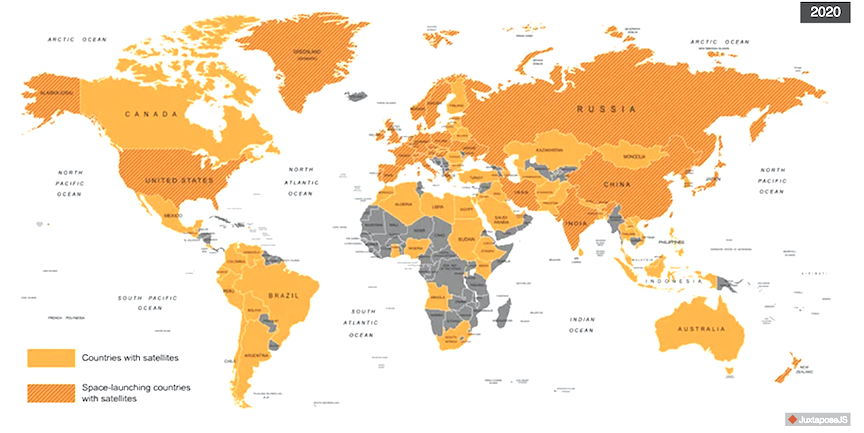
The map below shows that 72 nations own and/or operate satellites, but last week, English-speaking engineers at SpaceX and OneWeb were unable to agree on the orbit data and communicate and cooperate when it appeared that a collision might be forthcoming. If SpaceX and OneWeb cannot agree, what will happen when, for example, military satellites from China and the US are involved?
Space, like the oceans, is a global commons, and it is not in anyone’s interest to spoil it. We need global regulations, standards, procedures, and a means of enforcing compliance if we are to avoid collisions and mitigate debris. We are running out of time. We’ve been working on maritime law for centuries, and the UN International Maritime Council has 174 member states — have we begun talking about this issue with the Chinese?

It’s time to act

The European Space Agency (ESA) has produced a 12-minute video (with cool animations) that describes the debris problem and the current debris mitigation guidelines, which are neither universally followed nor adequate for the future. ESA projects for automating collision avoidance, refueling and repairing satellites in space, active debris removal, and technology to hasten the deorbiting of defunct satellites are mentioned in this call for action. Indeed the title of the video is “Time to Act.”

Space, like the oceans, is a global commons, and it is not in anyone’s interest to spoil it. We need global regulations, standards, procedures, and a means of enforcing compliance if we are to avoid collisions and mitigate debris. We are running out of time. We’ve been working on maritime law for centuries, and the UN International Maritime Council has 174 member states — have we begun talking about this issue with the Chinese?

By Larry Press, CircleID

Larry Press, Professor of Information Systems at California State University – He has been on the faculties of the University of Lund, Sweden and the University of Southern California, and worked for IBM and the System Development Corporation. Larry maintains a blog on Internet applications and implications at cis471.blogspot.com and follows Cuban Internet development at laredcubana.blogspot.com

  • ACCESS PR

Filed Under: Government & Regulation, SmallSat

Primary Sidebar

Coverage

  • Missions & Constellations
  • Business & Finance
  • Military & Defense
  • Launch
  • Software Automation & Ground Systems
  • Government & Regulation
  • Services & Applications

Most Read Stories

  • SpaceX Loses Contact With Starlink Satellite
  • Rocket Lab Emerging as Potential Bus Provider for 2,800-Satellite Equatys Constellation
  • SpaceX Accelerates Record-Breaking IPO Following Trillion-Dollar xAI Merger
  • Planet Labs Imposes Indefinite Blackout on Iran Satellite Imagery at U.S. Request
  • Amazon in Reported Talks to Acquire Globalstar in $9 Billion Move to Challenge Starlink

Secondary Sidebar

Footer


Satnews is a leading provider of satellite news, events, publications, research and other satellite industry information in both commercial and military enterprises worldwide.

Stories By Category

  • Business & Finance
  • Government & Regulation
  • Launch
  • Military & Defense
  • Missions & Constellations
  • Services & Applications
  • Software Automation & Ground Systems
  • Spectrum & Licensing
  • Startups & NewSpace Business

About Us

  • Leadership & Editorial Team
  • SatNews History
  • Free Satnews Subscription
  • SatNews Events
  • Magazines

Navigation

  • Latest Stories
  • Magazines
  • Events
  • Contact
  • Cookie & Privacy Policy for Satnews

We use cookies to ensure that we give you the best experience on our website. If you continue to use this site we will assume that you are happy with it.
x
Sign up Now (For Free)
Access daily or weekly satellite news updates covering all aspects of the commercial and military satellite industry.
Invalid email address
Notify Me Regarding ( At least one ):
We value your privacy and will not sell or share your email or other information with any other company. You may also unsubscribe at anytime.

Click Here to see our full privacy policy.
Thanks for subscribing!