

• Skip to primary navigation
  • Skip to main content
  • Skip to primary sidebar
  • Skip to secondary sidebar
  • Skip to footer
  • NEWS:
  • SatNews
  • SatMagazine
  • MilSatMagazine
  • SmallSat News
  • |     EVENTS:
  • SmallSat Symposium
  • Satellite Innovation
  • MilSat Symposium
  • SmallSat Europe

SatNews

Satellite Industry Intelligence Since 1983

Subscribe
  • LATEST
  • Missions & Constellations
    • Exploration & Science Missions
    • In-Orbit Servicing & Orbital Operations
    • LEO Constellations
    • Mission Autonomy & Onboard Systems
    • Mission Deployments & Manifests
    • Navigation & PNT
    • SmallSat
    • Spacecraft & Payload Technology
    View All in Missions & Constellations →
    General Galactic to Demonstrate Water-Powered “Genesis” Propulsion on 2026 Trinity MissionGeneral Galactic to Demonstrate Water-Powered “Genesis” Propulsion on 2026 Trinity Mission
    The Barcelona two-step reveals tough competitionThe Barcelona two-step reveals tough competition
    SES Activates Latest O3b mPOWER Satellites; Constellation Reaches 10-Unit Operational MilestoneSES Activates Latest O3b mPOWER Satellites; Constellation Reaches 10-Unit Operational Milestone
    Mynaric Secures ESA HydRON Element 3 Contract for High-Throughput Optical User SegmentMynaric Secures ESA HydRON Element 3 Contract for High-Throughput Optical User Segment
  • Business
    • Contracts & Commercial Deals
    • Earnings & Financial Reporting
    • Events & Conferences
    • Funding & Venture Capital
    • Market Forecasts
    • Mergers & Acquisitions
    • Personnel Moves & Appointments
    View All in Business & Finance →
    Lockheed Martin Commits £100M to UK Space Hub; New Manufacturing Plant to Create 2,000 JobsLockheed Martin Commits £100M to UK Space Hub; New Manufacturing Plant to Create 2,000 Jobs
    Vast Secures $500M in Series A and Debt Financing to Accelerate Commercial Space Station ProductionVast Secures $500M in Series A and Debt Financing to Accelerate Commercial Space Station Production
    Terran Orbital Names Kwon Park Senior Director of Manufacturing Operations to Lead Production ScalingTerran Orbital Names Kwon Park Senior Director of Manufacturing Operations to Lead Production Scaling
    The Barcelona two-step reveals tough competitionThe Barcelona two-step reveals tough competition
  • Defense
    • Counterspace & ASAT
    • Defense Budgets & Procurement
    • ISR & Reconnaissance
    • MILSATCOM
    • Missile Warning & Defense
    • National Security Programs
    • Space Domain Awareness
    View All in Military & Defense →
    Guardians in the Kill Chain: How the Space Force Led the Opening Salvo of Operation Epic FuryGuardians in the Kill Chain: How the Space Force Led the Opening Salvo of Operation Epic Fury
    BlackSky Awarded $99M Air Force Contract for Advanced Optical Testbed; Lockheed Martin Expands Missile ProductionBlackSky Awarded $99M Air Force Contract for Advanced Optical Testbed; Lockheed Martin Expands Missile Production
    Space Development Agency Faces “Growing Pains” as PWSA Scaling Hits ChokepointsSpace Development Agency Faces “Growing Pains” as PWSA Scaling Hits Chokepoints
    Sierra Space Secures $550 Million Series C to Scale Defense-Tech and Dream Chaser OperationsSierra Space Secures $550 Million Series C to Scale Defense-Tech and Dream Chaser Operations
  • Gov
    • Export Controls & Compliance
    • International Space Agreements
    • National Space Policy
    • Space Law & Treaties
    • Space Sustainability & Debris Policy
    • Space Traffic Management / Debris Removal
    View All in Government & Regulation →
    The Iran Precedent: Operation Epic Fury and the Law of Armed Conflict in SpaceThe Iran Precedent: Operation Epic Fury and the Law of Armed Conflict in Space
    Geopolitical Scrutiny: The Strategic Implications of APT Satellite’s Chinese State OwnershipGeopolitical Scrutiny: The Strategic Implications of APT Satellite’s Chinese State Ownership
    Sovereign Checkpoints and Debt CliffsSovereign Checkpoints and Debt Cliffs
    Securing the Future of the Orbital EnvironmentSecuring the Future of the Orbital Environment
  • Launch
    • Launch Providers
    • Launch Schedule & Calendars
    • Launch Sites & Infrastructure
    • Rocket Technology & Vehicles
    View All in Launch →
    SpaceX Evolves Beyond Broadband with “Million-Satellite” AI Data Center Plan; Amazon Mounts Legal ChallengeSpaceX Evolves Beyond Broadband with “Million-Satellite” AI Data Center Plan; Amazon Mounts Legal Challenge
    Times Microwave Systems Launches Levitate™ Ultra-Lightweight Cables for UAV and Defense AvionicsTimes Microwave Systems Launches Levitate™ Ultra-Lightweight Cables for UAV and Defense Avionics
    Blue Origin Accelerates New Glenn 9×4 Production and TeraWave Constellation DevelopmentBlue Origin Accelerates New Glenn 9×4 Production and TeraWave Constellation Development
    PLD Space Secures €180 Million Series C Led by Mitsubishi Electric to Scale MIURA 5 ProductionPLD Space Secures €180 Million Series C Led by Mitsubishi Electric to Scale MIURA 5 Production
  • Software
    • Autonomous Ground Operations
    • Data Processing & AI/ML
    • Digital Twins & Modeling
    • Ground Segment & Teleports
    • Mission Planning & Simulation
    • Space Systems Software Engineering
    • Spectrum & Licensing
    View All in Software Automation & Ground Systems →
    Danish Army Selects BAE Systems OneArc for 7-Year Simulation Modernization ProgramDanish Army Selects BAE Systems OneArc for 7-Year Simulation Modernization Program
    a.i. solutions Partners with USGS to Integrate AI into Landsat Flight Operationsa.i. solutions Partners with USGS to Integrate AI into Landsat Flight Operations
    Orbital Edge AI: Axelera AI and ESA Partner to Standardize Space-Based InferenceOrbital Edge AI: Axelera AI and ESA Partner to Standardize Space-Based Inference
    Rohde & Schwarz and Qualcomm Validate Advanced 5×5 MIMO for Wi-Fi 8 NetworkingRohde & Schwarz and Qualcomm Validate Advanced 5×5 MIMO for Wi-Fi 8 Networking
  • Services & Apps
    • Climate & Environmental Monitoring
    • Disaster Response & Security Mapping
    • Earth Observation & Imaging
    • Maritime & Aviation Satcom
    • Satellite Communications
    View All in Services & Applications →
    Blues and Skylo Debut Industry-First Hybrid IoT Module with Seamless Satellite FailoverBlues and Skylo Debut Industry-First Hybrid IoT Module with Seamless Satellite Failover
    a.i. solutions Partners with USGS to Integrate AI into Landsat Flight Operationsa.i. solutions Partners with USGS to Integrate AI into Landsat Flight Operations
    Axian Telecom and AST SpaceMobile to Launch Africa’s First Direct-to-Device Mobile NetworkAxian Telecom and AST SpaceMobile to Launch Africa’s First Direct-to-Device Mobile Network
    The Iran Precedent: Operation Epic Fury and the Law of Armed Conflict in SpaceThe Iran Precedent: Operation Epic Fury and the Law of Armed Conflict in Space
  • SatNews Events
  • Magazines
  • Calendar
  • Jobs

NSR Insight: A Critical Assessment Of HTS Satellite Constellations

December 3, 2020

Non-GEOs continue to make noise, and for the right reasons. With SpaceX launching hundreds of satellites and revealing more info on their user antennas (with Elon Musk admitting that the biggest challenge is cost of user terminals) to OneWeb restarting their production and awaiting a 36-satellite December launch, to Telesat forming a new public company post SSL acquisition – this space is becoming increasingly hot.
If you haven’t kept up to date on the nuances on Non-GEOs offer vs. GEOs, or on other burning timeline, revenue, pricing questions, NSR offers a quick list of burning questions to catch you up via our HTS Constellation: A Critical Assessment, 3rd Edition report…
ViaSat and Hughes already offer space-based Internet by using traditional satellites in GEO (Geosynchronous orbit), while new players such as SpaceX and Amazon are building LEO satellite constellations. What are the differences between the two kinds of Internet, for instance, in terms of costs, services, etc.?

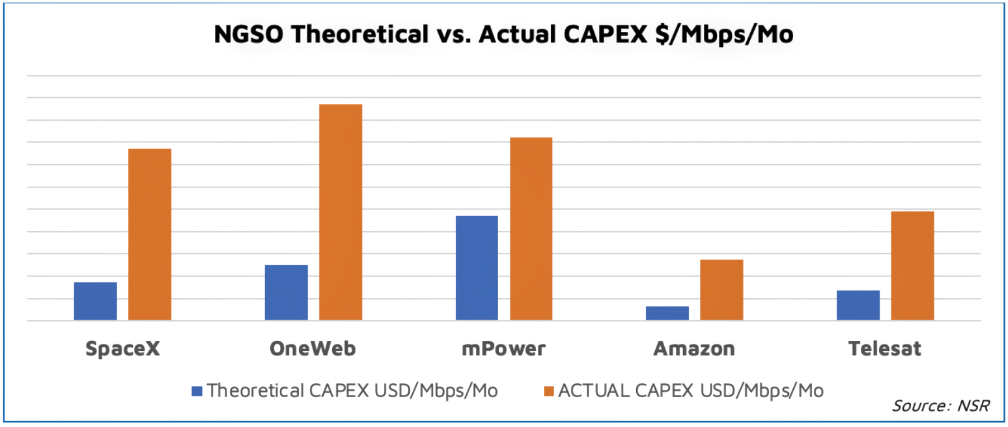
Expect the CAPEX $/Mbps/Mo to largely remain in the same range ($5-$10/Mbps/Mo) for ViaSat, Hughes and SpaceX on usable, uncontested capacity. Though Amazon is likely to break the $5/Mbps/Mo barrier with the first launch expected in 2024, making it more efficient. End-user ARPU is expected to largely remain the same around the $70-$80 mark, though LEO players offer better latency, while Amazon and 2nd Gen SpaceX will be able to provide end-to-end secure connectivity via inter-satellite links. The biggest plus point for GEO consumer broadband (ViaSat and Hughes) is the cost of user terminals ($250-$300), while LEO players are likely to offer user terminals in low thousands of dollars range.
Compared with mature terrestrial networks, what is special about non-GEO satellite-based internet? Will it pose a threat to traditional communications industry?

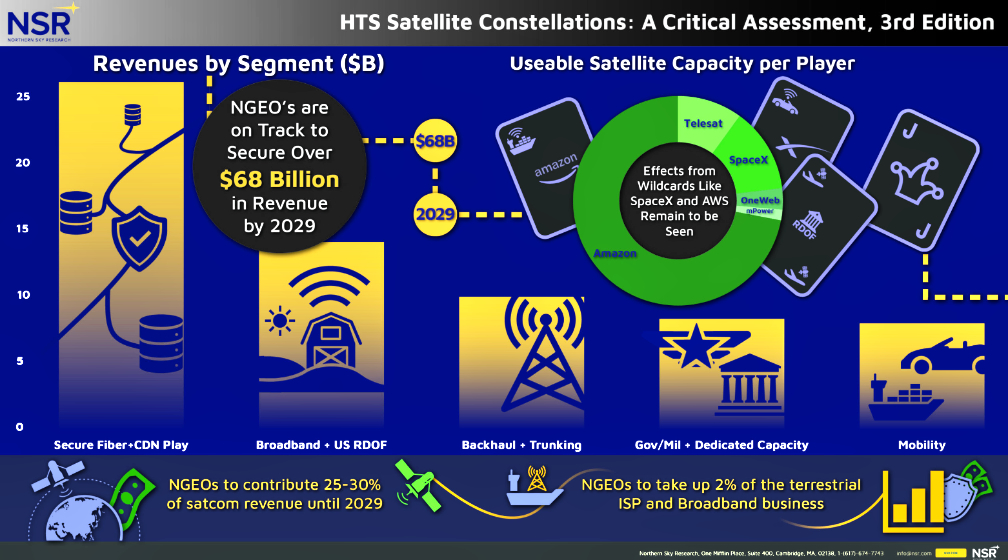
Global telecommunications is a ballpark $2 trillion industry, while satellite based internet is less than $20 Billion today, though growing at a fast pace of 10-15% CAGR. So, there is a long way to catch up for satellite sector, which has grown from critical communications in early 2000s, from serving unserved areas in 2010s to now defining the Mobility and Gov/Mil segments, and bringing efficiencies to compete in the underserved areas of the world.
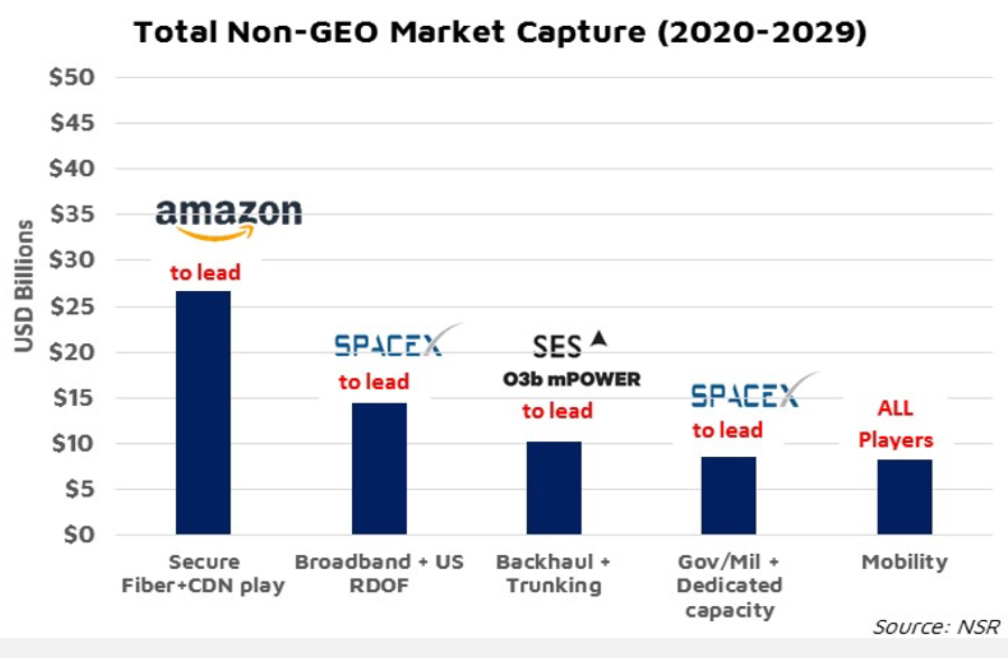
A lot of demand will come from Consumer Broadband and Backhaul use cases from Rural areas with USO opportunities, while Gov/Mil and Mobility will rake in the highest revenue per bit. Segments such as Secure Fiber+CDN play will surely look to disrupt a small percentage of fiber, CDN and cloud security business and is expected to be launched by the likes of Amazon as they build e-2-e secure cloud services.
What are the possible future application scenarios (and GEO limitations) of satellite-based Internet that Non-GEOs could support?

The biggest use case is (arguably) end-to-end secure networks, where there are no terrestrial touch points, and thus potentially help avoid security breaches. Low latency has limited use cases in specific applications (ex: gaming, autonomous vehicles, high frequency trading, etc.). Recently rural tele-medicine in the U.S. is touted to be a use case emanating from SpaceX broadband solution.

Musk estimated that Starlink could bring in revenue of $30 billion a year – or about 10 times the highest annual revenue SpaceX expects from its core rocket business. But currently the business has not proven its profitability.

Is this a risk for the satellite-based Internet industry? What are the other possible challenges in the industry?

The biggest challenge is affordable user terminals, as without them – scale is impossible. That said, $30B is still a very high number, given the precedence of annual business ViaSat and Hughes have done over the last 5 years, who have a well-established commercial solution. Also, given the competition, the annual Non-GEO revenue pie is certainly going to be split among multiple players (OneWeb, SES, Amazon, Telesat).

There are wild cards such as rural broadband subsidies (RDOF) by the FCC, or possible military payload leases that provide additional revenue. But $30 billion would be a 10x stretch even post combining all possible connectivity revenue channels in the near to medium term. Although, applications / revenues from services offered on top of connectivity revenues could rake in more revenue, similar to apps offered within Tesla. As manufacturing and throughput efficiencies improve, a 2nd Gen SpaceX constellation could post higher revenues from underserved areas.

Satellite constellations require large CAPEX and R&D, with associated risks. Will the industry be a battleground only for big companies like Space X and Amazon? How should start-ups compete and survive in the battle?

Unless the manufacturing and launch processes are done at scale, the CAPEX $/Mbps/Mo is not competitive enough for small players to match LEO efficiency. Constellations inherently require large funding ($3B-$10B) and risk to build towards this scale, which only billionaires and massive corporations are capable of.

However, startups aren’t meant to play this conventional game and should look at developing the next breakthrough technology that helps improve the current cost/performance efficiency by 10x, or develop new sensors, or push ground segment cost for LEO down by 10x. There are glaring gaps both in hardware sensing and software automation, and this would be the right battleground for startups to innovate.

Will the industry consolidate and become a battle of the few?

The industry is certainly witnessing a change in guard, with large players like SpaceX entering with thousands of satellites and with Amazon dedicating $10B to the development of its Kuiper constellation. Traditional players like Telesat are consolidating so as to raise capital for its LEO constellation, while SES has invested in a new fleet mPower and post C-band proceeds will potentially look at M&A.

Intelsat recently became vertically integrated in the IFC business with its Gogo acquisition, while large integrated players such as ViaSat and Hughes have demonstrated double-digit growth in the last 2 to 3 years. While this consolidation happens, the manufacturing and ground segment efficiencies improve and the wholesale pricing keeps dropping – hurting small operator economics even more.

While VHTS (200-1,000 Gbps) look to sell capacity at $100-$150/Mbps/Mo price points in Backhaul and Broadband segments, LEOs are expected to match and go lower than this price, creating a glut of capacity post 2024. This is expected to fuel further consolidation as legacy fleets will be bought at a distressed price. Bottom Line

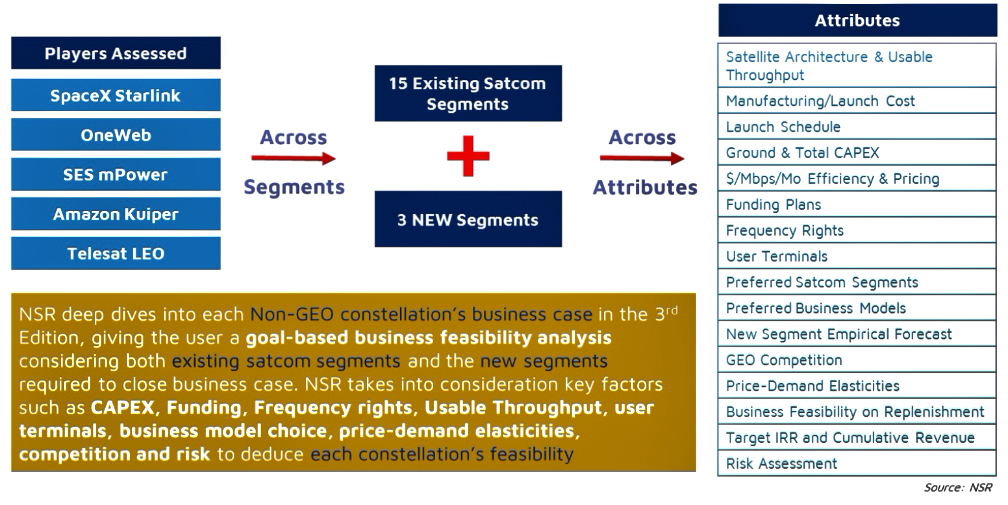
Non-GEOs have arrived and the top 5 contenders SpaceX (Starlink), OneWeb, SES (mPower), Amazon (Kuiper) and Telesat are certain to launch their 1st Gen constellations. There is enough addressable market for all players to play, but not for all players to succeed.

Order this informative report at this direct link…

Article authored by Gagan Agawal, NSR Senior Analyst, Mumbai, India

Filed Under: Market Forecasts, Missions & Constellations

Primary Sidebar

Coverage

  • Missions & Constellations
  • Business & Finance
  • Military & Defense
  • Launch
  • Software Automation & Ground Systems
  • Government & Regulation
  • Services & Applications

Most Read Stories

  • Global Shift Toward Sovereign Launch Gains Momentum Amid Geopolitical Tensions
  • SES Executive Confirms End of the 15-Year Satellite Era
  • SpaceX Unveils ‘Stargaze’ System to Revolutionize Space Traffic Management
  • The Space Data Layer is Coming, Just Not as Fast or as Small as You Think
  • AST SpaceMobile Encapsulates BlueBird 7 Satellite for Inaugural New Glenn Mission

Secondary Sidebar

Footer


Satnews is a leading provider of satellite news, events, publications, research and other satellite industry information in both commercial and military enterprises worldwide.

Stories By Category

  • Business & Finance
  • Government & Regulation
  • Launch
  • Military & Defense
  • Missions & Constellations
  • Services & Applications
  • Software Automation & Ground Systems
  • Spectrum & Licensing
  • Startups & NewSpace Business

About Us

  • Leadership & Editorial Team
  • SatNews History
  • Free Satnews Subscription
  • SatNews Events
  • Magazines

Navigation

  • Latest Stories
  • Magazines
  • Events
  • Contact
  • Cookie & Privacy Policy for Satnews

We use cookies to ensure that we give you the best experience on our website. If you continue to use this site we will assume that you are happy with it.
x
Sign up Now (For Free)
Access daily or weekly satellite news updates covering all aspects of the commercial and military satellite industry.
Invalid email address
Notify Me Regarding ( At least one ):
We value your privacy and will not sell or share your email or other information with any other company. You may also unsubscribe at anytime.

Click Here to see our full privacy policy.
Thanks for subscribing!