


- A recent consumer survey conducted by ABI Research reveals that today’s mobile phone owners use a mix of mobile content obtained from the web, from their personal collections, and from their wireless carriers. As an example, today’s mobile consumer is more likely to watch a video from YouTube on his or her phone than a video from the carrier’s own service, but is more than twice as likely to get ringtones from the carrier than from any other source. The 14 percent of respondents who said they use their phone to watch video was split nearly evenly between those who watch video from websites such as YouTube (35 percent), from their own carrier’s video offering (31 percent), and from video they sideload onto their mobile devices (28 percent). Music was also mixed: the leading source of music files on a mobile phone was ripped CDs and sideloading onto the phone (48 percent of mobile-music listening respondents), while over one third of music-listening respondents (35 percent) purchased music through their carriers. Lastly, pre-loaded content such as games were some of the most popular forms, as six in ten mobile gamers said they only play the games that came with the phone. More info here…
- In the front page story department, the March 19th issue of the online Financial Times (FT.com) indicated the megamusic companies are in discussions with Apple regarding unlimited access to the entire iTunes music library! The catch? Well, this sure as heck WON’T be free of charge. In order for this to occur, there will be a premium price to pay for iPod and iPhone appliances. More revenues for the music industry, more revenues for Apple as the nexgen set of devices would then debut. According to the Financial Times report, bylined by the publication’s Media Editor, Andrew Edgecliffe-Johnson, research reports reveal consumers truly enjoy bundling deals offering the appliance with the content. In fact, the cost factors could range as high as $100 extra for unlimited music access, or a monthly subscription fee to $8 for the iPhone. All this could certainly have been brought to a head by Nokia which is going to launch their “comes with music” appliances during Q2 of this year… they are believed to be paying about $80 per unit to music companies which would be divided amongst them according to their market share.
-
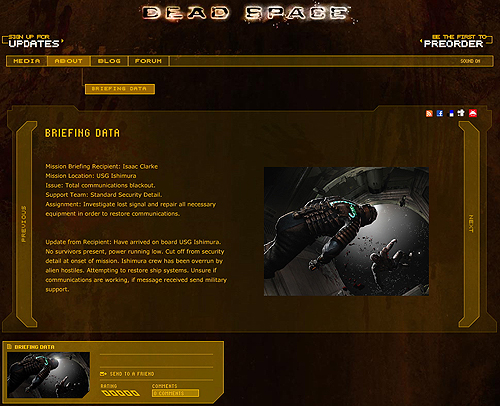
Set to release in time for this year’s Halloween is an animated movie prequel to the sci-fi survival/horror game, Dead Space. Electronic Arts and Starz Media are working on the project as well as animation projects currently in development for two additional Electronic Arts franchises. The script for the Dead Space animated feature picks up the plot where the original comic book series ends and leads up to the beginning of the Dead Space game. The story focuses on the events aboard a futuristic mining spaceship, the USG Ishimura, after it pulls a mysterious artifact from a remote dig site. The artifact triggers the sudden invasion of a long-dormant alien presence—the Ishimura’s crewmembers find themselves locked in a frantic struggle to survive. The animated feature is slated to premiere at the same time as the game is launched. This project signals both companies’ belief that mass-appeal games provide opportunities for new and exciting programming in a variety of different media. This announcement comes at a time when the video game industry is valued at more than $30 billion worldwide for packaged goods, wireless and online games in calendar year 2007 and game-inspired entertainment is pervasive in movie theaters, on TV and across online media—Redwood City and Burbank, California
-
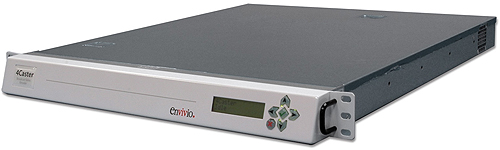
Envivio Inc.’s 4Caster C4 encoders are being used in extensive broadcast trials in Shanghai that, for the first time, combine AVS video encoding with China’s standard for digital terrestrial television broadcasting. This is the first large scale evaluation of AVS (a codec that’s an alternative to H.265/AAC/Vorbis) with the Digital Terrestrial Media Broadcasting (DTMB) standard to take place in China. Full commercial roll out of digital terrestrial TV services based on a combination of the two standards is expected to begin later this year. The three month long trial broadcasts were organized and managed by Shanghai Oriental Pearl Company Limited. AVS streams encoded using the Envivio 4Caster C4 were broadcast using the DTMB standard and then decoded by set top boxes (STBs) powered by Shanghai Longjing AVS chipsets. The Chinese government has long believed that digital terrestrial broadcasting is the most effective way to offer TV services to people living on the outskirts of cities such as Shanghai, as well as in remote rural areas. The commercial roll out of this technology will target more than one million subscribers in Shanghai alone and offer an array of services including standard TV set content delivery, in-vehicle entertainment, as well as outdoor and indoor signage and advertising. The success of the Shanghai trial will pave the way for trials and deployments of similar systems in the other regions of China—South San Francisco, California
-
 Garnering the whopping amount of 19.592B/USD for their 700 MHz wireless spectrum auction, the FCC closed the auction last March 18th. Nope, Google did not win a single license and, on the opposite side of company size, Bend Broadband did win a B block license for Oregon for 6.7M/USD. The big winner — Verizon Wireless winning regional licenses in the C block to build a footprint across the country for 9.63B/USD. And AT&T paid 6.64B/USD for some 227 licenses in the B block. The only bidder in the D block was Qualcomm, who paid 472M/USD for nine licenses… in fact, they were the ONLY D block bidder. Dish paid 711M/USD for 168 E block licenses, while Cox Wireless obtained 22 licenses in the A and B blocks for 304.6M/USD with an especially hefty price of 84.1M/USD for an A-block license in San Diego. Two A Block licenses were obtained by Paul Allen‘s Vulcan Capital for 112M/USD for the Pacific Northwest, which could certainly aid his cable holdings in that region of the country. In the final count, a total of 754 spectrum licenses were won by 99 winning bidders after 261 auction rounds—Washington, D.C.
-
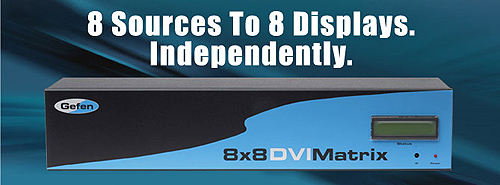
Gefen (NAB: SL 2312) will be presenting three new switchers at the NAB trade show, as their use is one of the easiest ways to integrate a variety of digital video equipment. The new Gefen switchers support single and dual link DVI sources and displays, all in rack mountable enclosures for easy installation. Their 4×4 DVI DL Matrix system connects any four computers or video sources to four DVI displays with complete KVM (keyboard, video, mouse) access and control. This unit is Ideal for assigning computers to edit bays in professional audio/video environments and delivers dual link DVI resolutions to 3840×2400 for detailed video productions. The 8×8 DVI Matrix is the first 8×8 matrix system to be offered by Gefen. This solution interconnects any eight DVI sources to eight displays, offering complete matrix switching among all sixteen connected devices. Displays have access to any source at any time using a 16-key IR remote control or the RS-232 connection. The third offering is their 8×1 DVI DL KVM Switcher, with as many as eight dual link DVI computers and video sources that can be accessed by one DVI display, which streamlines equipment costs. Dual link DVI resolutions are delivered for each computer and KVM access is switched for instant control, whatever source is selected.
-
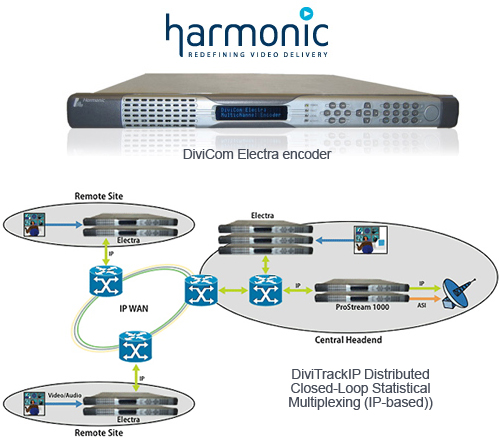
Harmonic Inc. revealed Sun Direct TV Private Limited has deployed Harmonic’s digital video solutions for India’s first MPEG-4 AVC (H.264) direct-to-home (DTH) broadcast service. Harmonic has enabled Sun Direct TV to quickly offer its new DTH service to 40 million homes in southern India by providing a rapidly deployable, end-to-end solution encompassing the latest generation DiviCom Electra encoders, DiviTrackIP statistical multiplexing, the ProStream 8000 digital mosaic solution and NMX Digital Service Manager. Sun Direct TV’s new service was launched in early 2008 with 120 standard definition (SD) channels, and the operator plans to add high definition (HD) video in the near future—Sunnyvale, California
-
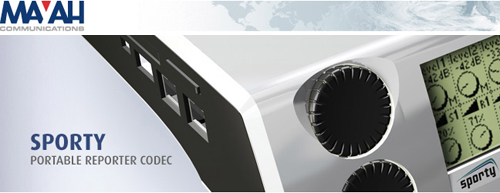
MAYAH Communications will present their Sporty Portable Reporter Codec at NAB. This extremely small and light unit can transmit from anywhere, to anywhere, while simultaneously recording to USB sticks or SD Cards. This portable studio with two, new audio formats (MPEG 4 HEv2 + MPEG 4 AAC ELD) provides one touch “High Quality” and “Low Latency” and can automatically recognize and connect to almost any audio codec and format available. The SPORTY is ideal for situations where the destination codec is unknown. This unit is also ideal for live reporting. The new easy interface is combined with network support and offers traditional PSTN and ISDN support. Added in are WLAN, UMTS/3G and Ethernet.
-
 Many recent announcements highlight the increasing use of bandwidth-enhancing DVB-S2 and MPEG4 technologies. Both continue making inroads into each of the five distinct satellite applications analyzed by NSR in its recently released MPEG4 and DVB-S2 study. All of the announcements reveal that the common denominator is leveraging the proven efficiencies of the two complementary standards to capitalize on lower satellite capacity costs, wider content choice or higher connectivity speed. More on this report can be found at at this link.
-
The U.S. Department of Homeland Security’s Science and Technology Directorate announced a contract award of $6.275 million to Thales Communications, Inc. to demonstrate the first-ever portable radio prototype allowing emergency responders—police officers, firefighters, and emergency medical service personnel—to communicate with partner agencies regardless of radio band. Equal in cost, size, and weight to existing portable radios, the multi-band radio will provide emergency responders with cutting-edge communications capabilities. To support emergency response radio communications, the Federal Communications Commission has reserved radio spectrum within several different frequency bands for public safety use. Today, a radio is developed to operate within a specific frequency band—with no one radio able to tune to channels within every public safety frequency band. Consequently, emergency response agencies and support units that operate in different radio frequency bands often cannot communicate
with each other. The multi-band radio project addresses this capability gap by demonstrating a single radio that operates on all public safety radio bands. The contract has a performance period of 12 months, and CCI will manage the multi-band radio demonstration to determine how well the technology meets the critical needs of frontline emergency responders—Clarksburg, Maryland

-
 Wowza Media Systems has announced its award-winning Wowza Media Server Pro is the first Flash media server to bring live streaming to Adobe Flash players using readily available H.264 encoders that support standard RTP/RTSP protocol. Part of the Wowza Media Server Pro 1.5.0 preview release, this exclusive capability empowers broadcasters, users and makers of telepresence systems, IPTV providers, content owners, and CDNs to immediately stream live H.264 SD and HD content to the Flash player, the most widely deployed media player on the Internet, without any changes to encoders, and it completely eliminates the need for encoders to support the proprietary RTMP Flash protocol. H.264 for video and HE-AAC for audio are already the de facto compression standards in many facets of broadcasting, online media and entertainment. In addition to IPTV and telepresence applications, H.264, in its 3GP variant, is the most popular video encoding format for mobile video. H.264 is also the encoding format of choice for Blue-ray, which recently became the high-definition DVD standard. Additionally, Wowza Pro 1.5.0 fully supports on-demand H.264 video and HE-AAC audio streaming and offers audio netcasters a unique capability of restreaming HE-AAC and MP3 SHOUTcast/Icecast sources to Flash—San Jose, California
PRIVACY POLICY
digiGO!™—The Digital World… does not sell or trade subscribers’ names or personal information to any interested parties.
DISCLAIMER
digiGO! and its agents and distributors used all best efforts to collect and prepare the information published herein. However, digiGO! does not assume, and hereby disclaims, any and all liability for any loss or damage caused by errors or omissions, whether such errors or omissions resulted from negligence, accident, or other causes.
Copyright 2006—2008 digiGO! | High Sierra Media Group (HSMG) & SatNews Publishers. All rights reserved.
