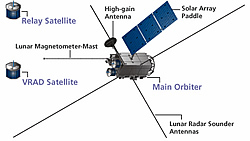
The "KAGUYA" consists of a Main Orbiter, which circulates 100 kilometers above the Moon, and two small satellites (a Relay Satellite and a VRAD Satellite). (Courtesy: JAXA)
JAPAN: August 16, 2007—Satnews Daily—The Japan Aerospace Exploration Agency (JAXA) has reported a rescheduling for the launch of the lunar Orbit Explorer KAGUYA to September 13, 2007. The craft will be sent aloft via the H-IIA Launch Vehicle #13 (H-IIA F13). The launch may now proceed after work was completed on the replacement of parts for the two, on board baby satellites.
The KAGUYA is the highest performing lunar probe since the Apollo program. The goal will be to gather data regarding the origin and evolution of the Moon, as well as what role the Sun plays on Earth’s satellite. The plan is for the craft to orbit the Earth twice and then head into lunar orbit. At that point, the Relay Satellite and the VRAD Satellite will separate from the Main Orbiter. They will observe the Moon’s surface for a one-year period of time, with each small satellite circling the Moon on different elliptic orbits. The Main Orbiter will continue in a circular orbit above the Moon, passing over both poles, with an orbit of 100 kilometers.
- Skip to primary navigation
- Skip to main content
- Skip to primary sidebar
- Skip to secondary sidebar
- Skip to footer


Satellite Industry Intelligence Since 1983
Footer

Satnews is a leading provider of satellite news, events, publications, research and other satellite industry information in both commercial and military enterprises worldwide.