

• Skip to primary navigation
  • Skip to main content
  • Skip to primary sidebar
  • Skip to secondary sidebar
  • Skip to footer
  • NEWS:
  • SatNews
  • SatMagazine
  • MilSatMagazine
  • SmallSat News
  • |     EVENTS:
  • SmallSat Symposium
  • Satellite Innovation
  • MilSat Symposium
  • SmallSat Europe

SatNews

Satellite Industry Intelligence Since 1983

Subscribe
  • LATEST
  • SatNews Events
  • Magazines
  • Calendar
  • Subscribe
  • Missions & Constellations
    • Exploration & Science Missions
    • In-Orbit Servicing & Orbital Operations
    • LEO Constellations
    • Mission Autonomy & Onboard Systems
    • Mission Deployments & Manifests
    • Navigation & PNT
    • SmallSat
    • Spacecraft & Payload Technology
    View All in Missions & Constellations →
    SpaceX Unveils 250 kW Starlink Gen3 AI Satellites Featuring 10 Tbps Throughput and Onboard Edge ComputeSpaceX Unveils 250 kW Starlink Gen3 AI Satellites Featuring 10 Tbps Throughput and Onboard Edge Compute
    Planet Labs Emerges as Cost-Effective Satellite Investment Amid High Multiples for Launch PeersPlanet Labs Emerges as Cost-Effective Satellite Investment Amid High Multiples for Launch Peers
    GomSpace Prepares 8U CubeSat GOMX-5 for SpaceX Transporter-18 Launch to Demonstrate Satellite Communications TechnologyGomSpace Prepares 8U CubeSat GOMX-5 for SpaceX Transporter-18 Launch to Demonstrate Satellite Communications Technology
    AT&T, T-Mobile, and Verizon Form Joint Venture to Standardize Satellite Direct-to-Device ConnectivityAT&T, T-Mobile, and Verizon Form Joint Venture to Standardize Satellite Direct-to-Device Connectivity
  • Business
    • Contracts & Commercial Deals
    • Earnings & Financial Reporting
    • Events & Conferences
    • Funding & Venture Capital
    • Market Forecasts
    • Mergers & Acquisitions
    • Personnel Moves & Appointments
    View All in Business & Finance →
    BAE Systems Awarded $16 Million Collins Aerospace Contract to Deliver M-Code GPS for U.S. Navy Carrier LandingsBAE Systems Awarded $16 Million Collins Aerospace Contract to Deliver M-Code GPS for U.S. Navy Carrier Landings
    PLD Space and CNES Partner to Expand Launch Infrastructure at Guiana Space CentrePLD Space and CNES Partner to Expand Launch Infrastructure at Guiana Space Centre
    True Anomaly Selected as Title Sponsor for Spacepower Conference 2026True Anomaly Selected as Title Sponsor for Spacepower Conference 2026
    Astro Digital to Go Public via $587 Million SPAC Merger with Proem Acquisition Corp IAstro Digital to Go Public via $587 Million SPAC Merger with Proem Acquisition Corp I
  • Defense
    • Counterspace & ASAT
    • Defense Budgets & Procurement
    • ISR & Reconnaissance
    • MILSATCOM
    • Missile Warning & Defense
    • National Security Programs
    • Space Domain Awareness
    View All in Military & Defense →
    Novaspace Releases Defense and Security Satellite Communications ReportNovaspace Releases Defense and Security Satellite Communications Report
    U.S. Space Force Mission Delta 2 Develops Advanced SDA Software to Prioritize Rapid Satellite TrackingU.S. Space Force Mission Delta 2 Develops Advanced SDA Software to Prioritize Rapid Satellite Tracking
    L3Harris Awarded $6 Billion Seven-Year Contract to Expand THAAD Missile Defense Propulsion ProductionL3Harris Awarded $6 Billion Seven-Year Contract to Expand THAAD Missile Defense Propulsion Production
    U.S. Space Force Solicits Commercial Proposals for Restructured SCAR Ground Antenna NetworkU.S. Space Force Solicits Commercial Proposals for Restructured SCAR Ground Antenna Network
  • Gov
    • Export Controls & Compliance
    • International Space Agreements
    • National Space Policy
    • Space Law & Treaties
    • Space Sustainability & Debris Policy
    • Space Traffic Management / Debris Removal
    View All in Government & Regulation →
    FCC Votes to Exempt Satellite Licensing from NEPA Environmental Reviews and Opens 1,000 MHz of SpectrumFCC Votes to Exempt Satellite Licensing from NEPA Environmental Reviews and Opens 1,000 MHz of Spectrum
    Taylor Jordan Puts a $2.35 Billion Price on NOAA’s New Commercial Data Vehicle.Taylor Jordan Puts a $2.35 Billion Price on NOAA’s New Commercial Data Vehicle.
    Europe Decides in December Whether to Launch Its Own Astronauts. The Money Comes Later.Europe Decides in December Whether to Launch Its Own Astronauts. The Money Comes Later.
    The ITU’s Outgoing Spectrum Chief Expects WRC-27 to Find Room for Direct-to-Device. 151 Mobile Operators Are Already Building Toward It.The ITU’s Outgoing Spectrum Chief Expects WRC-27 to Find Room for Direct-to-Device. 151 Mobile Operators Are Already Building Toward It.
  • Launch
    • Launch Providers
    • Launch Schedule & Calendars
    • Launch Sites & Infrastructure
    • Rocket Technology & Vehicles
    View All in Launch →
    Sateliot Launches Five Alén Space-Built CubeSats for Draconis 5G NTN IoT MissionSateliot Launches Five Alén Space-Built CubeSats for Draconis 5G NTN IoT Mission
    CAS Space Delays Maiden Flight of Reusable Lihong-2 Suborbital Rocket to 2027CAS Space Delays Maiden Flight of Reusable Lihong-2 Suborbital Rocket to 2027
    Momentus Demonstrates AI-Enabled LiDAR and Optical Suite During In-Orbit RPO Campaign with NASA SatelliteMomentus Demonstrates AI-Enabled LiDAR and Optical Suite During In-Orbit RPO Campaign with NASA Satellite
    SpaceX Launches Starship Flight 14 from Starbase in Inaugural Orbital Test FlightSpaceX Launches Starship Flight 14 from Starbase in Inaugural Orbital Test Flight
  • Software
    • Autonomous Ground Operations
    • Data Processing & AI/ML
    • Digital Twins & Modeling
    • Ground Segment & Teleports
    • Mission Planning & Simulation
    • Space Systems Software Engineering
    • Spectrum & Licensing
    View All in Software Automation & Ground Systems →
    SES and Sky Extend Direct-to-Home Satellite Capacity Agreement Across UK and IrelandSES and Sky Extend Direct-to-Home Satellite Capacity Agreement Across UK and Ireland
    Arqiva Proposes Managed 2044 Digital Terrestrial Television Switch-Off in UK Government Green PaperArqiva Proposes Managed 2044 Digital Terrestrial Television Switch-Off in UK Government Green Paper
    Everyone at WSBW Described a Bottleneck. In Every Case It Was Someone Else’s Business.Everyone at WSBW Described a Bottleneck. In Every Case It Was Someone Else’s Business.
    Space Development Agency Issues $369 Million Solicitation for Global Missile Tracking Ground Entry PointsSpace Development Agency Issues $369 Million Solicitation for Global Missile Tracking Ground Entry Points
  • Services & Apps
    • Climate & Environmental Monitoring
    • Disaster Response & Security Mapping
    • Earth Observation & Imaging
    • Maritime & Aviation Satcom
    • Satellite Communications
    View All in Services & Applications →
    Qorvo Unveils Integrated X-Band RF Front-End Solution for AESA Radar SystemsQorvo Unveils Integrated X-Band RF Front-End Solution for AESA Radar Systems
    ICEYE and Nokia Partner to Develop Sovereign LEO Satellite Communications Systems for DefenseICEYE and Nokia Partner to Develop Sovereign LEO Satellite Communications Systems for Defense
    BEC Technologies Launches MX-340-IRD Hybrid Cellular and Satellite Gateway for Remote InfrastructureBEC Technologies Launches MX-340-IRD Hybrid Cellular and Satellite Gateway for Remote Infrastructure
    ATLAS Space Operations and York Space Systems Activate Second Antenna at Rwanda Teleport to Double Equatorial Contact CapacityATLAS Space Operations and York Space Systems Activate Second Antenna at Rwanda Teleport to Double Equatorial Contact Capacity

Rheinmetall Walked Away. Germany Should Take the Hint.

March 16, 2026

Abbey White, Staff Writer, SatNews

With Rheinmetall officially abandoning its alternative bid for Mynaric on March 11, the German government’s justification for blocking Rocket Lab’s acquisition has completely collapsed.

Three Uncomfortable Truths for Berlin:

  • Over 90% of Mynaric’s backlog is U.S. DoD money. The company was never a sovereign German asset in any operational sense.
  • Rheinmetall was never structurally positioned to make a competing acquisition. Its involvement was political positioning, not a viable bid.
  • Six months of Foreign Direct Investment (FDI) review nearly starved the company Rocket Lab is prepared to fund with $150 million. Protectionism almost destroyed the asset it was meant to protect.

The Discordant Bid

Rheinmetall spent weeks positioning itself as the sovereign alternative to Rocket Lab’s $150 million acquisition agreement, cultivating a narrative in which German laser communications technology would remain under a German flag, protected from the uncomfortable reality of American ownership. Then the defense giant’s leadership looked at the actual company (a firm bleeding cash, deep in restructuring, with a customer base that is functionally a subsidiary of the Pentagon) and concluded it was better off buying the product than buying the company.

Rheinmetall explicitly stated that Mynaric’s CONDOR Mk3 optical communication terminals could be accessed through commercial licensing or subcontracts for its own constellation projects. The technology, in other words, does not require ownership. Sovereignty, apparently, has a price ceiling.

The Customer Reality
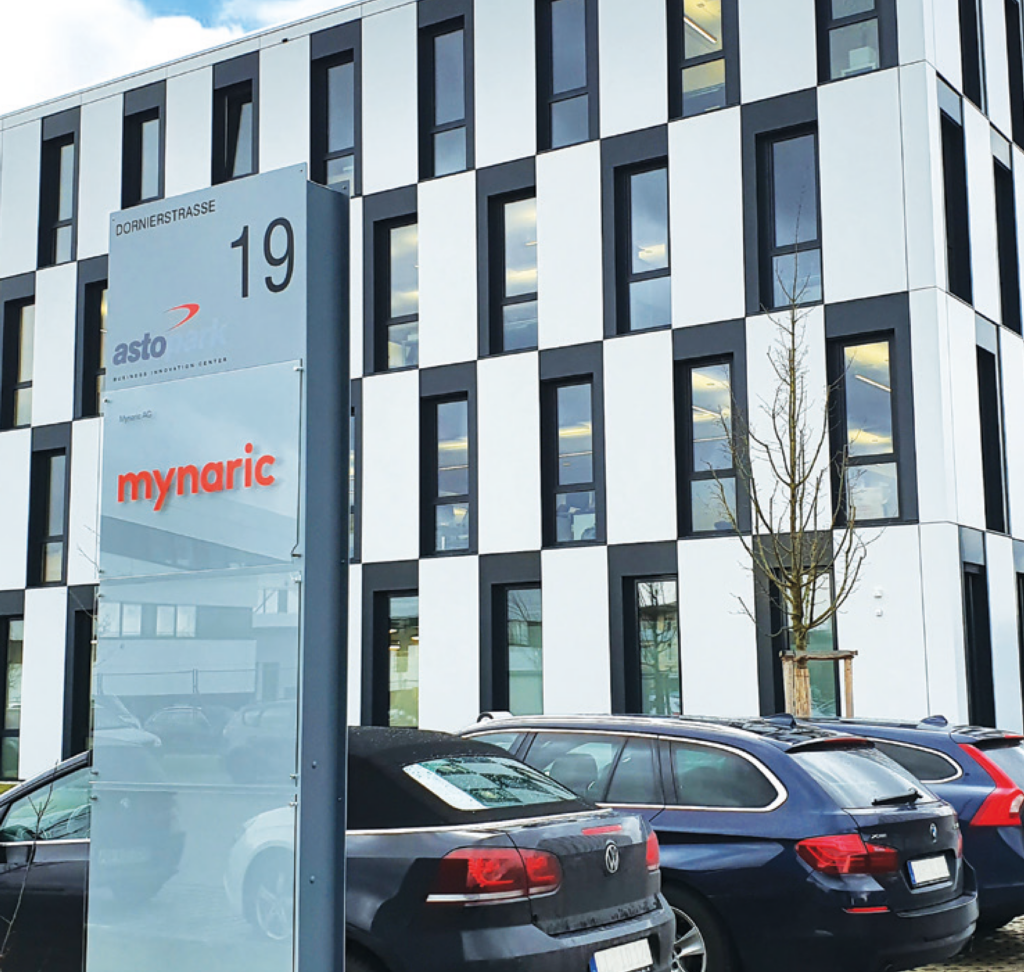
The fundamental problem with framing Mynaric as a sovereign German asset is arithmetic. Over 90% of the company’s order backlog is tied directly or indirectly to the U.S. Department of Defense, specifically the Space Development Agency’s Tranche 2 Transport Layer. Mynaric’s largest contractual relationship runs through Rocket Lab itself, supplying CONDOR terminals for the latter’s $515 million SDA prime contract to build 18 satellites. The European institutional space budget, fragmented across ESA, the EU’s IRIS-squared constellation, and individual national programs, has not produced a single contract of comparable scale for laser communications.

A company whose survival depends entirely on the American taxpayer is not meaningfully sovereign regardless of which flag flies above its Munich headquarters. Blocking the U.S. buyer does not change the underlying market structure. It merely ensures that the German company serving that market does so from a position of financial weakness rather than strength.

A Restructuring Is Not a Strategy

The sequence of events highlights exactly how bureaucratic friction destroys value. Mynaric entered StaRUG restructuring proceedings, the German equivalent of Chapter 11, because it could not sustain operations on its existing capital base. The company completed that process in August 2025. Rocket Lab signed a definitive agreement in September. Then the German Ministry of Economic Affairs initiated a Foreign Direct Investment review, and the file sat on a desk in Berlin for six months.

During those six months, Mynaric continued to burn through cash while its acquirer, the company prepared to inject $75 million immediately with up to $75 million more in earn-out payments, waited for permission to write the check. Furthermore, the FDI review attracted Rheinmetall’s attention, introducing the prospect of a competing bid that never materialized. The sovereign protectionism that was supposed to safeguard Mynaric instead subjected a financially fragile company to months of additional uncertainty at precisely the moment it could least afford it.

True sovereignty requires a thriving industrial base. A bankrupt laser communications company provides exactly zero sovereign capability to anyone.

The National Champion Fallacy

Rheinmetall’s withdrawal deserves close scrutiny because it reveals a structural misunderstanding that extends well beyond this single transaction. The implicit assumption behind a national champion rescue was straightforward: take a nimble, deep-tech startup and fold it into a large defense prime with stable government revenue, and the sovereignty problem is solved.

However, defense primes acquire companies to solve specific capability gaps within existing program architectures. Rheinmetall does not operate satellite constellations; it builds armored vehicles, ammunition, and air defense systems. Its interest in laser communications is real but narrow; it needs optical terminals for future Bundeswehr connectivity programs, not a 300-person R&D organization with its own product roadmap, manufacturing floor, and customer relationships. Crucially, Rheinmetall recognized this distinction before committing. A startup’s value lies in its independence, its speed, and its focus. Absorbing it into a legacy prime risks destroying precisely the characteristics that made the technology worth acquiring.

The ESA HydRON contract awarded to Mynaric on March 5, a laser communications demonstration for the High Throughput Optical Network, illustrates the point. Mynaric won that work as a specialist. It would not have won it as a division of Rheinmetall’s defense electronics unit.

The Legitimate Concern

None of this means the sovereignty objection is frivolous. There is a genuine security argument buried beneath the political theater, and it deserves a serious answer. Under U.S. ownership, Mynaric’s Munich operations could become subject to ITAR restrictions and U.S. export control regimes that limit which European defense programs the company can serve. A German-developed laser terminal manufactured in Bavaria but controlled by a U.S. parent company could require State Department approval before shipping to a French or Italian constellation partner. For a continent trying to build IRIS-squared as a sovereign European communications backbone, that dependency is not hypothetical; it is an operational planning constraint.

Furthermore, the track record of allied acquisitions in European defense technology is mixed. Washington’s willingness to share critical space technology with European allies fluctuates with administrations, trade disputes, and shifting geopolitical priorities. Berlin is not wrong to worry about what happens when allied interests diverge.

However, this concern must be weighed against the alternative that actually exists, not the alternative Berlin wishes it had. The choice is not between a sovereign Mynaric and an American-owned Mynaric. It is between a funded, manufacturing Mynaric under Rocket Lab and a financially broken Mynaric that cannot deliver terminals to anyone, European or American. ITAR restrictions on a functioning company are a manageable policy problem. Insolvency is not.

Sovereignty Reimagined

The German government now faces a binary choice, though the AWV review timeline can extend if the Ministry requests additional information. But approving the acquisition is not the same as surrendering sovereign ambition. It is an opportunity to redefine what sovereignty means in an allied defense ecosystem.

Rocket Lab has committed to making Munich its central European headquarters, retaining the 300-person engineering team, and scaling up manufacturing on German soil. That commitment is not charity; it is strategy. Rocket Lab needs a European production base to compete for ESA contracts, to serve NATO allies with shorter supply lines, and to position itself as a credible partner for IRIS-squared and future EU defense programs. Germany becomes the factory floor, the engineering talent pool, and the regulatory gateway to the European defense market. That is leverage, not dependency.

South Korea’s semiconductor industry, Taiwan’s TSMC, and Israel’s defense technology sector all demonstrate that sovereign capability does not require autarky. It requires becoming so deeply embedded in allied supply chains that your partners cannot route around you. A Munich-based laser communications hub manufacturing terminals for SDA, ESA, and NATO simultaneously would make Germany indispensable to the transatlantic space architecture. No amount of ITAR paperwork changes the fact that the engineers, the clean rooms, and the institutional knowledge sit in Bavaria.

The alternative, letting Mynaric wither while searching for a national buyer that does not exist, is not sovereignty. It is a slow-motion liquidation of the exact capability Berlin claims to be protecting.

The Ministry of Economic Affairs should approve the acquisition and stop pretending that a German-owned bankruptcy is preferable to an allied-owned success story.

  • Mail
  • LinkedIn

Correction (March 16, 2026): This article originally overstated the certainty of the FDI review timeline and the nature of Rheinmetall’s involvement. The text has been updated.

Filed Under: Export Controls & Compliance, Mergers & Acquisitions, MILSATCOM Tagged With: Editorial

Primary Sidebar

Coverage

  • Missions & Constellations
  • Business & Finance
  • Military & Defense
  • Launch
  • Software Automation & Ground Systems
  • Government & Regulation
  • Services & Applications

Most Read Stories

  • No U.S. Servicer Has Captured a Dead Satellite. The Pentagon Is Buying It Anyway.
  • Isar Aerospace Reaches Orbit with Spectrum Rocket Launch from Norway's Andøya Spaceport
  • The FCC Asked Cowboy Space How Big Its Satellites Are
  • Rocket Lab Files GAO Bid Protest Over NASA’s $700M Mars Orbiter Award to Blue Origin
  • Loft Orbital and Marlan Space Award $1 Billion Contract for 50 AI-Equipped LEO Satellites

Secondary Sidebar

Footer


Satnews is a leading provider of satellite news, events, publications, research and other satellite industry information in both commercial and military enterprises worldwide.

Stories By Category

  • Business & Finance
  • Government & Regulation
  • Launch
  • Military & Defense
  • Missions & Constellations
  • Services & Applications
  • Software Automation & Ground Systems
  • Spectrum & Licensing
  • Startups & NewSpace Business

About Us

  • Leadership & Editorial Team
  • SatNews History
  • Free Satnews Subscription
  • SatNews Events
  • Magazines

Navigation

  • Latest Stories
  • Magazines
  • Events
  • Contact
  • Cookie & Privacy Policy for Satnews

We use cookies to ensure that we give you the best experience on our website. If you continue to use this site we will assume that you are happy with it.
x
Sign up Now (For Free)
Access daily or weekly satellite news updates covering all aspects of the commercial and military satellite industry.
Invalid email address
Notify Me Regarding ( At least one ):
We value your privacy and will not sell or share your email or other information with any other company. You may also unsubscribe at anytime.

Click Here to see our full privacy policy.
Thanks for subscribing!