

Reports emerged on April 1 and 2, 2026, indicating that Amazon is in advanced negotiations to acquire satellite telecommunications provider Globalstar for approximately $9 billion.
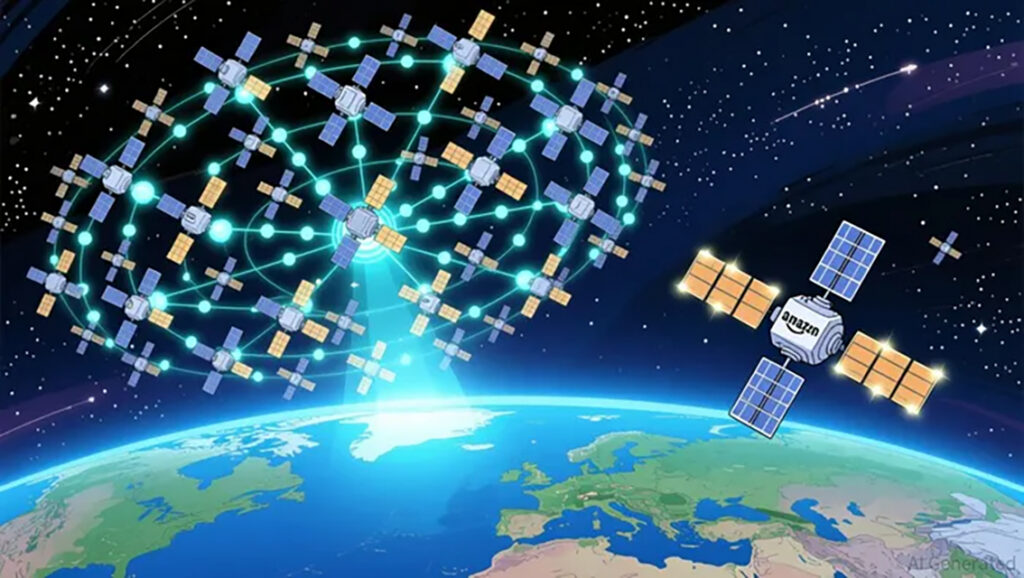
This strategic move is seen as a major escalation in Amazon’s effort to close the gap with SpaceX’s Starlink, providing the company with immediate access to critical spectrum and a functioning orbital network.
The deal would integrate Globalstar’s assets into Amazon Leo (formerly known as Project Kuiper), which has faced pressure to meet aggressive FCC deployment deadlines. Following the news, Globalstar (GSAT) shares surged by more than 24%, reaching an 18-year high in early April trading.
The Apple Factor: A Complex Three-Way Negotiation
The most significant hurdle to the acquisition is Apple’s deep-seated relationship with Globalstar. In 2024, Apple invested $1.5 billion into the company for a 20% equity stake and secured a commitment for 85% of Globalstar’s network capacity to power iPhone features like Emergency SOS and Messages via satellite.
- Veto Power: As a 20% shareholder, Apple effectively holds veto power over major corporate changes, including a total sale of the company.
- Competitive Tension: Amazon and Apple are direct rivals in consumer hardware and cloud services. The prospect of Amazon owning the infrastructure that powers a signature iPhone safety feature is a significant point of friction.
- Ongoing Talks: Reports from the Financial Times suggest that Amazon is currently engaged in separate, parallel negotiations with Apple to either buy out their stake or ensure the continuity of iPhone services under Amazon ownership.
As Amazon negotiates this 9 billion dollar acquisition of Globalstar, a central technical challenge is how to integrate Globalstar’s L-band and S-band spectrum into the Amazon Leo network without interfering with Apple’s critical iPhone emergency services. As of April 2, 2026, the Federal Communications Commission (FCC) is reviewing several interference mitigation strategies that Amazon intends to employ to ensure “peaceful coexistence” between high-speed internet traffic and life-saving messaging.
Dynamic Frequency Separation and Guard Bands
Amazon’s primary strategy involves a software-defined “Dynamic Spectrum Management” system. This technology allows the Amazon Leo satellites to identify when an iPhone is attempting a satellite SOS connection and automatically shift its high-bandwidth data transmissions to a different portion of the frequency band.
By maintaining “guard bands”—narrow buffers of unused spectrum—between the Amazon data streams and the Globalstar emergency channels, the company can prevent signal leakage that would otherwise drown out the low-power transmissions from handheld devices. This is particularly vital for the iPhone 17’s enhanced “Real-Time Satellite Video” emergency feature, which requires a clean, jitter-free signal to reach emergency dispatchers.
Geofencing and Beam Steering
Because Amazon Leo satellites utilize advanced phased array antennas, they can perform highly precise “beam steering.” This allows the satellites to “null” or skip over specific geographic areas where high volumes of emergency satellite traffic are detected.
By beam steering Amazon’s satellites can focus their high-power internet beams away from known Globalstar ground stations and areas with active SOS pings. And with cooperative geofencing, under a proposed agreement with Apple, Amazon would receive anonymized, real-time telemetry regarding the location of active satellite-connected iPhones, allowing the Leo constellation to adjust its power levels in those specific 50-kilometer “cells.”
The “Sovereign Waveform” for Emergency Priority
Beyond physical frequency separation, Amazon is proposing the implementation of a “Sovereign Priority Waveform” within its network. This technical standard would grant Globalstar/Apple emergency packets absolute priority over all other traffic in the constellation.
If the network reaches a state of congestion, the onboard AI agents—which now manage the Amazon Leo mesh—will automatically throttle commercial video streaming or enterprise data to ensure that 100% of the required bandwidth is available for emergency SOS services. This “pre-emptive” architecture is designed to satisfy FCC requirements for Public Safety and Homeland Security.
Addressing the FCC Milestone Pressure
To undertake all this seeming gobbledygook, is the urgency of this spectrum sharing plan driven by Amazon’s looming FCC deadline. The company is currently required to launch half of its 3,232-satellite constellation by July 30, 2026. As of early April, Amazon has approximately 212 satellites in orbit, leaving it nearly 1,400 units short of the milestone.
By acquiring Globalstar and successfully implementing these interference mitigation techniques, Amazon can potentially leverage Globalstar’s existing, licensed orbital assets to satisfy regulatory requirements for “coverage” while its own launch cadence catches up. This strategy, often referred to in the industry as “trading capital for time,” remains subject to final approval from the FCC Space Bureau, which is currently weighing objections from SpaceX regarding the “spectral efficiency” of such a combined network.
Why Amazon Wants Globalstar
While Amazon’s own Leo constellation has approximately 180 satellites in orbit, it is dwarfed by Starlink’s 10,000+ units. Acquiring Globalstar provides three immediate strategic advantages:
- Spectrum Goldmine: Globalstar holds valuable, internationally-cleared L-band and S-band spectrum licenses. These frequencies are ideal for mobile satellite services and “Direct-to-Device” (D2D) connectivity, which would allow Amazon to offer satellite-to-phone services without specialized hardware.
- Operational Infrastructure: Globalstar brings a mature network of 20+ ground gateway stations and a proven operational team, bypassing years of regulatory and construction cycles.
- Commercial Urgency: Amazon recently signed major connectivity deals with Delta Air Lines and JetBlue. Globalstar’s existing capacity could serve as a stopgap or supplement to ensure these services launch on time in 2027 and 2028.
Market and Regulatory Outlook
Analysts suggest that an Amazon-Globalstar merger would signal an “industrial inflection point,” moving the LEO sector from technical verification to commercial consolidation. However, the deal is expected to face intense regulatory scrutiny from both the FCC and competition authorities due to the intersection of two “Big Tech” giants and the control of scarce spectrum resources.
Globalstar has officially declined to comment on the reports, citing a policy against addressing industry rumors.
