

By Danny Sabour, VP of Sales and Marketing at Avalanche Technology Inc.
The aerospace and defense industry has universally accepted that the future of orbital superiority lies in proliferated, software-defined constellations. The mandate from the Space Development Agency (SDA), with support from the Defense Innovation Unit (DIU), is clear: move away from vulnerable, exquisite “battlestars” and build agile, interconnected data networks in Low Earth Orbit (LEO). But while our architectural theory has evolved, the hardware foundation we are building it on is trapped in a dangerous compromise.
What Amnesia Looks Like at Mach 20
Consider a proliferated LEO constellation tasked with tracking hypersonic glide vehicles. In this architecture, raw infrared and radar data can’t be downlinked to a terrestrial station for processing. The latency alone would break the kill chain. The tracking, targeting, and handoff must be calculated autonomously, in real-time, on the satellite itself.
Now, introduce a contested environment. Whether it’s a directed energy attack, an electromagnetic pulse (EMP), or simply a severe solar weather event, power disruptions in orbit are an operational reality.
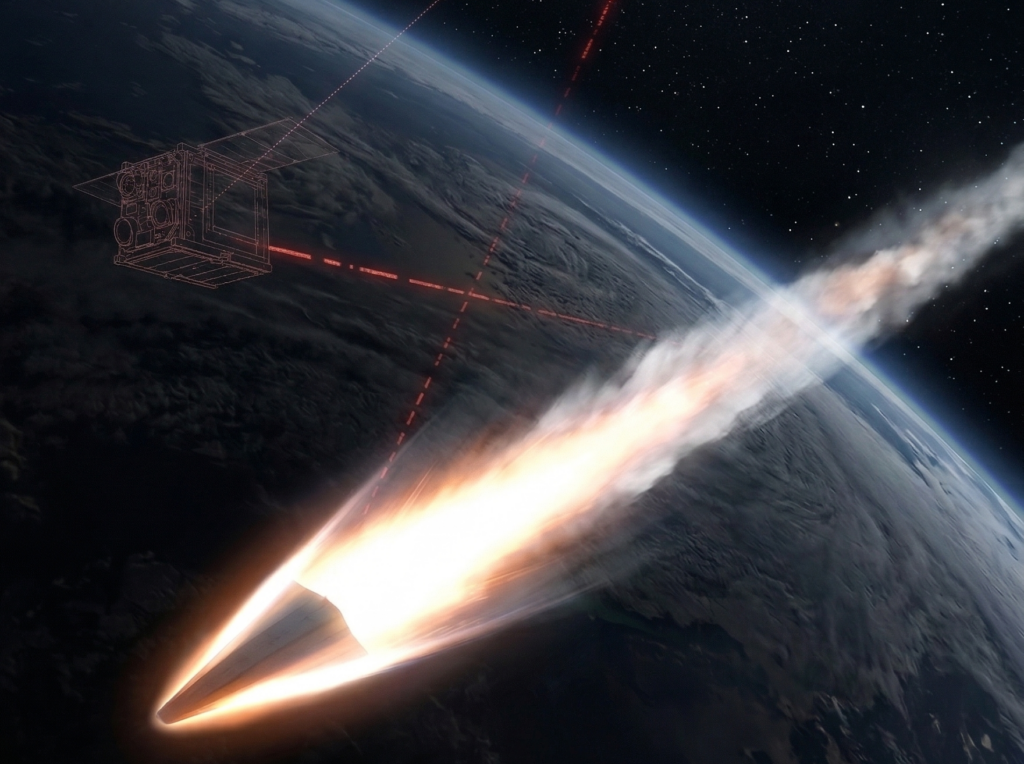
If that tracking satellite is relying on standard, charge-based memory for its in-situ processing, a momentary loss of power is catastrophic. The millisecond the power drops, the electrical charges dissipate. The satellite effectively wakes up with total amnesia. It must spend precious seconds, possibly minutes, rebooting, pulling its operating system from slower storage, recalibrating its star trackers, and attempting to reacquire the hypersonic target. By the time the node is back online, the threat has traveled hundreds of miles. The network has failed.
This isn’t a theoretical risk. Standard commercial silicon, whether Flash, SRAM, or DRAM, fundamentally relies on microscopic electrical charges to store data. In the high-radiation environment of orbit, these electrical states are inherently fragile, highly susceptible to bit flips and catastrophic latch-ups from cosmic rays. And yet this is exactly what we’re building proliferated constellations on.
The COTS Compromise: A Napkin Math Reality Check
To understand why the industry is making this hardware choice, and why it’s the wrong one, we have to do the system-level napkin math.
Consider a standard proliferated LEO constellation designed for a 5-year mission. To survive the Van Allen belts and solar weather, the SDA and prime contractors generally require components to withstand a Total Ionizing Dose (TID) of roughly 30 krad(Si).
Standard commercial memory (like SRAM) typically begins experiencing severe bit flips or failure between 5 and 10 krad. To bridge this gap, engineers take the “Careful COTS” middle road: they use the cheap commercial memory, but wrap it in shielding and implement Triple Modular Redundancy (TMR). Here is where the math destroys the economics of the SmallSat:
The TMR Power Tax: TMR dictates that you must use three identical memory chips to do the job of one, utilizing a “voting” circuit to correct radiation-induced bit flips. You’ve instantly tripled your memory component footprint and power draw.
The Volatility Tax: Standard SRAM is volatile. It requires a continuous flow of electricity just to hold data, plus extra processing power to constantly “scrub” the memory for errors.
The System-Level Cascade: On a satellite, power is a zero-sum game. As a general aerospace rule of thumb, every 1 Watt of continuous power draw requires roughly 2 to 4 Watts of total system overhead (including solar array sizing, battery mass, and power conditioning) to survive the eclipse phase of the orbit.
When you combine the tripled power draw of TMR, the constant electrical drain of volatile memory, and the physical weight of shielding, the compounded effects are severe. At current launch costs of thousands of dollars per kilogram, adding structural mass for larger batteries and heavy shielding entirely erases the upfront cost savings of using commercial silicon. Worse, every watt of power dedicated to keeping memory alive is a watt stolen from the primary payload.
The entire operational advantage of a proliferated architecture relies on optimizing Size, Weight, and Power (SWaP). If a contractor must dedicate a massive percentage of a SmallSat’s mass and power budget simply to prevent its memory from wiping itself, the agility of the constellation evaporates. We’re effectively putting heavy medieval armor on modern infantry and expecting them to sprint.
A Better Foundation
When we run this same math using a true Space-Grade, non-volatile architecture, the equation flips, but precision matters here. MRAM is a more modern and optimal alternative that overcomes these innate vulnerabilities seen in traditional legacy memories. However, not all STT-[1] MRAM is created equal. The magnetic memory cell itself is radiation-immune, storing data via a Magnetic Tunnel Junction rather than fragile electrical charges. But generic industrial MRAM still carries radiation-vulnerable support circuitry: the read/write logic, power delivery, and peripheral circuits that can fail just as readily as any other chip under particle bombardment. The difference with a purpose-built Space Grade device is that TMR is integrated directly into the logic on the die at the deep submicron level, and the power delivery circuitry is hardened as well. Error detection and correction (EDAC) functionality is built in. The system integrator doesn’t add any of that externally. It’s already solved at the component level.
The result: no external TMR boards, no bolt-on shielding, no battery backup for volatile states. And because the memory itself is non-volatile, it draws zero power at rest. By avoiding the “Careful COTS” compromise and choosing a memory architecture where radiation hardening is a feature of the chip rather than a burden on the system designer, satellite engineers aren’t just buying better memory. They’re buying back critical mass, power, and engineering margin for the mission.
And the satellite that loses power in a contested environment? When data is stored via magnetic states rather than trapped electrons, the system is immune to power-loss amnesia. If power drops, the data is frozen in place. When power is restored, the system experiences “instant-on” recovery, picking up the tracking algorithm exactly where it left off. No reboot. No recalibration. No lost target.
A New Foundation for Orbital Superiority
The Department of Defense’s vision for a proliferated, AI-driven Hybrid Space Architecture is the correct path forward for national security. But we can’t achieve next-generation orbital superiority using last-generation terrestrial hardware compromises.
Continuing to force fragile, charge-based memory into the hostile environment of space and attempting to mitigate the inevitable failures with heavy shielding or redundant software is a losing battle against physics and SWaP constraints. To build true “data centers in space” that can process hypersonic threats in real-time and survive contested environments, the aerospace industry must adopt a new hardware baseline.
We must transition to inherently radiation-immune, non-volatile memory architectures from the ground up. While many technologies claim to be “Space Grade”, it requires that 5 objective criteria be met simultaneously. Space Grade memory must:
1️⃣ Survive radiation without disruption
2️⃣ Retain data for the full mission lifetime
3️⃣ Endure unlimited writes
4️⃣ Commit data instantly with non-volatile persistence
5️⃣ Demonstrate real space heritage
The afforded resilience and adaptability from employing truly Space Grade MRAM also happens to provide the most elegant hardware and software framework for enduring innovation. Only by building on an uncompromising foundation can we deliver the processing density of commercial silicon with the absolute reliability required for national security. It’s time to cut the terrestrial cord and deploy autonomous constellations that don’t merely survive the modern space domain but dominate it.
Danny Sabour is VP of Sales and Marketing at Avalanche Technology Inc., which manufactures Space Grade STT-MRAM. Avalanche’s devices integrate TMR, EDAC, and radiation-hardened power delivery on-die, achieving an SEU threshold 84 times higher than Flash and an expected time to first event in LEO of 500 years. Learn more at avalanche-technology.com.
