

On Wednesday, March 18, 2026, South Korean space energy firm Flexell Space and Lithuania-based Kongsberg NanoAvionics (NanoAvionics) announced the signing of a multi-million euro contract for the supply of kilowatt-class solar arrays.
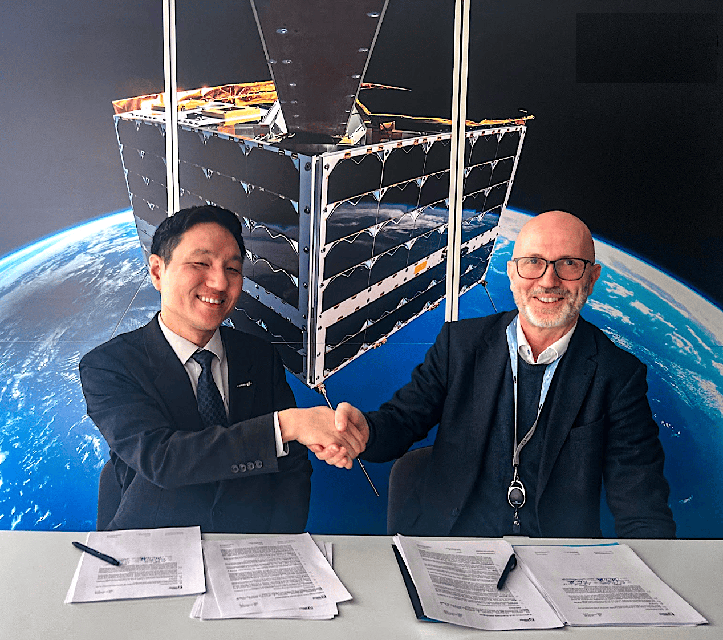
The agreement supports a sovereign Low-Earth Orbit (LEO) national security satellite program currently under development by Hanwha Systems.
The partnership integrates NanoAvionics’ heritage in satellite bus manufacturing with Flexell’s specialized quality assurance and technical validation infrastructure. Under the terms of the deal, NanoAvionics will design and manufacture the deployable solar arrays, while Flexell—an in-house venture of Hanwha Systems—will perform final quality inspections and acceptance testing to meet the rigorous standards of the Republic of Korea (ROK) military.
Context: The 40-Satellite SAR Constellation
The contract is a critical component of South Korea’s broader push for domestic orbital reconnaissance capabilities. Hanwha Systems is currently competing for a 1.2 trillion won ($850 million) contract to build a 40-satellite Synthetic Aperture Radar (SAR) constellation for the ROK military.
This program, often referred to as the “K-LEO” constellation, aims to reduce the revisit rate for monitoring the Korean Peninsula to under 30 minutes. To meet the military’s strict mass requirements—targeted at sub-150 kg per unit—Hanwha has proposed an integrated “panel-type” design where the solar arrays are fused into a compact structure to maximize launch fairing density.
Advancing Next-Generation Photovoltaics
Beyond the immediate hardware supply, the two companies are exploring the integration of Flexell’s proprietary solar cell technology into NanoAvionics’ existing CubeSat and microsatellite platforms. Flexell is currently developing Copper Indium Gallium Selenide (CIGS) and perovskite solar cells, which offer:
- Large-area scalability: Optimized for high-volume manufacturing.
- Ultra-lightweight characteristics: Reducing total satellite mass without sacrificing power.
- Cost Efficiency: Aiming to match the lifetime efficiency of traditional Gallium Arsenide (GaAs) cells at a lower production cost.
“This collaboration goes beyond simple component procurement and represents an important opportunity to further strengthen our quality verification capabilities,” said Taehun (Tim) Ahn, CEO of Flexell Space. “It will also serve as a meaningful milestone in accelerating the integration of our next-generation solar cells into actual satellite array systems.”
Strategic International Cooperation
For NanoAvionics, the deal solidifies its expanding presence in the South Korean market. The company has previously collaborated with the Korea Aerospace Research Institute (KARI) and the Institute for Basic Science. Atle Wøllo, CEO of Kongsberg NanoAvionics, noted that the contract serves as a model for strategic collaboration between domestic space technology firms and global platform providers.
The delivery of the flight-ready solar arrays is expected to begin in the second half of 2027. This timeline aligns with the scheduled deployment of the ROK military’s SAR constellation, which plans to launch its first units as early as late 2026 or 2027 following final hardware evaluations in October 2026.
