

• Skip to primary navigation
  • Skip to main content
  • Skip to primary sidebar
  • Skip to secondary sidebar
  • Skip to footer
  • NEWS:
  • SatNews
  • SatMagazine
  • MilSatMagazine
  • SmallSat News
  • |     EVENTS:
  • SmallSat Symposium
  • Satellite Innovation
  • MilSat Symposium
  • SmallSat Europe

SatNews

Satellite Industry Intelligence Since 1983

Subscribe
  • LATEST
  • Missions & Constellations
    • Exploration & Science Missions
    • In-Orbit Servicing & Orbital Operations
    • LEO Constellations
    • Mission Autonomy & Onboard Systems
    • Mission Deployments & Manifests
    • Navigation & PNT
    • SmallSat
    • Spacecraft & Payload Technology
    View All in Missions & Constellations →
    Satellite Deployers to be Used on JAXA Small Satellite Mission by ExolaunchSatellite Deployers to be Used on JAXA Small Satellite Mission by Exolaunch
    SmallSat Europe Speaker Focus: Dr. Ane Aanesland, ThrustMeSmallSat Europe Speaker Focus: Dr. Ane Aanesland, ThrustMe
    EarthEarth
    CAS Space Successfully Launches Kinetica-2, Aiming for Global Cost LeadershipCAS Space Successfully Launches Kinetica-2, Aiming for Global Cost Leadership
  • Business
    • Contracts & Commercial Deals
    • Earnings & Financial Reporting
    • Events & Conferences
    • Funding & Venture Capital
    • Market Forecasts
    • Mergers & Acquisitions
    • Personnel Moves & Appointments
    View All in Business & Finance →
    Azercosmos and Viasat Sign Partnership Agreement for In-Flight ConnectivityAzercosmos and Viasat Sign Partnership Agreement for In-Flight Connectivity
    Redwire’s ESA Quantum Satellite Deal Expands European Defense Growth StoryRedwire’s ESA Quantum Satellite Deal Expands European Defense Growth Story
    PMGC Holdings Launches NorthStrive Defense Tech to Capture Drone and Autonomous Systems MarketPMGC Holdings Launches NorthStrive Defense Tech to Capture Drone and Autonomous Systems Market
    Space42 and Viasat: Contract close for 2800 satellitesSpace42 and Viasat: Contract close for 2800 satellites
  • Defense
    • Counterspace & ASAT
    • Defense Budgets & Procurement
    • ISR & Reconnaissance
    • MILSATCOM
    • Missile Warning & Defense
    • National Security Programs
    • Space Domain Awareness
    View All in Military & Defense →
    Russia Replaces Starlink With European-Built SatellitesRussia Replaces Starlink With European-Built Satellites
    Chief Data and Artificial Intelligence Officer for the United States Space Force, Chandra Donelson, Steps AwayChief Data and Artificial Intelligence Officer for the United States Space Force, Chandra Donelson, Steps Away
    What Doubling Space Force Funding Actually Means for the IndustryWhat Doubling Space Force Funding Actually Means for the Industry
    Planet Labs Imposes Indefinite Blackout on Iran Satellite Imagery at U.S. RequestPlanet Labs Imposes Indefinite Blackout on Iran Satellite Imagery at U.S. Request
  • Gov
    • Export Controls & Compliance
    • International Space Agreements
    • National Space Policy
    • Space Law & Treaties
    • Space Sustainability & Debris Policy
    • Space Traffic Management / Debris Removal
    View All in Government & Regulation →
    Isaacman’s Budget Math: How NASA Plans to Reach the Moon With a Quarter Less MoneyIsaacman’s Budget Math: How NASA Plans to Reach the Moon With a Quarter Less Money
    FCC Seeks Comment on Expanding Spectrum Access for “Weird Space Stuff”FCC Seeks Comment on Expanding Spectrum Access for “Weird Space Stuff”
    The FCC Must Choose: Enforce the Rules or Preserve LEO CompetitionThe FCC Must Choose: Enforce the Rules or Preserve LEO Competition
    Space Force Reassigns Final GPS III Mission to SpaceX Following Vulcan AnomalySpace Force Reassigns Final GPS III Mission to SpaceX Following Vulcan Anomaly
  • Launch
    • Launch Providers
    • Launch Schedule & Calendars
    • Launch Sites & Infrastructure
    • Rocket Technology & Vehicles
    View All in Launch →
    Liftoff: NASA Successfully Launches Artemis II to the MoonLiftoff: NASA Successfully Launches Artemis II to the Moon
    AAC Clyde Space Expands Orbital Presence with Transporter-16 LaunchAAC Clyde Space Expands Orbital Presence with Transporter-16 Launch
    Built by Thales Alenia Space for ESA’s Celeste mission, IOD-2 Satellite lifts off today from New ZealandBuilt by Thales Alenia Space for ESA’s Celeste mission, IOD-2 Satellite lifts off today from New Zealand
    Defense Economics and the European SmallSat MarketDefense Economics and the European SmallSat Market
  • Software
    • Autonomous Ground Operations
    • Data Processing & AI/ML
    • Digital Twins & Modeling
    • Ground Segment & Teleports
    • Mission Planning & Simulation
    • Space Systems Software Engineering
    • Spectrum & Licensing
    View All in Software Automation & Ground Systems →
    The Downlink Deficit: The Pentagon’s Optical Mesh Network and the Terrestrial BottleneckThe Downlink Deficit: The Pentagon’s Optical Mesh Network and the Terrestrial Bottleneck
    NexSat Space Systems Debuts with ACE ‘Invisible’ Aero-Conformal AntennaNexSat Space Systems Debuts with ACE ‘Invisible’ Aero-Conformal Antenna
    Laser Communications and the Rise of Orbital Data CentersLaser Communications and the Rise of Orbital Data Centers
    ThinKom Showcases Modular MILSATCOM Architecture for Contested EnvironmentsThinKom Showcases Modular MILSATCOM Architecture for Contested Environments
  • Services & Apps
    • Climate & Environmental Monitoring
    • Disaster Response & Security Mapping
    • Earth Observation & Imaging
    • Maritime & Aviation Satcom
    • Satellite Communications
    View All in Services & Applications →
    Cinemo Reimagines the Vehicle as a Software-Defined Entertainment HubCinemo Reimagines the Vehicle as a Software-Defined Entertainment Hub
    IEC Telecom Wins CSR Initiative of the Year at the Oil & Gas Middle East Awards 2026IEC Telecom Wins CSR Initiative of the Year at the Oil & Gas Middle East Awards 2026
    Can SMEs Compete in Starlink-Dominated Space?Can SMEs Compete in Starlink-Dominated Space?
    Traditional Media and Online Video Revenues Projected to Exceed One Trillion Dollars by 2030Traditional Media and Online Video Revenues Projected to Exceed One Trillion Dollars by 2030
  • SatNews Events
  • Magazines
  • Calendar

NASA laser retroreflector array delivered to ESA for Lunar Pathfinder satellite navigation + Lunar Pathfinder info

November 14, 2022

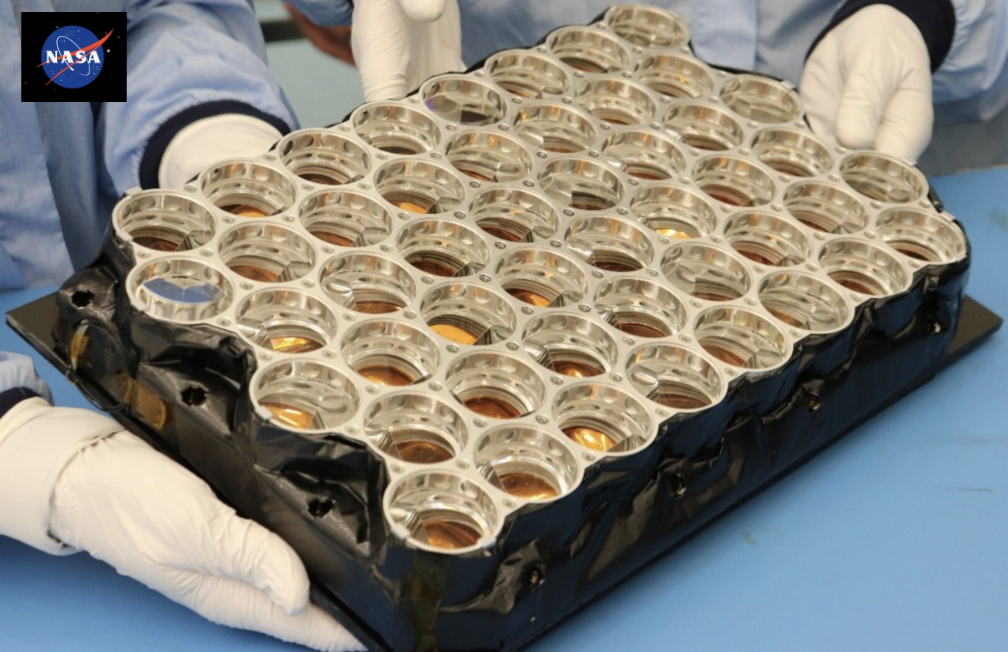
NASA’s retroreflector array. Photo is courtesy of SSTL.

A NASA retroreflector array has been delivered to the European Space Agency (ESA) that will allow the Lunar Pathfinder mission to be pinpointed by laser ranging stations back on Earth as it orbits the Moon.
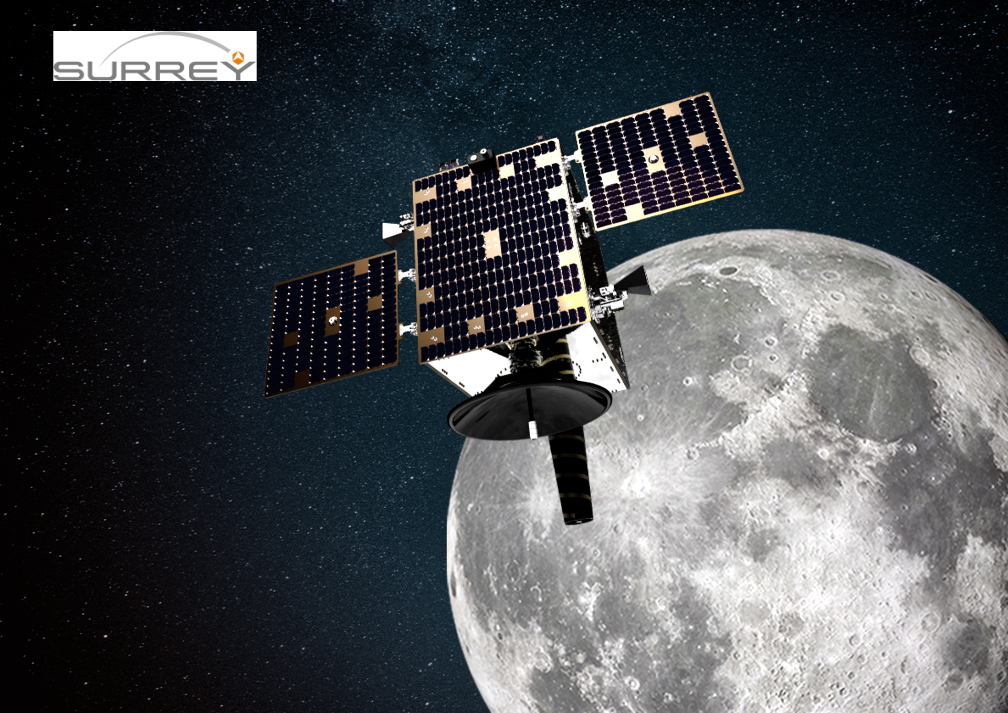
Artistic rendition of Surrey Satellite Technology Ltd. (SSTL)’s Lunar Pathfinder satellite that will provide communications services around the Moon. Image is courtesy of SSTL.

Such centimeter level laser measurements will serve as an independent check on the spacecraft as it fixes its position using Galileo and GPS signals from an unprecedented 400,000 km. away from Earth — proving the concept of lunar satellite navigation (SATNAV) while also relaying telecommunications ahead of ESA’s dedicated Moonlight initiative.
Safeguarded within multiple layers of packaging with ‘shock watches’ in three dimensions within the shipping case, to detect any rough treatment, NASA’s Laser Retroreflector Array, LRA, was successfully delivered to Surrey Satellite Technology Ltd. (SSTL), in Guildford, UK.

After unpacking and following the established procedures, a visual inspection of the LRA was jointly performed by ESA, NASA and SSTL, confirming there are no scratches and nicks in the optics. As a result, the instrument was formally accepted by ESA and was passed to SSTL for integration aboard their washing-machine-sized spacecraft, which is due to be launched in 2025.

SSTL’s Lunar Pathfinder will serve as a telecommunications relay satellite for future missions to the Moon, with ESA as a core customer, while NASA will also make use of its services in exchange of delivering Lunar Pathfinder to lunar orbit through its Commercial Lunar Payload Services (CLPS) initiative.

Today, tracking a spacecraft in lunar orbit requires multiple ground stations to perform radio ranging. Lunar Pathfinder will employ a standard X-band transponder for this purpose, but in addition will carry ESA’s NaviMoon Global Navigation Satellite System receiver (photo below).
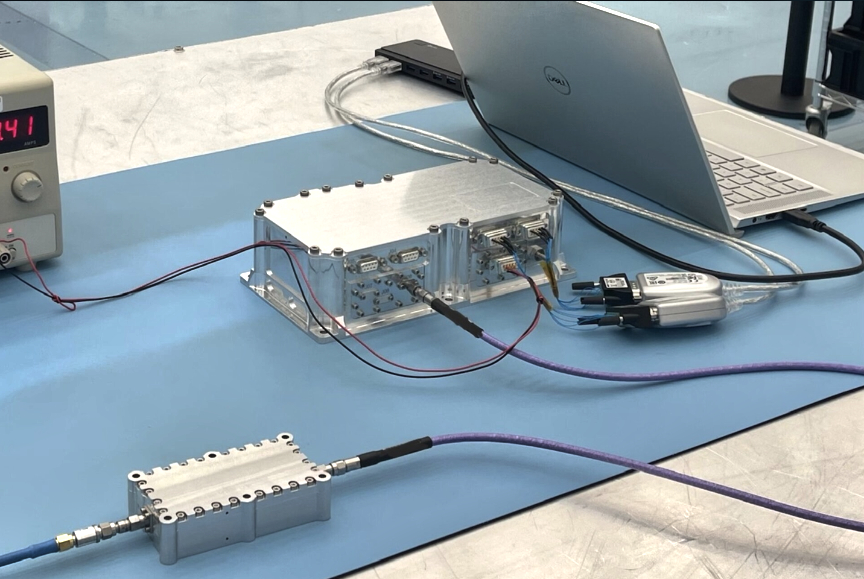
Achieving position fixes from Galileo and GPS so far out in space requires clever engineering and signal processing techniques, because the signals extending out to lunar orbit are millions of times weaker than those we receive using our smartphones or cars. But success would mean future Moon missions could effectively steer themselves – fixing their position automatically using GNSS better than 100m, an order of magnitude improvement over current radio ranging – while foregoing the use of costly ground infrastructure.

Laser retroreflectors are well-established space technology, normally used to precisely determine the orbit of satellites around the Earth. By measuring the time of flight for the laser pulses to travel from Earth to the satellite and back, its precise distance can be calculated — along the same lines as radio-based ranging, but achieving much higher accuracy because of the short wavelength of light.

In approach they resemble the mirrored ‘cat’s eyes’ embedded in motorways to reflect light precisely back to its source, thanks to an intricate internal reflection setup — a total of 48 ‘corner cubes’ in the case of the LRA, which were individually and rigorously inspected and measured in the laboratory. The optical performance of the array was accurately measured at NASA’s Goddard Space Flight Center.

About the size of a laptop, the LRA was produced for NASA by KBR, based on a previous LRA already flying on NASA’s Lunar Reconnaissance Orbiter (LRO). The International Laser Ranging Service currently has four stations capable of laser ranging out to lunar distance, three based in Europe (Grasse, Wetzel, and Matera) and one in the US (Apache Point). In addition, ESA is considering the use of its own Tenerife-based Laser Ranging Station, which is currently being upgraded.
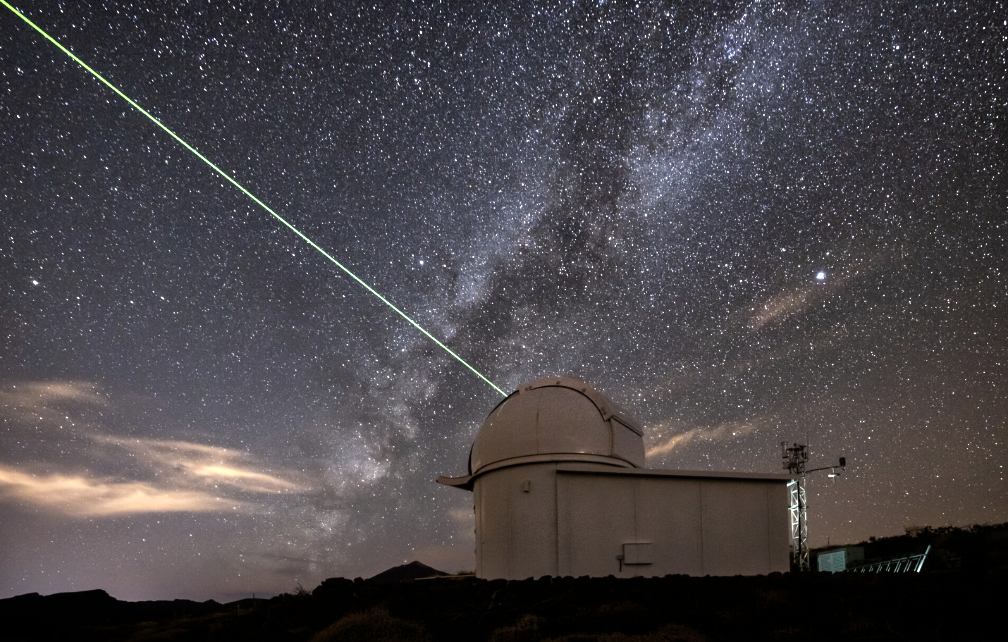
ESA’s IZN-1 laser ranging station on top of the Izaña mountain in Tenerife, Spain, has recently undergone months of testing and commissioning, passing its final tests with flying colours. As it reached ‘station acceptance’, it was handed over to ESA from the German company contracted to build it, DiGOS. The station is a technology test bed and a vital first step in making debris mitigation widely accessible to all space actors with a say in the future of our space environment. Image is courtesy of ESA.

As a next step, the LRA will undergo final inspection at SSTL before being integrated onto Lunar Pathfinder — having to be precisely fitted and aligned to maximize positioning accuracy. Then, in the decade to come, dedicated Moonlight satellites and eventually additional hardware on the lunar surface will establish a common communications and navigation infrastructure for all lunar missions, effectively bringing the Moon closer to Earth in practical terms, rendering it our planet’s eighth continent.

Moonlight is being presented to Europe’s space ministers for approval at ESA’s Council at Ministerial Level in Paris on 22-23 November.

“Today’s delivery is an additional element of this unique ESA-NASA collaboration, which includes an in-orbit test campaign to demonstrate the use of satellite navigation signals in lunar orbit and laser ranging to authenticate these pioneering satnav positioning fixes,” said Javier Ventura-Traveset, leading ESA’s Galileo Navigation Science Office and coordinating ESA lunar navigation activities. “Both ESA and NASA are highly interested in exploiting the LRA data with our NaviMoon satnav receiver, which will enable the cross-checking of positioning fixes across cislunar distance and open up new possibilities in lunar geodesy. These tests will also provide a very valuable technological learning for ESA’s Moonlight initiative, which will provide before the end of this decade an autonomous network of communications and navigation satellites supporting lunar exploration.”

Stephen Merkowitz, NASA’s Space Geodesy Project Manager, said, “This LRA is larger and will return more than 12 times the laser light than the one on LRO since it has 48 corner cubes at 4 cm in diameter, compared to LRO’s 12 reflector cubes at 3 cm in diameter. This opportunity is then rather unique.”

Lily Forward, SSTL Lunar Pathfinder Systems Engineer, said, “This is SSTL’s first piece of flight hardware for the Lunar Pathfinder and is the result of an excellent collaboration between ESA, NASA and SSTL. We are all eager to put this ranging experiment to the test once SSTL’s Lunar Pathfinder has launched.”

NASA’s reflector array, photo courtesy of the agency.

About the Lunar Pathfinder

SSTL’s Lunar Pathfinder is a single spacecraft in lunar orbit that is due to launch in 2025, designed with the objective of offering communication services to a number of lunar assets (surface or orbiter), as well as hosting a number of navigation and scientific experiments.

Communication Services
Lunar Pathfinder is due to operate in an Elliptical Lunar Frozen Orbit (ELFO) for an operational lifetime of 8 years. The spacecraft can operate 2 simultaneous channels of communication with lunar assets: 1 in S-band and 1 in UHF. Performance, such as coverage and data-rate, depend both on the relative position of the user asset to Pathfinder at the moment of the connection, as well as the capabilities of the communication module onboard the user asset. Once safely retrieved onboard Lunar Pathfinder, communications are relayed back to Earth ground stations in X-band.
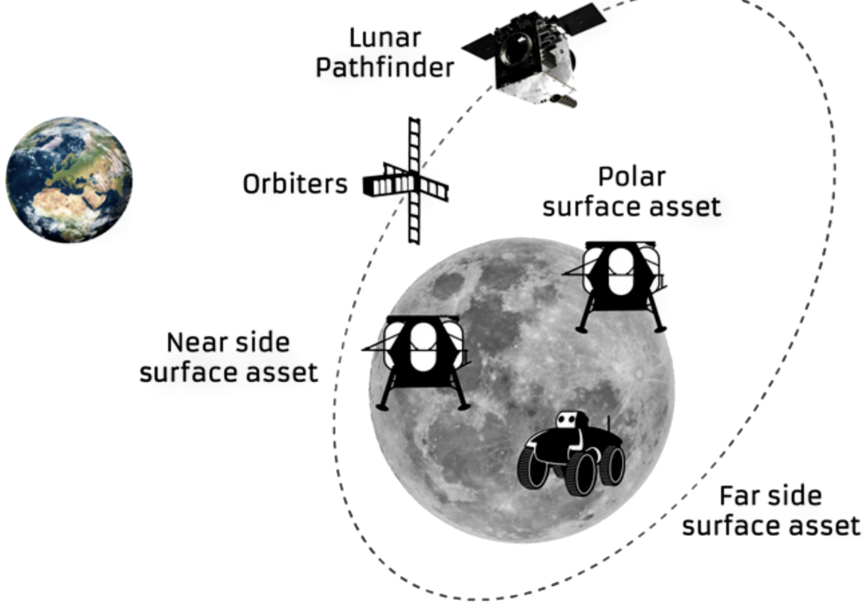
Lunar Pathfinder will relay communications from orbital and surface missions. Infographic is courtesy of SSTL.

For surface assets on the far side of the Moon, the use of data-relay infrastructure is a requirement for their missions. Without of line of sight of the Earth, they need a data-relay service such as the one offered by Lunar Pathfinder to communicate back with Earth.

For polar surface assets, potentially with limited direct to Earth visibility, the use of the data-relay service provides the assurance of a communication link, whatever obstacle the terrain may put between the asset and the Earth.

Rovers, constrained to remain within line of sight of the lander to relay their communication, will find a new independence, both in how far they can go from the lander and how long they can survive beyond the lander’s limited lifetime.

For all lunar missions, including orbiters and near side surface assets, which could manage with Direct to Earth (DTE) communication , there is an additional economical and technical benefit to using the proximity data-relay service. Due to the proximity of the Lunar Pathfinder spacecraft, user assets could achieve higher data-rates with a lower performance, lower mass and lower cost communication module on-board, compared with the equipment needed for DTE communication.

In addition to communication services, the Lunar Pathfinder spacecraft has been selected by ESA and NASA to host a number of experimental payloads:

  • An ESA GNSS receiver capable of detecting weak signals coming from the Earth GNSS infrastructure (GPS and Galileo), demonstrating its potential role into Lunar navigation
  • A NASA retro-reflector to demonstrate laser ranging capabilities
  • An ESA radiation monitor to study orbital radiation conditions

Acting both as technology and service demonstrator, Lunar Pathfinder is the opportunity for scientific and commercial mission developers to support the development, test and standardization of Lunar communication infrastructure, and for emerging off-planet telcos to acquire experience of lunar asset operations and off-planet service delivery.

A Lunar Pathfinder infovideo is located at this direct link…

Filed Under: Contracts & Commercial Deals, Exploration & Science Missions

Primary Sidebar

Coverage

  • Missions & Constellations
  • Business & Finance
  • Military & Defense
  • Launch
  • Software Automation & Ground Systems
  • Government & Regulation
  • Services & Applications

Most Read Stories

  • Rheinmetall Withdraws From Mynaric Bidding Process; Rocket Lab Acquisition Clears Major Competitive Hurdle
  • L3Harris Unveils XL-300P: The First P25 Handheld with 5G and Satellite Direct-to-Device Connectivity
  • Rheinmetall Walked Away. Germany Should Take the Hint.
  • Rocket Lab Emerging as Potential Bus Provider for 2,800-Satellite Equatys Constellation
  • Guardians in the Kill Chain: How the Space Force Led the Opening Salvo of Operation Epic Fury

Secondary Sidebar

Footer


Satnews is a leading provider of satellite news, events, publications, research and other satellite industry information in both commercial and military enterprises worldwide.

Stories By Category

  • Business & Finance
  • Government & Regulation
  • Launch
  • Military & Defense
  • Missions & Constellations
  • Services & Applications
  • Software Automation & Ground Systems
  • Spectrum & Licensing
  • Startups & NewSpace Business

About Us

  • Leadership & Editorial Team
  • SatNews History
  • Free Satnews Subscription
  • SatNews Events
  • Magazines

Navigation

  • Latest Stories
  • Magazines
  • Events
  • Contact
  • Cookie & Privacy Policy for Satnews

We use cookies to ensure that we give you the best experience on our website. If you continue to use this site we will assume that you are happy with it.
x
Sign up Now (For Free)
Access daily or weekly satellite news updates covering all aspects of the commercial and military satellite industry.
Invalid email address
Notify Me Regarding ( At least one ):
We value your privacy and will not sell or share your email or other information with any other company. You may also unsubscribe at anytime.

Click Here to see our full privacy policy.
Thanks for subscribing!