

On March 30, 2026, the Chinese commercial space firm CAS Space (Zhongke Yuhang) achieved the successful maiden flight of its Kinetica-2 Y1 (also known as Lijian-2 Y1) carrier rocket. The vehicle lifted off at 7:00 p.m. Beijing Time from the Dongfeng Commercial Space Innovation Pilot Zone in northwest China, marking a significant milestone in the country’s push for a low-cost, high-frequency launch infrastructure.
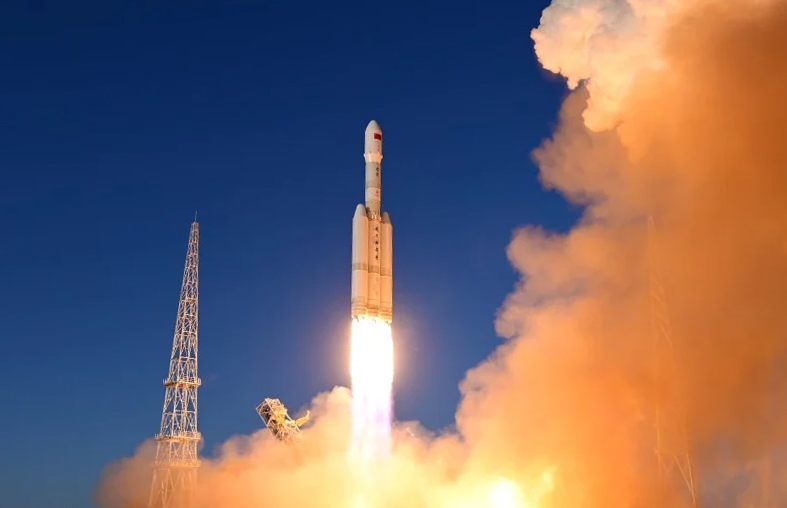
The mission, titled “The Global Capital of Textile,” successfully deployed three payloads into their designated orbits: the Qingzhou (Light Ship) prototype cargo spacecraft, the New March 02 satellite, and the TS 01 educational satellite.
Technical Breakthrough: The Common Booster Core
The Kinetica-2 is China’s first launch vehicle to adopt a Common Booster Core (CBC) configuration. Standing 53 meters tall with a liftoff weight of 625 metric tons, the rocket utilizes a liquid-propellant system designed for both reliability and cost-efficiency.
- Payload Capacity: 8 metric tons to a 500 km Sun-Synchronous Orbit (SSO) or 12 metric tons to a 200 km Low Earth Orbit (LEO).
- Design Efficiency: By using a CBC architecture—where the core stage and two side boosters share the same diameter (3.35m) and structural design—CAS Space has significantly streamlined the manufacturing process.
- Simplified Flight: The current configuration fastens the boosters to the core stage as a single unit during the ascent, reducing the number of risky separation events and enhancing overall mission reliability.
Revolutionizing Space Logistics: The Qingzhou Cargo Craft
The primary payload, the Qingzhou Cargo Spacecraft Test Vehicle, represents a new generation of affordable logistics for the Tiangong Space Station. Developed by the Innovation Academy for Microsatellites of the Chinese Academy of Sciences, the 4.2-ton prototype is designed to provide a lightweight, agile alternative to the larger Tianzhou freighters.
During its mission, the Qingzhou will conduct in-orbit tests across altitudes of 200 to 600 kilometers, carrying 27 different scientific and medical projects. These include advanced “space refrigerators” for supply storage and specialized plasma therapeutic devices designed to accelerate tissue regeneration in microgravity.
The Roadmap to Reusability and Competitive Pricing
The Kinetica-2 is central to China’s strategy to lower the “barrier to entry” for space. While the Y1 flight was expendable, CAS Space has confirmed that developers are actively integrating reusable technology into the Kinetica-2 platform.
Initial tests on smaller-scale vehicles have already verified vertical landing and recovery technologies, with full-scale recovery tests scheduled for later in 2026. The goal is to achieve a price-per-kilogram that is competitive with the global commercial standard, which currently sits at approximately $7,000 to $11,000 per kilogram for medium-lift vehicles.
By moving away from specialized, one-off rocket types toward a systematic framework of mass-produced, modular vehicles, the Chinese commercial sector is positioning itself as a primary provider for global satellite constellations and interplanetary exploration logistics.
While CAS Space offers a compelling price-to-performance ratio, its “Western market” is currently a geopolitical impossibility for most commercial operators. Its real success is likely to come from capturing the massive domestic Chinese market and the emerging satellite demand from the Belt and Road Initiative nations.
