

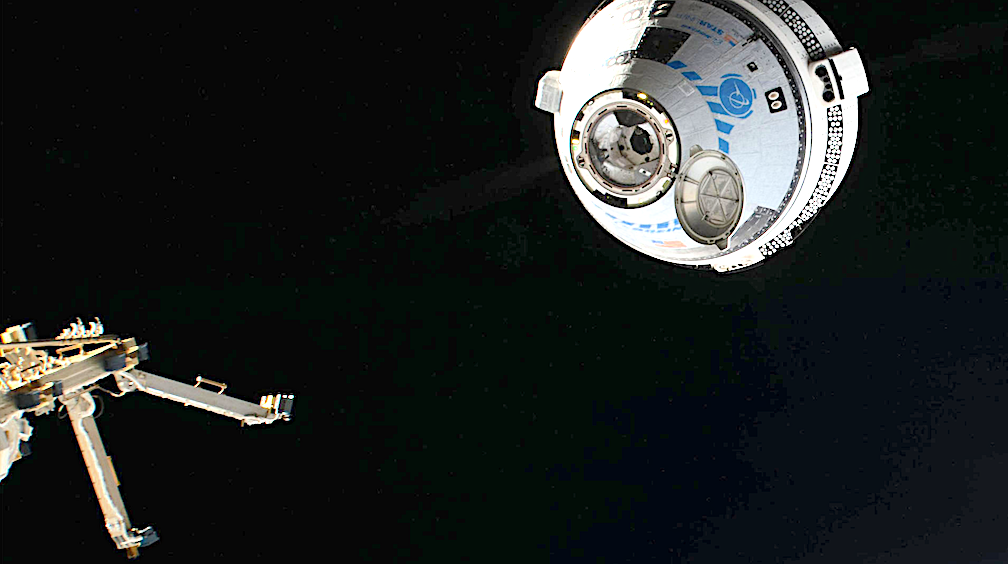
Starliner Flight Day 4 Activities
Starliner post-docking activities winding down, crew turning attention to space station support
NASA astronauts Butch Wilmore and Suni Williams continue testing and evaluating the Starliner spacecraft while docked to the International Space Station, a stay that will be extended by a few days.
Ahead of turning their attention to space station support, the crew worked in partnership with Boeing engineers and flight control teams on the ground to efficiently tick through more flight test objectives and operational capability checkouts of the spacecraft.
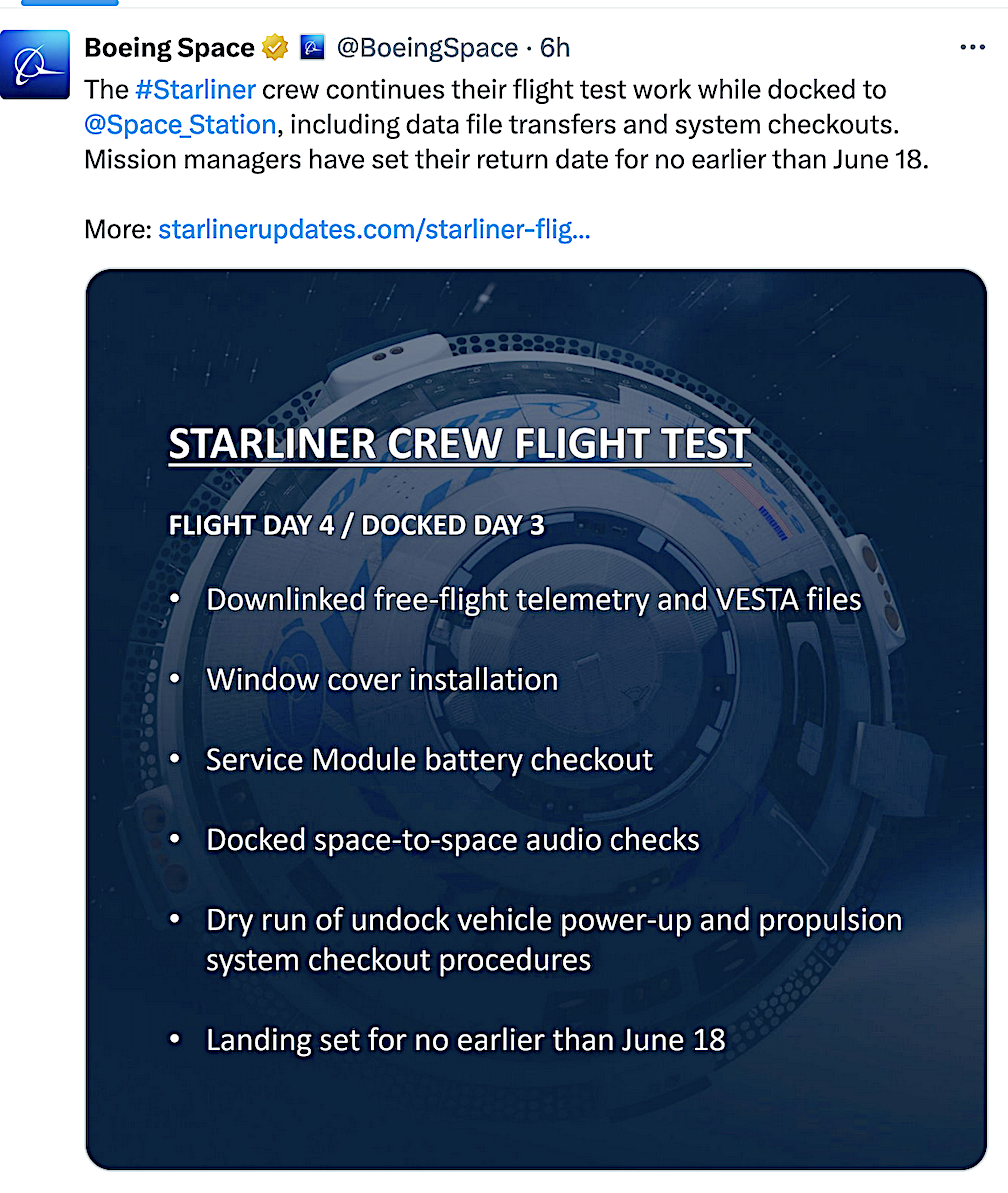
On June 9, Wilmore and Williams performed docked space-to-space audio checks, installed a window cover designed for long-duration missions, and performed a dry run of undock vehicle power up and propulsion system checkout procedures. Starliner’s Service Module batteries were also checked out and are fully charged for the next leg of the Crew Flight Test journey – returning to Earth in the southwest United States.
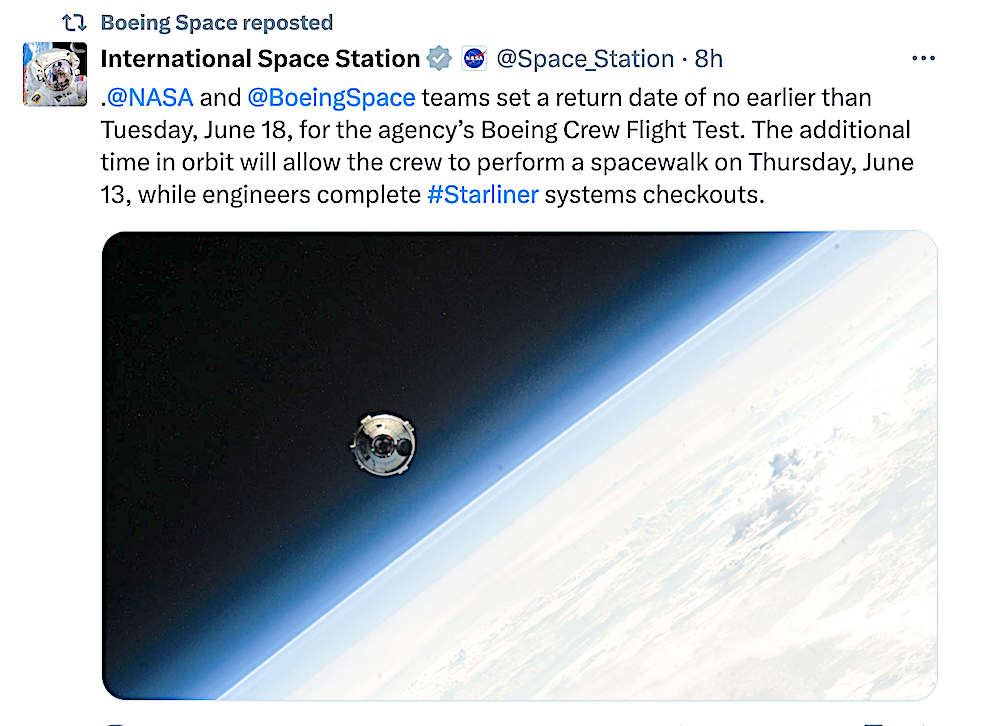
The crew was informed by CAPCOM Neal Nagata that mission managers are now targeting Starliner’s landing for no earlier than June 18. This paves the way for the crew to support additional station activities, such as the upcoming spacewalk on June 13, while engineers complete Starliner systems checkouts.
On June 10, the crew will participate in a number of public outreach events that will be carried live on NASA TV.
Starliner Flight Day 3 Activities
Starliner and Expedition crews work together to conduct flight test objectives and evaluate spacecraft capabilities.
NASA astronauts Butch Wilmore and Suni Williams continue to settle into the pace of the International Space Station (ISS) after flying Boeing’s Starliner spacecraft, named Calypso, to the orbital complex.
June 8 began with Boeing engineers and flight control teams powering the spacecraft down and back up ahead of a scheduled “safe haven” demonstration. The ability to shelter in the spacecraft or depart the station quickly is a requirement of any visiting crew vehicle. In the “safe haven” configuration, Starliner’s own systems would be used to provide air and other essentials to astronauts during a contingency. Expedition crews occasionally move into their spacecraft if space debris is predicted to pass by or if solar radiation is higher than usual.
“We practiced a safe haven event where we would use this as a lifeboat. If something, say a conjunction or something was about to intercede with the space station, some space debris, then we would all go scurry to our spacecraft and hunker down and hopefully everything passes. We went through that process today, closing the hatches, everything, and it was quite a successful event,” said Wilmore while giving a tour of Calypso during a live downlink event.
In a test of what it would be like to live and work inside Starliner with additional crew members, Wilmore and Williams were joined by Matthew Dominick and Tracy Caldwell Dyson for a number of hours. Together, they assessed air circulation, sleeping arrangements, privacy space, windows, and spacesuit donning, doffing and storage.
Data was also collected by Starliner as the space station received a re-boost from Northrop Grumman’s NG-20 Cygnus spacecraft, an operational activity that will occur regularly on future long-duration missions.
Wilmore and Williams then conducted a bit of weekend housekeeping, cleaning up the spacecraft that they occupied for about 30 hours from pre-launch to docking.
Finally, Starliner was again powered down to enter quiescent mode – another critical capability for future long-duration missions. It will be powered back on June 9 for an undock systems checkout before going back into and remaining quiescent until the pre-undock power up.
All this follows a busy June 7, when Wilmore and Williams worked with ISS crew members to unpack cargo, including a late add – a pump for the station’s Urine Processing Assembly, which is now back in full operation.
For test pilots like Wilmore and Williams, who both graduated from the U.S. Navy’s test pilot school before joining NASA’s astronaut corps, data collection and precise evaluation is the normal routine for learning about a new vehicle whether it be a high-performance aircraft or sophisticated spacecraft.
Day 2 Starliner Flight Activities
With Starliner Calypso docked to the International Space Station, flight test activities continue for the spacecraft, ground teams and crew on board.
On June 7, one day after docking, Crew Flight Test (CFT) Commander Butch Wilmore and Pilot Suni Williams unloaded cargo, charged tablets and reviewed emergency procedures to prepare for the “safe haven” operational capability checkout.
Wilmore and Williams also met with Boeing teammates on the ground to talk about their experiences so far, including crew-interactive type items like spacesuits, seats, cargo bag placement, maneuverability in the interior, food, sleeping arrangements, hatch operations and lighting.
On June 8, at 9:00 a.m. ET, Wilmore and Williams will welcome the world aboard the spacecraft for the first time in space with a tour of Calypso live on NASA TV.
Day 1 Starliner Completes 1st Crewed Docking
Astronauts guide the Boeing spacecraft to orbital connection with the International Space Station
June 6, 2024
A combination of sensors, automatic steering and the careful gaze of two astronauts worked together to make history Thursday, June 6, by guiding Boeing’s CST-100 Starliner to its first docking to the International Space Station (ISS) while carrying astronauts. Crew Flight Test (CFT) Commander Butch Wilmore and pilot Suni Williams became the first of what is expected to be dozens of astronauts who will fly aboard Starliner on crew-rotation missions to the orbital laboratory complex.
The docking capped a precisely choreographed flight plan that saw the Boeing-owned and -operated spacecraft lift off Wednesday precisely at 10:52 a.m. Eastern time from Space Launch Complex 41 in Florida. Starliner began a planned series of thruster firings to first lift Starliner’s orbit and then refine its track to the space station.
Wilmore and Williams performed some manual steering and navigation checks on Starliner throughout the flight to station to confirm the systems operated properly. They also demonstrated the spacecraft’s manual control system, which allows an astronaut to take over all of Starliner’s operations, if needed. Equipped with cutting-edge sensors and complex flight computers, Starliner carried out the maneuvers autonomously while its crew evaluated every step and stood ready to jump into the process if needed.
Starliner progressively caught up to the station then moved ahead of it, lining itself up perfectly with the forward port of the ISS.
“It’s nice to be attached to the big city in the sky,” Wilmore said as the Starliner made contact with the space station. “It’s a great place to be. We are looking forward to … getting all the things done in Starliner we need to get done and also on station.”
Starliner is designed to fit a maximum crew of seven, though future NASA missions will carry a crew of four to five.
This flight test is being carried out with two people aboard to prove all the systems operate as expected. Confirming a raft of sensors and systems perform correctly is, in fact, the prime task for Wilmore and Williams during the eight to 10 days they are at the ISS. They will also unpack a number of cargo containers in orbit and move them into the station before boarding Starliner again for the return flight to a landing on land in the American southwest.
“We’ve had an ideal start for this flight test that our team has been working toward for some time,” said Boeing’s Mark Nappi, program manager for Starliner. “We are going to be careful with this spacecraft, making sure we are listening to what its systems are telling us. So far, Starliner is telling us everything we want to hear, but we are not taking anything for granted.”
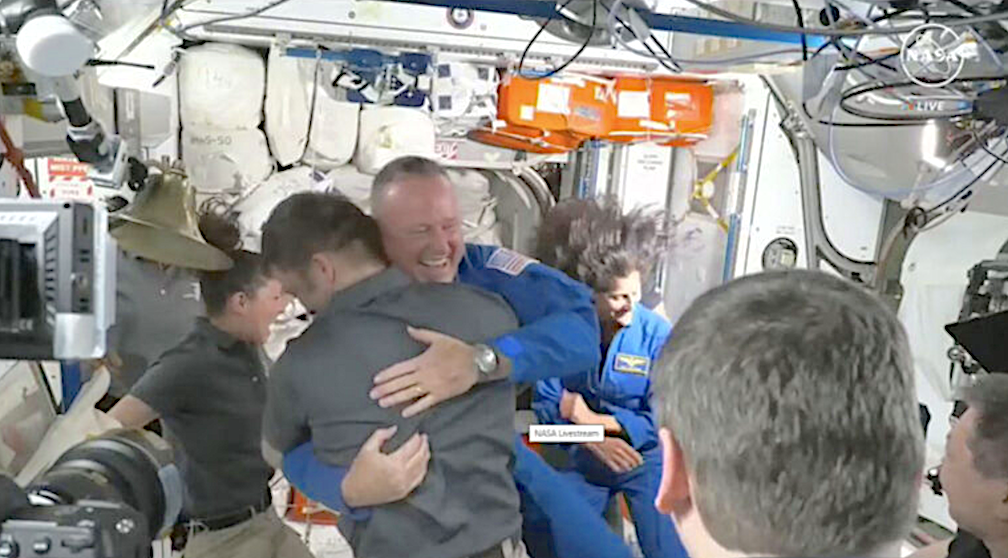
After concluding a number of procedures to connect the Starliner’s systems fully with the ISS, Wilmore and Williams opened the Starliner hatch and joined the seven ISS crew members inside the sprawling, million-pound complex.
“Butch and Suni, we are glad to see you,” said Oleg Kononenko, the current ISS commander, as Wilmore and Williams floated through the hatch into the main part of the station. “We want to congratulate the whole team … for launch, for docking. Very happy.”
“We are just as happy as can be to be up in space, one in Starliner, in on Atlas 5, and then here on the International Space Station,” Williams said. “It just doesn’t get much better.”
