

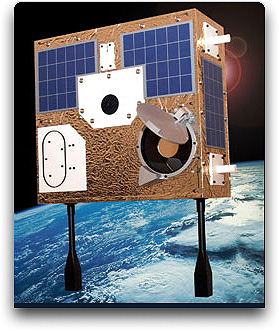
 The MOST (Microvariability & Oscillations of Stars) microsatellite was launched June
30, 2003 from the Plesetsk Cosmodrome with a 12-month mission to study the vibration
of distant stars and draw inferences about their hidden composition — a technique called
asteroseismology. Although just six years old and entering Grade One in human terms, MOST, nicknamed the “Humble Space Telescope” by its creators, has actually been the source of numerous
post doctorate level studies from scientists around the world for years as it continues to
deliver startling results to the astronomic community concerning the makeup and origins
of the universe. From its modest original goal of studying distant stars, Dr. Jaymie Matthews, MOST Mission Scientist, and his global team of scientists have extended the capabilities of MOST to explore exoplanets — alien worlds around other stars — to try to shed light on the timeless question — are we alone in the universe? MOST is gathering evidence on the
existence of earth-like planets around these stars, a feat not possible from even the largest
earth-bound telescopes.
The MOST (Microvariability & Oscillations of Stars) microsatellite was launched June
30, 2003 from the Plesetsk Cosmodrome with a 12-month mission to study the vibration
of distant stars and draw inferences about their hidden composition — a technique called
asteroseismology. Although just six years old and entering Grade One in human terms, MOST, nicknamed the “Humble Space Telescope” by its creators, has actually been the source of numerous
post doctorate level studies from scientists around the world for years as it continues to
deliver startling results to the astronomic community concerning the makeup and origins
of the universe. From its modest original goal of studying distant stars, Dr. Jaymie Matthews, MOST Mission Scientist, and his global team of scientists have extended the capabilities of MOST to explore exoplanets — alien worlds around other stars — to try to shed light on the timeless question — are we alone in the universe? MOST is gathering evidence on the
existence of earth-like planets around these stars, a feat not possible from even the largest
earth-bound telescopes.
Although well into middle age for a microsatellite, MOST continues to exceed performance specifications. The MSCI MOST operations team constantly monitors the health of the spacecraft. Operational adjustments are made from the MSCI facilities in Mississauga, Canada, to counter the inevitable degradation from the harsh environment of space. Dr. James Wells, head of MSCI Systems Engineering and lead engineer on MOST, observes that “along with the scientific data, we are extracting a wealth of operations data enabling us to track every facet of spacecraft performance – key information that we are using to improve the design of NEOSSat, our current microsatellite program”.
