

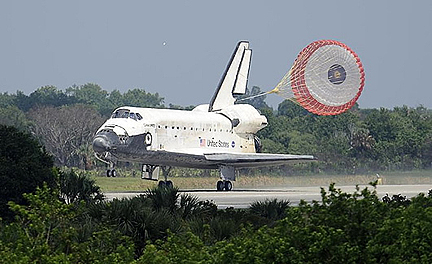
 Perfect. That’s pretty much the description of the return trip that the space shuttle Discovery and its crew enjoyed as they landed without incidence at Cape Canaveral, Florida on Saturday at 11:15 EDT. If the astranauts could receive frequent flyer milage, they’d be collecting on more than 5.7 million miles trekked in the last 14-day journey. Descending 7x steeper than a commercial jet, shuttle commander Mark Kelly piloted Discovery through a huge circle to burn off speed after a two-week, 5.7-million-mile (9.2-million-km) trip at a top speed of 17,500 miles per hour (28,000 km per hour).
The STS-124 mission was the second of three flights to launch components to the International Space Station to complete the Japan Aerospace Exploration Agency’s Kibo laboratory. Discovery delivered Kibo’s tour bus-sized Japanese Pressurized Module, or JPM, which is the station’s largest module. The mission included three spacewalks to install and outfit the JPM and activate its robotic arm system. The lab’s logistics module, which was delivered and installed in a temporary location in March, was attached to its permanent position on top of the JPM. In addition to installing Kibo, the seven-member Discovery crew delivered a new pump for the station’s broken toilet and prepared the $100 billion orbital outpost for a crew of six, rather than the current three, beginning next year.
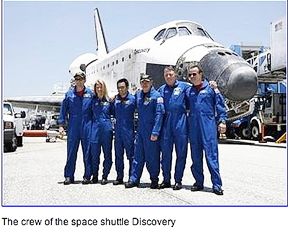
 Mark Kelly commanded the flight and was joined by Pilot Ken Ham,
Mission Specialists Karen Nyberg, Ron Garan, Mike Fossum, Greg
Chamitoff, and Japan Aerospace Exploration Agency astronaut Akihiko
Hoshide. Chamitoff remained aboard the space station, replacing
Expedition 17 Flight Engineer Garrett Reisman, who returned to Earth on Discovery after nearly three months on the station. Chamitoff will return on shuttle Endeavour’s STS-126 mission, targeted for launch
November 10. The crew is reported to have exited with ease, as if they had traveled on a short jaunt, rather than their major journey into space.
Mark Kelly commanded the flight and was joined by Pilot Ken Ham,
Mission Specialists Karen Nyberg, Ron Garan, Mike Fossum, Greg
Chamitoff, and Japan Aerospace Exploration Agency astronaut Akihiko
Hoshide. Chamitoff remained aboard the space station, replacing
Expedition 17 Flight Engineer Garrett Reisman, who returned to Earth on Discovery after nearly three months on the station. Chamitoff will return on shuttle Endeavour’s STS-126 mission, targeted for launch
November 10. The crew is reported to have exited with ease, as if they had traveled on a short jaunt, rather than their major journey into space.
STS-124 was the 123rd space shuttle flight, the 35th flight for shuttle Discovery and the 26th flight of a shuttle to the station. With Discovery and its crew safely home, the stage is set for the launch of STS-125 on October 8. Atlantis’ mission will return the space shuttle to the Hubble Space Telescope for one last visit before the shuttle fleet retires in 2010. Over 12 days and five spacewalks, Atlantis’ crew will make repairs and upgrades to the telescope, preparing it for at least another five years of research.
 Until Discovery’s last day in space, NASA had only a few technical issues to worry about. However, as the crew prepared for landing, they noticed a piece of debris floating past the shuttle’s cargo bay, then they thought they saw a bump in the shuttle’s tail. The debris turned out to be a clip that anchored a section of the tail during the rigors of launch and was not needed for re-entry into the atmosphere or landing.
