

A new Boeing-built satellite has been successfully delivered to its launch site as of April 7, 2026, marking a critical milestone in the mission’s lifecycle. The delivery underscores Boeing’s ongoing effort to more than double its satellite production this year, with a target of delivering twenty-six spacecraft in 2026—a significant increase from the twelve units produced in 2025.
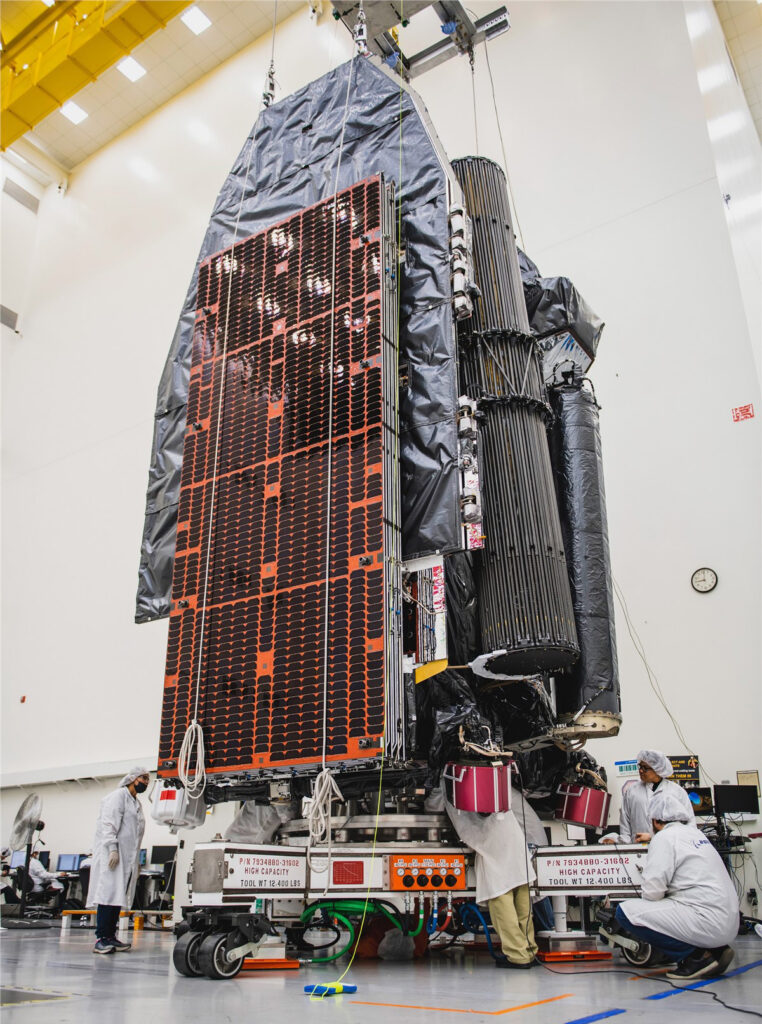
This ramp-up is driven by a surge in demand for both commercial connectivity and resilient military space architectures, particularly for the U.S. Space Force’s missile tracking and early warning constellations.
The spacecraft was transported from Boeing’s primary satellite manufacturing facility in El Segundo, California, which recently expanded its production footprint with a new nine-thousand-square-foot electro-optical infrared (EO/IR) sensor line. This expansion was specifically designed to accelerate the delivery of advanced payloads for the Resilient Missile Warning and Tracking program in Medium Earth Orbit (MEO). By transitioning from rapid prototyping to high-rate manufacturing, Boeing and its subsidiary, Millennium Space Systems, are working to meet the compressed timelines required by modern defense strategies, such as the Golden Dome missile defense initiative.
In the commercial sector, Boeing is also achieving key milestones with its software-defined BSS-702X satellite bus. Just last month, in March 2026, the ninth and tenth O3b mPOWER satellites—built by Boeing for the operator SES—successfully entered commercial service. These satellites provide high-throughput, low-latency connectivity that can be dynamically steered and reallocated from the ground, demonstrating the flexibility of the next generation of orbital communications infrastructure.
The delivery of this latest satellite highlights the broader industrial shift toward a proliferated space architecture, where the reliability of mass-produced commercial hardware is being integrated into the most sensitive national security missions. As Boeing continues to scale its output, these deliveries are becoming increasingly frequent, reflecting a global aerospace sector that is now operating on a wartime-style production footing to ensure orbital superiority and connectivity.
VIDEO: New Boeing satellite spacecraft delivered
Would you like me to research the specific “thermal vacuum” testing protocols Boeing is utilizing at its El Segundo facility to ensure these mass-produced EO/IR sensors can maintain their calibration during the extreme temperature shifts of Medium Earth Orbit?
