

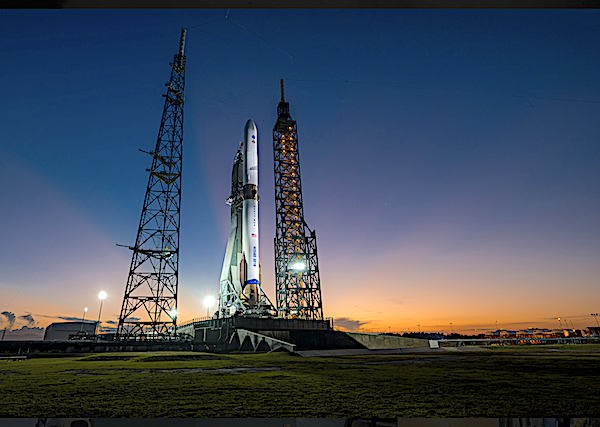

Blue Origin’s second flight of New Glenn launch vehicle carrying the Escape and Plasma Acceleration and Dynamics Explorers (EscaPADE), a dual-spacecraft mission with University of California, Berkeley’s Space Sciences Laboratory to study ion and sputtered escape from Mars was scrubbed on Wednesday from Launch Complex 36A, Cape Canaveral SFS. This is the result of extreme solar storms, that have created aurora borealis as far south as New Glenn’s Florida launchpad.
NG-2 Update: We are scheduled to launch Thursday, November 13, with a launch window from 2:57 PM – 4:25 PM EST / 19:57 – 21:25 UTC. The live webcast starts at T-20 minutes.
MessNG-2 Update: New Glenn is ready to launch. However, due to highly elevated solar activity and its potential effects on the ESCAPADE spacecraft, NASA is postponing launch until space weather conditions improve. We are currently assessing opportunities to establish our next launch window based on forecasted space weather and range availability. The mission has already been delayed several times from an expected October 2024 liftoff date due to technical and scheduling issues, and a recent launch attempt on Nov. 9 was stood down due to the weather on Earth.
Blue Origin’s New Glenn to carry EscaPADE the first multi-spacecraft orbital science mission to Mars on Wednesday
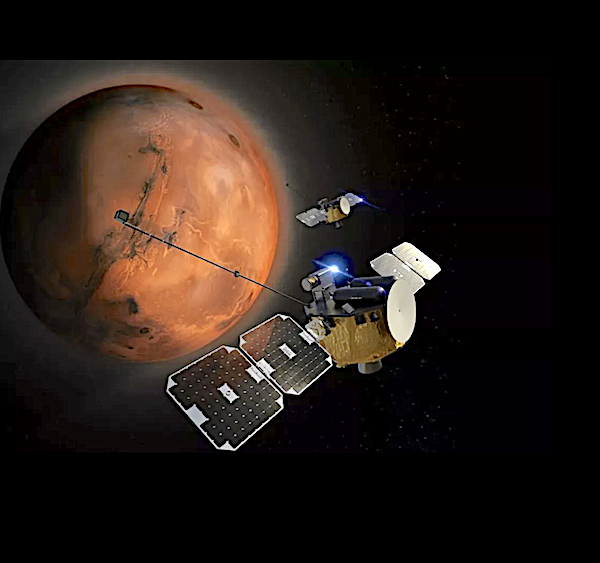

Blue Origin’s second flight of New Glenn launch vehicle carrying the Escape and Plasma Acceleration and Dynamics Explorers (EscaPADE), a dual-spacecraft mission with University of California, Berkeley’s Space Sciences Laboratory to study ion and sputtered escape from Mars on Wednesday from Launch Complex 36A, Cape Canaveral SFS, from 11:50 AM – 1:17 PM PST.
The spacecrafts’ scientific goals are to understand the processes controlling the structure of Mars’ hybrid magnetosphere and how it guides ion flows; understand how energy and momentum are transported from the solar wind through Mars’ magnetosphere; and understand the processes controlling the flow of energy and matter into and out of the collisional atmosphere.
To achieve this mission Escape’s twin orbiters will take simultaneous observations from different locations around Mars, and the observations will reveal the planet’s real-time response to space weather and how the Martian magnetosphere changes over time.
ESCAPADE will analyze how Mars’ magnetic field guides particle flows around the planet, how energy and momentum are transported from the solar wind through the magnetosphere, and what processes control the flow of energy and matter into and out of the Martian atmosphere.
The ESCAPADE mission is managed by the Space Sciences Laboratory at the University of California, Berkeley, with key partners Rocket Lab, NASA’s Goddard Space Flight Center, Embry-Riddle Aeronautical University, Advanced Space LLC, and Blue Origin.
