

China successfully deployed a satellite internet technology test payload on Saturday, April 11, marking a continued push toward establishing its sovereign Low Earth Orbit (LEO) communications infrastructure.
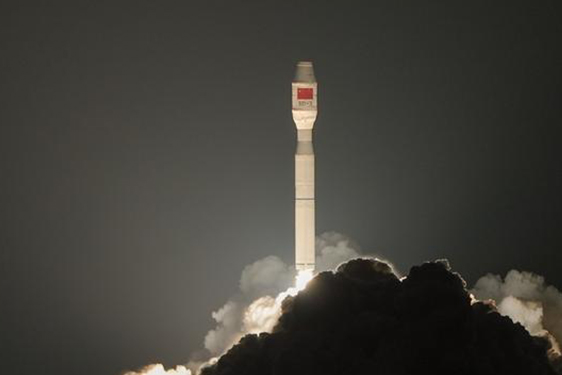
The mission utilized the Smart Dragon-3 (SD-3) carrier rocket, which launched at 7:32 p.m. Beijing Time from a mobile sea-based platform in the waters off Yangjiang, Guangdong province.
The mission was managed by the Taiyuan Satellite Launch Center, representing the 11th successful flight of the Smart Dragon-3 vehicle.
Technical Specifications: The Smart Dragon-3
Developed by the First Academy of the China Aerospace Science and Technology Corporation (CASC), the SD-3 is a four-stage solid-propellant vehicle designed to address the growing demand for high-cadence commercial launches.
- Payload Capacity: The rocket is capable of delivering up to 1,500 kilograms to a 500-kilometer Sun-Synchronous Orbit (SSO).
- Operational Flexibility: Its sea-launch capability allows for optimized launch azimuths and reduced risk to populated areas, a critical factor for China’s increasing launch volume.
- Configuration: The vehicle features a maximum diameter of 2.64 meters and is part of a broader strategy to lower the cost-per-kilogram for small and medium satellite deployments.
Context: The “Thousand Sails” and Sovereign Connectivity
This test launch occurs as China accelerates its “Thousand Sails” (G60 Starlink) and “Guowang” constellations, which are intended to rival Western megaconstellations. As of March 2026, China had successfully deployed approximately 160 operational satellites within its primary internet networks.
The “satellite internet technology support” designation for this payload suggests it is part of the ongoing validation phase for high-speed orbital data transmission and inter-satellite links. These tests are vital for China to meet its International Telecommunication Union (ITU) milestones, which require the deployment of 10% of its filed constellation capacity by late 2032.
Timeline for Orbital Infrastructure
Following this successful technology validation, China is expected to maintain an aggressive launch schedule throughout 2026. The state-run sector, alongside commercial entities like LandSpace and Deep Blue Aerospace, is targeting more than 100 orbital missions this year to support the rapid scaling of its space-based internet architecture.
