

At the 2026 Satellite Show in Washington, D.C., ThinKom Solutions, Inc. details its roadmap for high-mobility ground architecture designed to address the vulnerabilities of static satellite command centers. During a technical presentation Chairman and CTO Bill Milroy talks of a transportable ground entry point system developed in coordination with the U.S. Space Force (USSF).
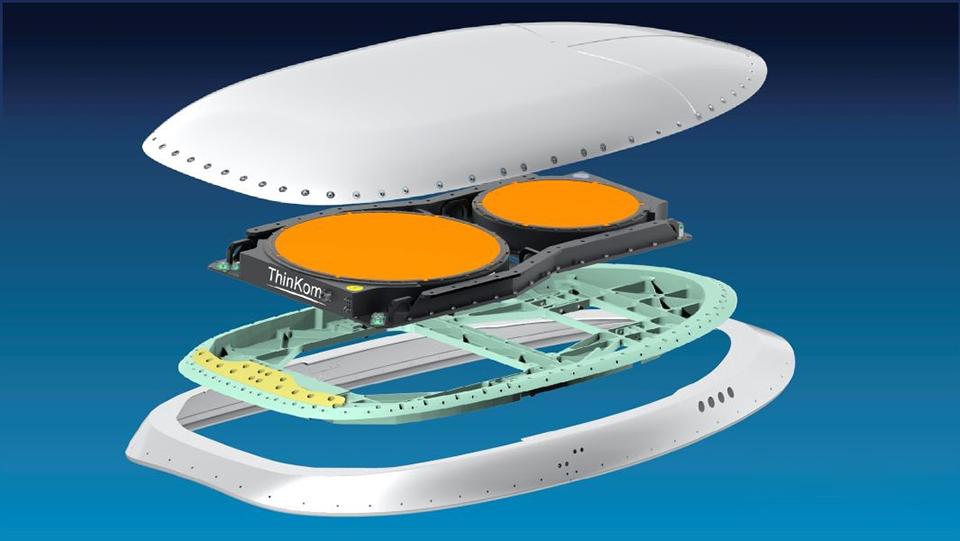
The initiative shifts away from large, fixed “target-rich” ground stations toward a distributed network of smaller, modular nodes. This architecture utilizes ThinKom’s Variable Inclination Continuous Transverse Stub (VICTS) technology to maintain low-profile physical and electronic signatures while ensuring persistent connectivity across Geostationary (GEO), Medium Earth Orbit (MEO), and Low Earth Orbit (LEO) constellations.
Strategic Shift to Distributed Ground Systems
The presentation highlighted the growing threat to static SATCOM infrastructure in multi-domain operations. Traditional ground stations are increasingly susceptible to long-range precision strikes and electronic warfare. ThinKom’s response involves “Distributed Data Transport Nodes” that can be rapidly deployed and relocated to prevent adversary targeting.
This effort follows a 2025 contract award from the U.S. Space Force to adapt ThinKom’s commercial phased-array technology for the government’s Proliferated Warfighter Space Architecture (PWSA). The goal is to create a “Gateway-in-a-Box” that provides the same throughput as a 2.4-meter parabolic dish but in a form factor that fits on a standard tactical vehicle.
VICTS Technology and Technical Specs
The core of the new architecture is the VICTS phased-array antenna, which differs from traditional Electronically Scanned Arrays (ESAs) by using mechanical rotation of internal plates to steer the beam. This method provides several advantages for military mobile applications:
- Beam Agility: Near-instantaneous switching between satellites in different orbits.
- Efficiency: High spectral efficiency with lower power consumption than equivalent liquid-crystal or silicon-based ESAs.
- Profile: A low-drag, low-visibility design that reduces the physical footprint of the terminal.
- Frequency: Support for multiple bands, including Ka-band and Q-band, providing resilience against localized jamming.
Executive Perspective
“The modern battlefield offers no place to hide for large static targets,” said Bill Milroy, Chairman and CTO of ThinKom. “Survivability in contested environments now depends entirely on mobility and low observability. By modularizing the ground entry point and leveraging the inherent low-profile nature of VICTS technology, we are providing the Space Force with a communication backbone that is as agile as the units it supports.”
Future Deployment and USSF Integration
ThinKom used the event to demonstrate a scaled model of the transportable ground architecture, which is currently undergoing field trials with government partners. The modular units are designed to integrate directly into the USSF’s “Satellite Control Network” (SCN) modernization program.
Looking ahead to 2027, ThinKom plans to expand its Digital Array product family to include higher-frequency Q- and V-band capabilities. These advancements are aimed at meeting the extreme bandwidth requirements of future JADC2 (Joint All-Domain Command and Control) operations while maintaining the transportability and survivability of the ground nodes.
