

MADRID — Indra Group has confirmed that the Spainsat NG-II secure communications satellite suffered a significant anomaly caused by an “external impact” while en route to its final geostationary orbital slot.
In a statement released to the Spanish National Securities Market Commission (CNMV) on Saturday, Jan. 3, the company disclosed that the incident occurred at an altitude of approximately 50,000 kilometers from Earth. Preliminary technical assessments suggest the spacecraft was struck by a “space particle,” a term often used to describe untrackable orbital debris or micrometeoroids.
Hispasat, the satellite’s operator and a subsidiary of Indra, has activated emergency contingency protocols. While the full extent of the damage remains under analysis, the operator stated that the satellite’s propulsion or control systems may have been compromised during the transfer phase.
Program Status and Continuity
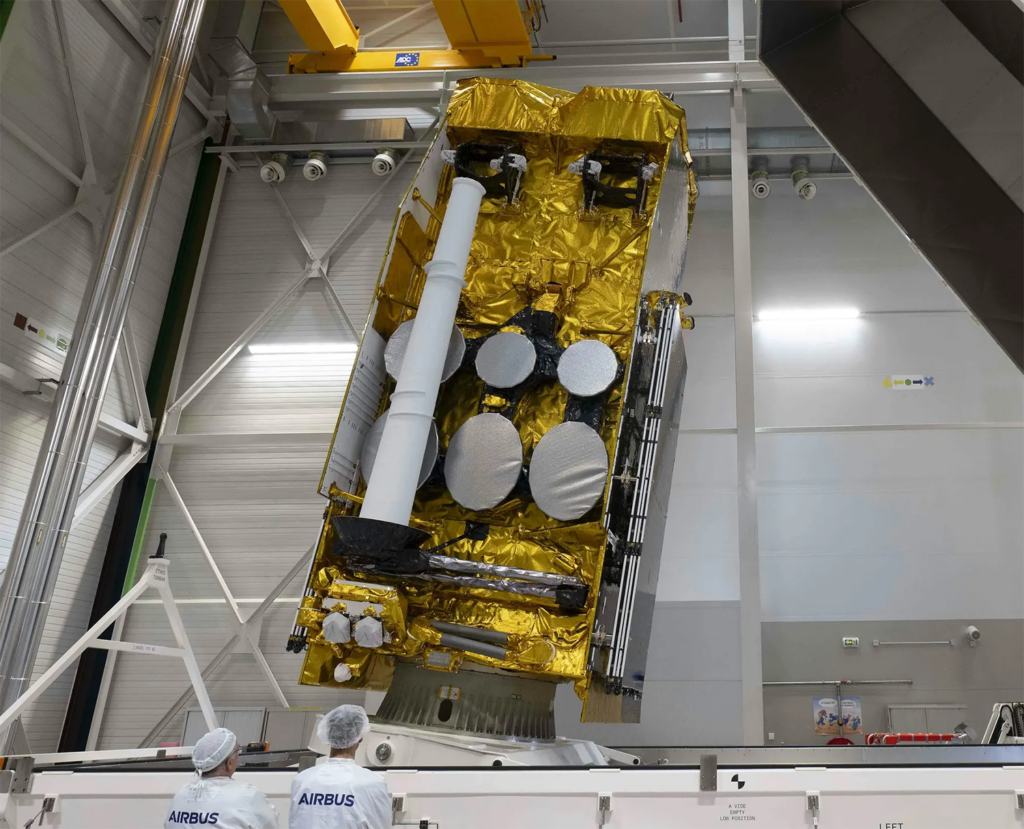
The Spainsat NG-II spacecraft was launched on October 23, 2025, aboard a SpaceX Falcon 9 rocket from Cape Canaveral Space Force Station. The satellite is the second of two spacecraft in the Spainsat NG program, designed to provide secure X-band and Ka-band communications for the Spanish Ministry of Defence, NATO allies, and other government agencies.
The first satellite in the constellation, Spainsat NG-I, was launched in January 2025 and is currently fully operational. According to the Spanish Ministry of Defence, secure communications services remain uninterrupted. The existing capacity of Spainsat NG-I, combined with the legacy Spainsat satellite, ensures coverage for ongoing Armed Forces operations.
“The event has had no impact on the Defence Ministry’s satellite communications services or on the normal conduct of Armed Forces operations,” the Ministry confirmed in a parallel statement.
Corporate and Operational Impact
This incident comes just weeks after Indra Group formally completed its acquisition of a majority stake in Hispasat, consolidating the defense contractor’s position in the space sector.
The Spainsat NG program, managed by Hisdesat (a consortium now primarily controlled by Indra and Hispasat), represents a critical infrastructure investment valued at over €2 billion. The satellites were manufactured by a consortium led by Airbus Defence and Space and Thales Alenia Space.
Timeline and Recovery
Technical teams from Hispasat and the manufacturing consortium are currently analyzing telemetry data to determine if the satellite can be recovered or if it constitutes a total loss.
Indra’s disclosure noted that “if necessary, Spainsat NG-II will be replaced as soon as possible.” The Ministry of Defence indicated it is prepared to commission the construction of a third satellite—Spainsat NG-III—should the damage prove irreparable, to ensure long-term redundancy and strategic autonomy.
No further details regarding the specific trajectory changes or fuel loss have been released as of Sunday morning.
