

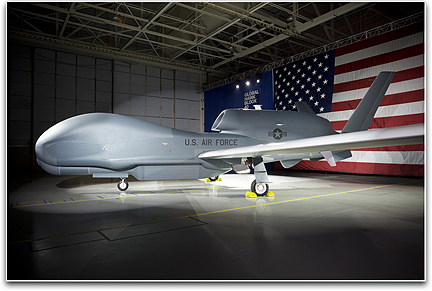
 Northrop Grumman Corporation (NYSE:NOC) and the U.S. Air Force have unveiled the nexgen of high-flying unmanned aircraft — the RQ-4 Block 40 Global Hawk — in a ceremony today at Northrop Grumman’s Palmdale, California, manufacturing facility.
“This unveiling of the first of 15 Block 40 aircraft is a significant step to fielding Global Hawk to Grand Forks Air Force Base, North Dakota, in 2010 and reaffirms our excellent track record of delivering Global Hawks since low rate production began,” said Duke Dufresne, sector vice president for Northrop Grumman Aerospace System‘s Strike and Surveillance Systems Division. “Carrying an advanced, all-weather multi-platform radar technology insertion program (MP-RTIP) sensor, the Block 40 aircraft will provide game-changing situational awareness for our warfighters with its unprecedented capability to detect, track and identify stationary and moving targets.”
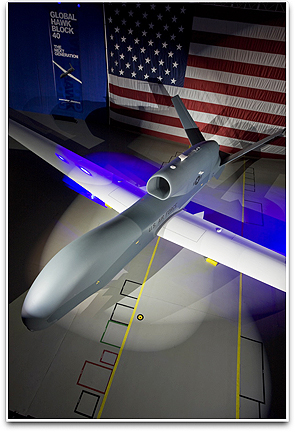 Use of the MP-RTIP sensor on the Block 40 Global Hawks marks the first time the active electronic scanned array (AESA) technology has been used on a high-altitude unmanned aircraft. AESA technology provides all-weather, day-night synthetic aperture radar mapping and ground moving target indicator capability. Designated AF-18, this Block 40 aircraft was the 27th Global Hawk built since the program’s inception in 1995 and is scheduled to begin flight testing next month.
Global Hawk’s range, endurance and large payload capabilities are well suited to support a variety of customers and missions, including environmental and Earth science research, homeland security, border and coastal patrol, hurricane and fire monitoring, and other disaster relief support activities. Global Hawk effectively provided imagery of the California wildfires in 2007 and 2008, and of Hurricane Ike in 2008. Flying at altitudes of more than 60,000 feet for more than 32 hours per sortie at speeds approaching 340 knots, the MP-RTIP-equipped Block 40 Global Hawk can persistently see through most type of weather, day or night. As the world’s first fully autonomous high-altitude, long-endurance unmanned aircraft system, Global Hawk is the platform of choice for a wide variety of sensors, foreign and domestic, meeting the global need for persistent ISR.
Northrop Grumman is the prime contractor for the Global Hawk and MP-RTIP programs and continues to move these technologies forward under the stewardship of the U.S. Air Force’s Aeronautical Systems Center at Wright-Patterson Air Force Base, Ohio, and the Electronic Systems Center, located at Hanscom Air Force Base, Massachusetts. Northrop Grumman’s Norwalk, Connecticut, facility is the principal MP-RTIP radar developer along with principal subcontractor, Raytheon Space and Airborne Systems, El Segundo, California. The development MP-RTIP sensor is undergoing a radar system level performance verification on a surrogate aircraft, and will be integrated into AF-18 for an operational evaluation.
Northrop Grumman’s Global Hawk program is based at its Aerospace Systems‘ Unmanned Systems Development Center in San Diego, Calif. The company performs Global Hawk sub-assembly work at its Unmanned Systems Center in Moss Point, Mississippi, and final assembly at its Antelope Valley Manufacturing Center in Palmdale, California. The principal Global Hawk industry team includes: Aurora Flight Sciences, Bridgeport, West Virginia (V-tail assembly and other composite structures); L-3 Communications, Salt Lake City, Utah (communication system); Raytheon Company, Waltham, Massachusetts (ground station); Rolls-Royce Corporation, Indianapolis, Indiana (engine); and Vought Aircraft Industries, Dallas, Texas (wing). (Both photos are courtesy of Northrop Grumman Corp.)
