

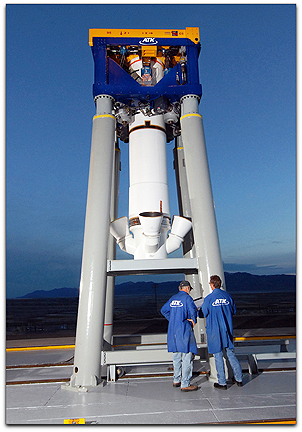
 NASA and Alliant Techsystems (ATK) have unveiled a new vertical test stand that will be used later this summer to support NASA’s Constellation Program. The stand will be used to test fire the full-scale abort motor for the launch abort system, which will sit atop the Orion crew exploration vehicle. The abort motor is designed to pull the crew module away from the Ares I launch vehicle in an emergency situation on the launch pad or during the first 300,000 feet after launch. A full scale inert motor, without oxidizer in the propellant, is now secured top end down in the test stand with its nozzles pointing skyward at ATK’s facility in Promontory, Utah. Engineers will spend the next few months performing a final checkout. The abort motor stands more than 17 feet high and three feet in diameter and is equipped with four nozzles. The motor’s specially designed manifold uses a reverse flow technology that forces hot gas through the manifold’s four nozzles, creating a pulling force. The hot gas exits the top of the motor, allowing the resulting plume to clear the crew module—Washington, D.C.
NASA + ATK Are Vertically Challenged
NASA and Alliant Techsystems (ATK) have unveiled a new vertical test stand that will be used later this summer to support NASA’s Constellation Program. The stand will be used to test fire the full-scale abort motor for the launch abort system, which will sit atop the Orion crew exploration vehicle. The abort motor is designed to pull the crew module away from the Ares I launch vehicle in an emergency situation on the launch pad or during the first 300,000 feet after launch. A full scale inert motor, without oxidizer in the propellant, is now secured top end down in the test stand with its nozzles pointing skyward at ATK’s facility in Promontory, Utah. Engineers will spend the next few months performing a final checkout. The abort motor stands more than 17 feet high and three feet in diameter and is equipped with four nozzles. The motor’s specially designed manifold uses a reverse flow technology that forces hot gas through the manifold’s four nozzles, creating a pulling force. The hot gas exits the top of the motor, allowing the resulting plume to clear the crew module—Washington, D.C.