

The global media and entertainment industry is approaching a historic financial milestone as combined revenues for traditional TV and online video are forecast to surpass 1.03 trillion dollars by 2030. According to data presented by Maria Rua Aguete, Senior Research Director at Omdia, during the FED Show in Madrid on March 31, 2026, this represents a massive structural shift from 775 billion dollars in 2025.

The growth is being driven almost entirely by digital advertising, which is expected to overtake all other forms of media monetization. Online video advertising alone is projected to expand from 309 billion dollars in 2025 to 540 billion dollars in 2030, increasing its total market share from 40 percent to 53 percent.
The Dominance of Social Video and Mobile Platforms
Social video platforms such as Meta, TikTok, and YouTube are set to play a decisive role in this trillion-dollar economy. Omdia predicts these platforms will generate approximately 400 billion dollars in streaming advertising revenue by 2030. This trend reflects a fundamental consumer pivot toward mobile-first, short-form, and highly personalized video experiences. Discovery algorithms and robust creator ecosystems are now the primary engines driving engagement and large-scale monetization.
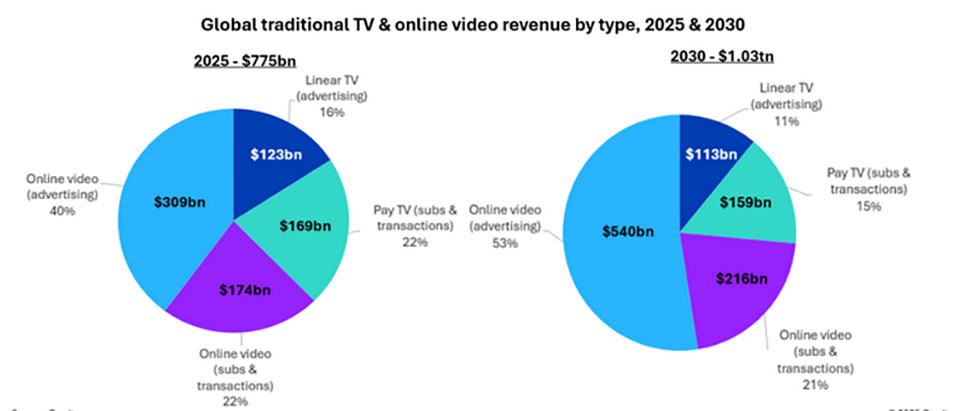
In contrast, the subscription and transaction segment of online video is entering a more mature phase. While revenues in this area are expected to grow from 174 billion dollars in 2025 to 216 billion dollars in 2030, the rate of increase is slowing significantly compared to the rapid rise of advertising-led models.
The Structural Decline of Linear and Pay TV
As digital platforms ascend, traditional broadcast and cable models are facing a steady decline. Linear TV advertising is expected to fall from 123 billion dollars in 2025 to 113 billion dollars by 2030, with its share of total revenue dropping from 16 percent to just 11 percent.
The pay-TV sector, including subscriptions and transactions, is also seeing a downward trend. Revenues are predicted to decrease from 169 billion dollars to 159 billion dollars over the same period. This shift highlights the ongoing impact of cord-cutting and the migration of audiences toward more flexible digital alternatives. Maria Rua Aguete noted that as the industry nears the one-trillion-dollar mark, the balance of power has clearly shifted toward advertising-led digital growth.
