

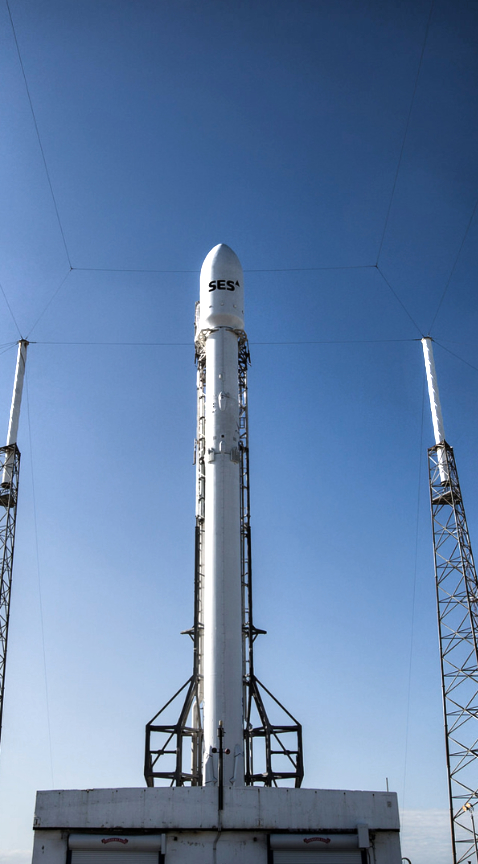
On March 20, 2026, Space Systems Command (SSC) announced it is reassigning the launch of the final GPS III satellite from United Launch Alliance (ULA) to SpaceX. The satellite, GPS III Space Vehicle 10 (SV-10), was originally manifested for a March liftoff on ULA’s new Vulcan Centaur rocket but will now target a late April 2026 launch aboard a Falcon 9 from Cape Canaveral Space Force Station.
The decision stems from a “significant performance anomaly” observed during the Vulcan USSF-87 mission on Feb. 12, 2026. While the Vulcan booster successfully delivered its payloads to orbit, one of its four solid rocket motors (SRMs) experienced a malfunction shortly after liftoff. The Space Force has since paused all National Security Space Launch (NSSL) missions on Vulcan pending a root cause investigation, which officials indicate could take “many months.”
Strategic Flexibility and the Rapid Response Trailblazer
This swap marks the fourth time the Space Force has moved a GPS III mission from Vulcan to Falcon 9 to maintain constellation modernization timelines. The transfer is enabled by the Rapid Response Trailblazer program, which standardizes GPS III satellites for compatibility with both heavy-lift providers.
To maintain the contract balance established under NSSL Phase 2, the Space Force executed a mission trade: while SpaceX gains the immediate SV-10 launch, ULA was awarded the USSF-70 mission—originally a SpaceX assignment—slated for summer 2028. USSF-70 will carry Northrop Grumman’s Geosynchronous Auxiliary Support Tanker (GAS-T), a prototype designed for in-orbit refueling and proximity operations.
The Immediate Trigger: The Vulcan Anomaly
The primary reason for the recent swap is a “significant performance anomaly” that occurred on February 12, 2026, during the USSF-87 mission. While the Vulcan Centaur rocket successfully delivered its payloads to orbit, one of the four Northrop Grumman-built solid rocket boosters (SRBs) suffered a visible nozzle malfunction shortly after liftoff.
Because this was the second nozzle-related issue in just four flights, the Space Force placed a pause on all military missions for Vulcan. This investigation is expected to take “many months,” making it impossible for ULA to meet the immediate launch window for the critical GPS satellite.
The Balancing Act
While it may appear that SpaceX is gaining an unfair advantage, the Space Force utilizes a “Mission Trade” mechanism to keep the two providers on a balanced contractual footing. When a mission is moved from ULA to SpaceX due to delays, the Space Force typically reassigns a future SpaceX mission back to ULA.
- The GPS Swap: SpaceX received the urgent GPS III SV-10 launch (April 2026).
- The Counter-Trade: In exchange, ULA was awarded the USSF-70 mission (a Northrop Grumman refueling tanker) originally slated for SpaceX in 2028.
This “kid glove” treatment, as some analysts call it, actually protects ULA’s revenue and backlog while ensuring that high-priority military assets like GPS—which feature advanced anti-jamming M-Code—are not left sitting in a warehouse.
A Pattern of Delays
The frustration voiced by Space Force officials, such as Assistant Secretary Frank Calvelli, stems from a multi-year trend rather than a single event. Before the 2026 anomaly, Vulcan’s development was delayed by nearly four years, primarily due to issues with its BE-4 engines.
Vulcan Anomaly Context and Technical Impact
The February anomaly involved a nozzle issue on one of the GEM 63XL solid rocket boosters provided by Northrop Grumman. This is the second such incident for Vulcan; a similar “manufacturing defect” in a booster nozzle occurred during a test flight in October 2024.
The grounding comes at a critical juncture for ULA, which is currently operating under interim CEO John Elbon following the sudden departure of long-time leader Tory Bruno in January 2026. ULA entered the year aiming for a high-cadence launch schedule of up to 22 flights to clear a backlog of over 80 missions, including those for Amazon’s Project Kuiper.
Executive Perspective
“With this change, we are answering the call for rapid delivery of advanced GPS capability while the Vulcan anomaly investigation continues,” said Col. Ryan Hiserote, Systems Delta 80 Commander. “We are once again demonstrating our team’s flexibility and are fully committed to leveraging all options available for responsive and reliable launch for the Nation.”
Timeline for GPS Modernization
The SV-10 mission will complete the initial 10-satellite tranche of the GPS III series developed by Lockheed Martin. These satellites provide three times greater accuracy and up to eight times improved anti-jamming capabilities compared to legacy blocks.
- GPS III SV-10 Transfer to SpaceX: March 20, 2026.
- New Launch Window: Late April 2026.
- Vulcan Return-to-Flight (Military): TBD (Post-investigation).
- Next Tranche: Transition to GPS IIIF (Follow-on) begins in late 2026/2027.
