

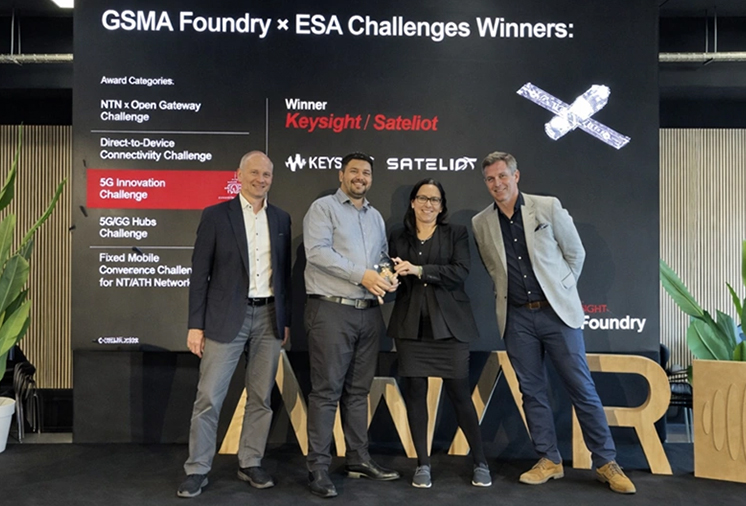
As 5G Non-Terrestrial Networks (NTN) move toward commercial scale, the industry faces a critical trust gap in verifying performance across hybrid space-terrestrial segments. In a statement released Tuesday, April 7, 2026, Keysight Technologies, Inc. and Sateliot announced they have been named winners of the fifth annual European Space Agency (ESA) and GSMA Foundry Innovation Challenge for their joint project addressing this infrastructure vulnerability.
Blockchain-Enabled Network Integrity
The award-winning project, titled “Blockchain-enabled anomaly detection end‑to‑end solution for 5G Non‑Terrestrial Networks,” targets the integration of secure auditing with satellite-to-ground connectivity. The proposal integrates blockchain, artificial intelligence (AI), and machine learning (ML) with digital calibration certificates. This stack enables traceable calibration from the satellite manufacturing phase through to active network operation.
By ensuring device trust and real-time anomaly detection, the solution allows for greater satellite autonomy. This architecture is designed to optimize network reliability and maximize uptime by enabling rapid response to performance issues in the hybrid environment. The project was funded through ESA’s Space for 5G/6G and Sustainable Connectivity line within the Advanced Research in Telecommunications Systems (ARTES) program.
Executive Perspective
“This recognition from the European Space Agency and the GSMA Foundry underscores the importance of trust, assurance, and autonomy as NTNs scale toward commercial readiness,” said Eric Taylor, Vice President, Aerospace, Defense and Government Solutions at Keysight. “Our collaboration with Sateliot demonstrates how advanced test, measurement, and AI‑driven analytics can bring unprecedented visibility into hybrid space-terrestrial networks.”
Strategic Context and 2026 Milestones
This achievement follows a period of rapid industrialization for Sateliot. On February 16, 2026, Sateliot partnered with LMT Group and the ESA to advance dual-mode 5G satellite IoT modules, moving the technology from Technical Readiness Level 2 to TRL 3. That initiative focused on a hybrid module using the 3GPP Release 17 standard, allowing devices to switch seamlessly between terrestrial towers and Sateliot’s Low Earth Orbit (LEO) constellation.
Albert Pujol, CIO at Sateliot, noted that the current award recognizes the talent of their R&D team in creating a trusted architecture. He stated that the partnership with Keysight proves Sateliot is leading in the resilience and operational autonomy necessary to transform space into a secure infrastructure.
Outlook for NTN Deployment
The joint project is positioned to help operators and enterprises prepare for commercial NTN deployments by providing verifiable performance metrics. Sateliot plans to launch five additional satellites later in 2026 to enhance its existing 5G NB-IoT constellation, with a goal of reaching a full constellation of 250 satellites. The integration of Keysight’s test and measurement technologies with Sateliot’s orbital assets is expected to accelerate the global deployment of resilient, standards-based NTN services.
