

On March 30, 2026, SpaceX successfully launched its Transporter-16 rideshare mission from Vandenberg Space Force Base, carrying a diverse manifest of 119 payloads. Among the spacecraft deployed were seven satellites designed and built by AAC Clyde Space, marking another significant milestone for the Swedish-headquartered space technology provider.
The mission continues AAC Clyde Space’s streak of having its technology on every SpaceX Transporter flight to date, underscoring its integrated role within the small satellite ecosystem.
VIREON Constellation and EPIC Platforms
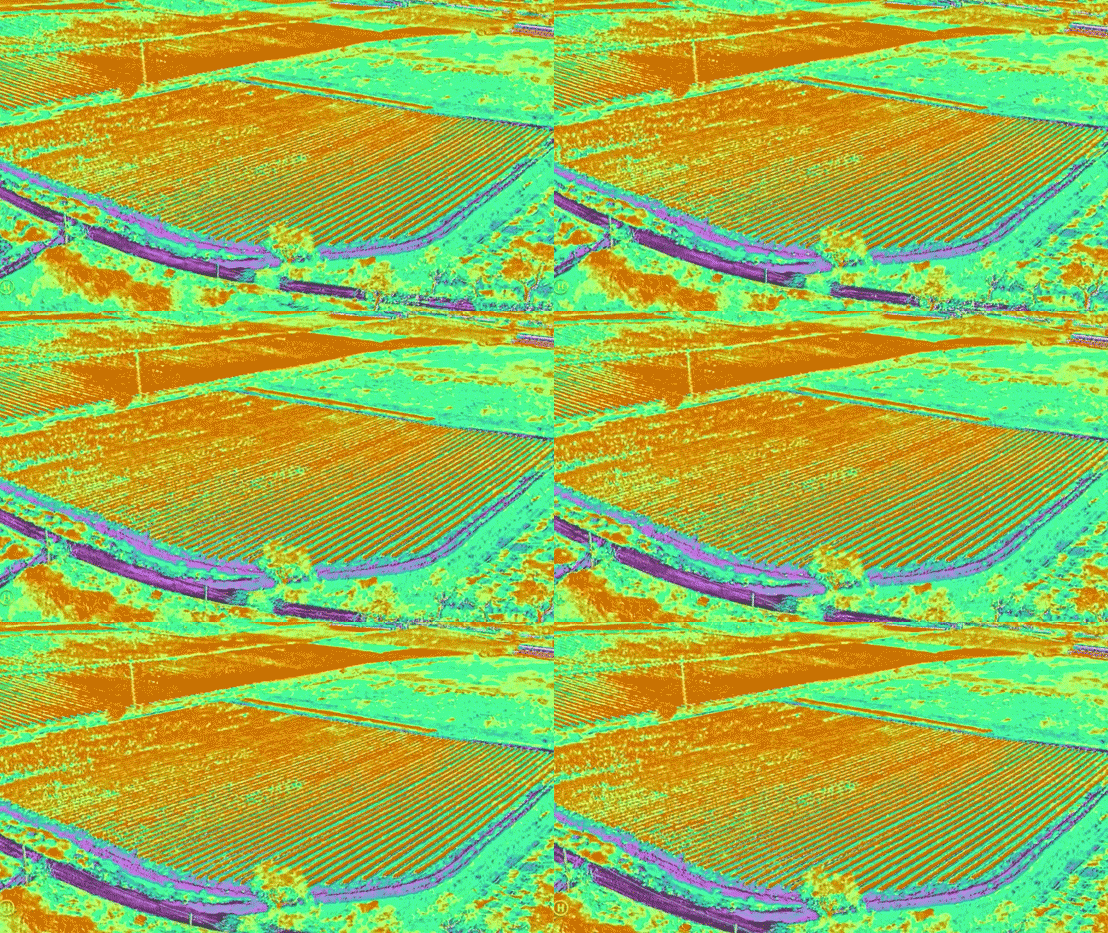
The launch featured the first two satellites of AAC Clyde Space’s proprietary Earth Observation constellation, VIREON-1 and VIREON-2. These 16U-class satellites are optimized for high-resolution land and vegetation monitoring, providing multispectral imagery with a 1.5-meter ground sample distance. The VIREON system is designed to deliver analysis-ready data for sectors such as agriculture and forestry, enabling resource-conscious decision-making through frequent revisits and detailed canopy-level insights.
In addition to its own constellation, the mission included several spacecraft built for commercial and institutional customers using the EPIC satellite platform family. This modular architecture allows for the rapid manufacturing of high-reliability satellites tailored for either Earth observation (EPIC VIEW) or communications (EPIC LINK). One notable customer mission on this flight is Io-1, a 4U EPIC satellite developed for Iota Technology as part of the MagQuest competition to advance global magnetic field measurements.
Advancing High-Speed Data with CubeCAT
A major technological highlight of the mission is the inclusion of CubeCAT laser communication terminals on multiple spacecraft. These compact subsystems represent a transition from traditional radio frequency (RF) to optical communications, which allows for significantly higher data throughput without the complexities of radio spectrum licensing.
The CubeCAT terminal is designed specifically for the size, mass, and power constraints of nanosatellites. It enables bidirectional space-to-ground links with downlink speeds reaching up to 1 Gbps. By incorporating an onboard data management system with a large storage buffer, the subsystem acts as a plug-and-play solution for data-hungry missions that require the rapid offloading of high-resolution imagery or large sensor datasets.
Strategic Impact of Rideshare Access
The Transporter-16 mission illustrates the importance of the SpaceX rideshare program as a reliable and cost-effective access route for small satellite operators. For AAC Clyde Space, the mission demonstrates a vertically integrated business model that spans satellite components, complete mission services, and space-based data delivery.
Luis Gomes, CEO of AAC Clyde Space, noted that the launch highlights the company’s breadth across the space value chain. By supporting both its own data-as-a-service initiatives and providing advanced subsystems for third-party missions, the company is positioning itself at the center of the push for more accessible and actionable space-based intelligence.
