

New Zealand — At 10:14 CET on March 28, 2026, the first two satellites of the European Space Agency’s (ESA) Celeste mission—IOD-1 and IOD-2—successfully lifted off from Rocket Lab’s Launch Complex 1 on the Māhia Peninsula, New Zealand. The mission, named “Daughter of the Stars,” marks the formal start of Europe’s push into Low Earth Orbit Positioning, Navigation, and Timing (LEO-PNT) services.
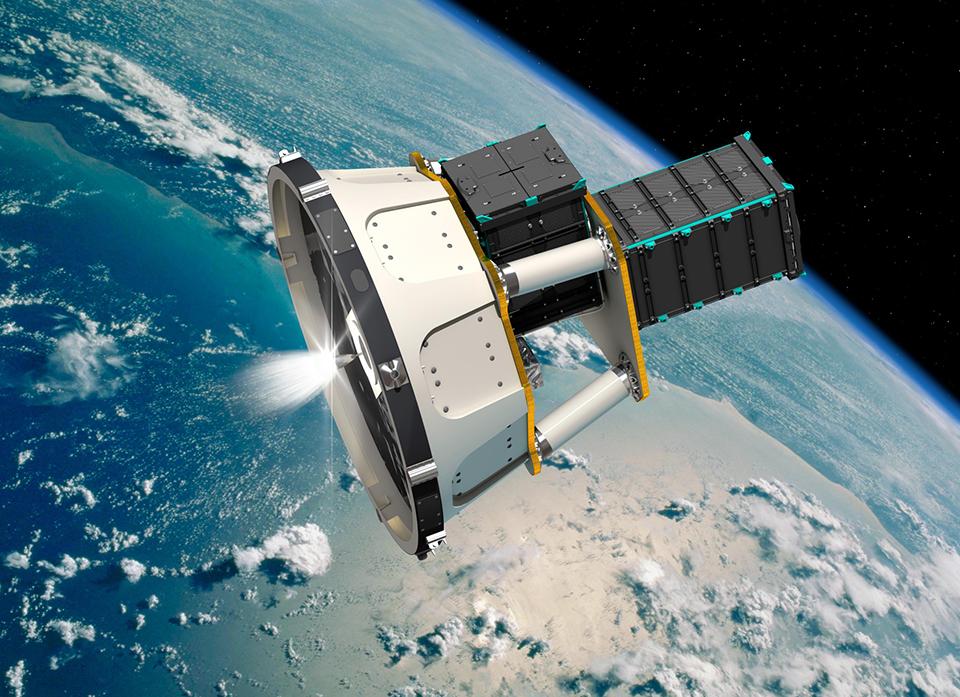
Following a successful deployment by the Electron rocket, both satellites separated from the launcher approximately one hour after liftoff. They have since entered their early operations phase, with mission control beginning health checkouts and frequency activation.
The Satellite Platform: IOD-2 and the Thales Alenia Space Contribution
The IOD-2 satellite is a 16U CubeSat, roughly suitcase-sized and weighing approximately 30 kilograms. Built by Thales Alenia Space (a joint venture between Thales and Leonardo), it serves as a critical testbed for the core technologies that will underpin a full LEO navigation layer.
While IOD-2 is a compact demonstrator, Thales Alenia Space is already developing four additional, larger satellites for the next phase of the program. These follow-on spacecraft will feature twice the mass of IOD-2, allowing them to carry expanded payloads to test multi-frequency signals and enhanced service capabilities. The parallel pathfinder, IOD-1, was developed by a Spanish-led consortium headed by GMV.
Mission Objectives: Strengthening the Galileo Ecosystem
The Celeste mission is designed to demonstrate how a complementary layer of satellites in low Earth orbit can improve the performance and resilience of Europe’s flagship Galileo system, which operates in Medium Earth Orbit (MEO).
- Multi-Orbit Architecture: By flying significantly closer to Earth (~510 km) than Galileo (~23,000 km), Celeste provides stronger signals that are more resistant to interference and natural ionospheric effects.
- Centimeter-Level Accuracy: The mission aims to demonstrate that LEO satellites can achieve high-precision positioning in a fraction of the time required by traditional systems.
- Reduced Latency: Fast signal acquisition and ultra-low latency are key for next-generation applications, including autonomous driving and the synchronization of 5G/6G telecommunications networks.
- Interference Resistance: The use of L- and S-band frequencies from low orbit enhances protection against jamming and spoofing, particularly in “urban canyons” or polar regions where traditional satellite signals often struggle.
Strategic Importance for European Sovereignty
The launch of Celeste is a major milestone for ESA’s “FutureNAV” and “European Resilience from Space” initiatives. By securing frequency filings with the International Telecommunication Union (ITU) before a May 2026 deadline, the mission ensures Europe’s long-term access to critical orbital spectrum.
Hervé Derrey, President and CEO of Thales Alenia Space, emphasized the mission’s importance:
“As demand for precise positioning continues to grow, space-based navigation systems such as Galileo need to be complemented by multifrequency satellites in low Earth orbit. ESA’s Celeste program represents a major advance, paving the way for next-generation applications requiring robustness and integrity.”
From Demonstration to Operation
| Phase | Timeline | Milestone |
| In-Orbit Demonstration (IOD) | March 2026 | Launch of IOD-1 and IOD-2 Pathfinders. |
| Expansion Phase | 2026–2027 | Launch of 9 additional “Pathfinder B” satellites. |
| Preparatory (IOP) Phase | 2027–2030 | Validation of pre-operational infrastructure. |
| Full Constellation | 2035 | Target for an 11-satellite operational layer. |
