

The European space community began an emotional countdown at the Guiana Space Centre in Kourou, marking the final hours before the maiden flight of the Ariane 64.
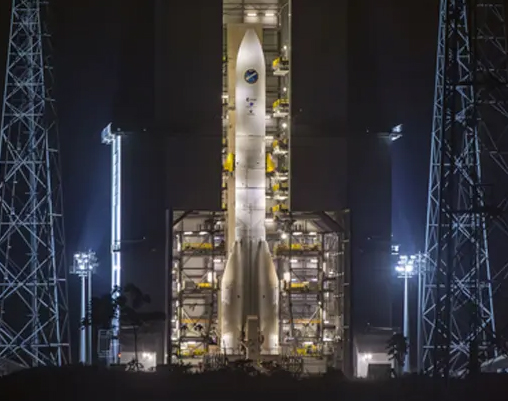
As the most powerful configuration of Europe’s new heavy-lift launcher, the Ariane 64 represents more than just a technological achievement; it is a critical symbol of European “space sovereignty” and a necessary response to the global launch monopoly currently held by SpaceX.
Restoring Independent European Access to Space
The road to this launch has been fraught with delays and strategic anxiety, leaving Europe without its own heavy-lift capability since the retirement of the Ariane 5 in 2023. This “launch gap” forced European institutional missions to rely on American rockets, a move that many officials viewed as a threat to the continent’s strategic autonomy. The Ariane 64, featuring four powerful P120C solid rocket boosters, is designed to restore this independence, capable of carrying massive payloads to both Low Earth Orbit (LEO) and Geostationary Transfer Orbit (GTO).
The Kuiper Mission: A Massive Commercial Debut
In a high-stakes validation of its commercial viability, the maiden flight is tasked with deploying 32 satellites for Amazon’s Project Kuiper. This mission marks the beginning of a massive multi-year contract that will see Ariane 6 launch a significant portion of Amazon’s planned 3,236-satellite LEO broadband constellation. The success of this flight is essential for Amazon to meet its strict FCC regulatory deadlines and for ArianeGroup to prove that the Ariane 6 can handle the high-cadence deployment schedules required by modern mega-constellations.
Industrial Resilience and the Vinci Upper Stage
At the heart of the Ariane 64’s capability is the Vinci re-ignitable upper stage, a piece of engineering that allows the rocket to deploy satellites into multiple different orbits during a single mission. This flexibility is vital for the modern market, where “rideshare” missions and complex orbital maneuvers are now the industry standard. The manufacturing process has also been revolutionized at ArianeGroup’s facilities in France and Germany, utilizing horizontal assembly and 3D-printed components to reduce costs and complexity compared to its predecessor.
Strategic Competition in a Proliferated Era
The launch arrives at a pivotal moment as the U.S. Space Force and various sovereign nations transition to “Proliferated LEO” architectures. By providing a reliable, heavy-lift alternative to the Falcon 9, the Ariane 64 ensures that global satellite operators—and European defense agencies—have a “redundant pathway” to orbit. If successful, this mission will solidify Europe’s place in the 2026 space economy, proving that the continent remains a top-tier space power capable of competing in a market increasingly dominated by rapid-reusability and high-volume satellite deployment.
| Metric | Ariane 64 Maiden Launch Specifications (2026) |
| Launch Site | ELA-4, Guiana Space Centre (Kourou) |
| Configuration | 4 Solid Rocket Boosters (A64 Variant) |
| Primary Payload | 32 Amazon Project Kuiper Satellites |
| Upper Stage | Vinci (Re-ignitable for multi-orbit delivery) |
| LEO Payload Capacity | Up to 21.6 Metric Tons |
| Strategic Goal | European Sovereign Access and SpaceX Competition |
