

By Evan Grey, Legal Contributor, SatNews
Recent developments in Greenland offer a case study in how geopolitical tensions are influencing satellite service procurement decisions. While the territory’s small population limits direct market impact, its choices illuminate broader trends that operators should monitor.
Diplomatic Tensions and Infrastructure Decisions
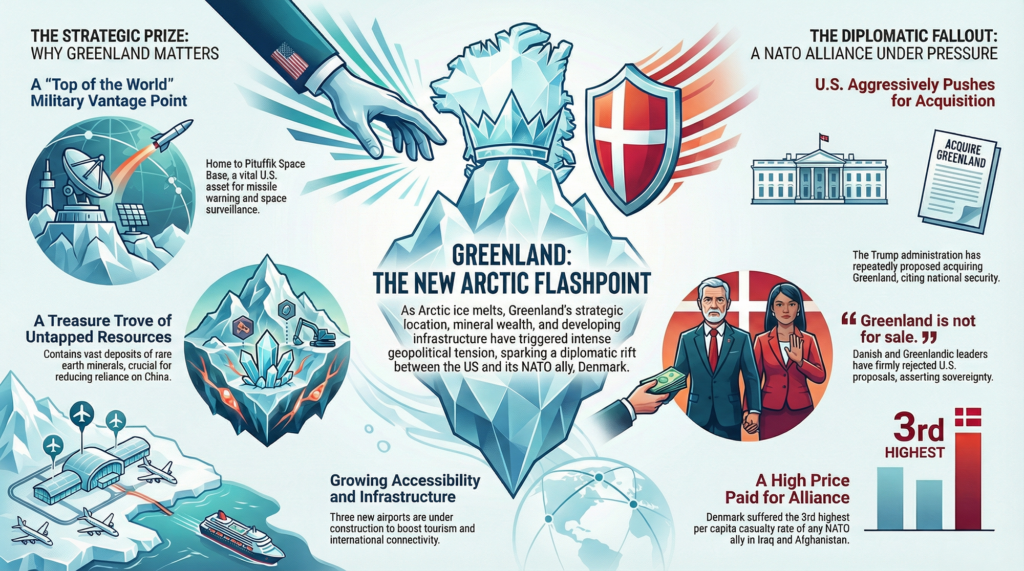
The Trump administration’s renewed interest in acquiring Greenland has created diplomatic friction. White House press secretary Karoline Leavitt confirmed that officials are discussing options to acquire the territory, stating that “utilizing the U.S. Military is always an option at the Commander in Chief’s disposal.” This prompted a joint statement from European NATO members affirming that “Greenland belongs to its people” and that decisions rest with Denmark and Greenland. SatNews reported that this stance has already triggered significant diplomatic fallout, placing NATO in a precarious position regarding Arctic sovereignty.
For satellite operators, the relevant question is how such geopolitical pressures affect infrastructure partnerships. Greenland’s position between North America and Europe, combined with its rare earth deposits used in satellite manufacturing, places it at the intersection of security and commercial interests.
The Starlink Decision
In 2024, Greenland banned Starlink after approximately 10 users were found using the service. Initially framed as protection for state-owned provider Tusass’s licensed monopoly, the decision appears to reflect broader concerns. With internet infrastructure increasingly viewed as critical to national security, Greenland opted instead to partner with Eutelsat, which officials describe as providing communities in East and North Greenland with “significantly better and faster internet coverage.”
This partnership positions Greenland to potentially access the EU’s IRIS² constellation. In December 2024, the European Commission signed a contract with the SpaceRISE consortium for a 290-satellite multi-orbital constellation, with governmental services expected to begin in 2030. The consortium comprises SES, Eutelsat, Hispasat, and eight supporting companies including Thales Alenia Space, OHB, and Airbus Defence and Space. Recent updates indicate that the SpaceRISE consortium has already initiated the procurement phase for the constellation hardware, transitioning from political mandate to physical acquisition.
Whether Greenland’s decision was primarily technical, commercial, or political, it demonstrates how governments are weighing constellation choices against strategic considerations beyond traditional procurement criteria.
Military Space Infrastructure Expansion
Pituffik Space Base (formerly Thule Air Force Base) continues to evolve within U.S. space defense plans. The Space Development Agency (SDA) announced in December 2025 approximately $3.5 billion in awards to Lockheed Martin, Rocket Lab USA, Northrop Grumman, and L3Harris Technologies for 72 Tracking Layer satellites in Tranche 3 of the Proliferated Warfighter Space Architecture, scheduled for fiscal year 2029 launch.
While these contracts don’t specify Greenland ground segment details, the Arctic’s value for space domain awareness and polar orbit coverage makes Pituffik a logical component of expanding missile warning and tracking architecture. Furthermore, the region is seeing a push for high-latitude data resilience; for instance, the European Space Agency (ESA) recently launched construction of a new optical ground station in Greenland to enable secure, high-speed laser data transfers.
Rare Earth Resources and Supply Chain Considerations
Greenland’s rare earth element deposits factor into broader satellite industry supply chain discussions, particularly around reducing dependence on Chinese sources for satellite components and sensors. However, practical extraction faces significant challenges including Arctic environmental constraints that limit mining to approximately six months annually and substantial infrastructure investment requirements.
The attention to these resources reflects industry concern about supply chain concentration rather than near-term availability of alternative sources.
Industry Implications
Several observations emerge from Greenland’s recent decisions:
- Sovereignty Screening: LEO constellation market access may increasingly involve political evaluation alongside technical and commercial factors. Operators should anticipate governments applying strategic criteria to satellite service providers, particularly for government and critical infrastructure applications.
- Ground Station Considerations: Companies requiring Arctic ground stations for polar orbit operations may encounter more complex approval processes as governments implement infrastructure screening measures.
- Alternative Models: The IRIS² approach—combining government anchor tenancy with commercial services through public-private partnership—provides a template that may appeal to regions seeking options beyond dominant constellations from major space powers.
- Strategic Geography: Small territories with strategic locations may exercise disproportionate influence over ground segment access and service licensing, particularly where geopolitical considerations intersect with technical requirements.
Key Takeaway
Greenland’s telecommunications and infrastructure choices are noteworthy not because its 57,000-person market will significantly affect operator revenues, but because the territory’s decisions occur at the intersection of great power competition, digital sovereignty concerns, and critical infrastructure protection—dynamics that are emerging in larger markets as well.
As IRIS² development continues toward 2030 operational capability and SDA’s Tranche 3 deployment approaches, Greenland offers one data point among many for how governments balance technical performance, cost, political alignment, and sovereignty considerations when selecting satellite services.
For operators, the key takeaway is straightforward: market access increasingly requires understanding not just technical requirements and pricing expectations, but also the strategic context in which procurement decisions are made.
About the Author:
Evan Grey is a legal contributor for SatNews. A lawyer with a focus on regulatory policy and international relations, he specializes in the evolving geopolitical and industrial frameworks of the global space sector.
